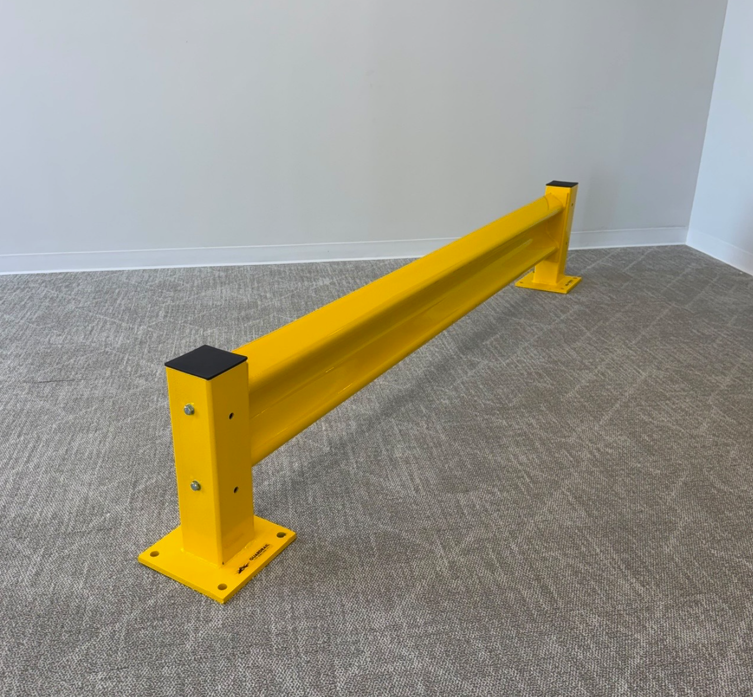
Quick answer: To install warehouse guardrail, plan the run on a sound concrete floor, snap a chalk line, and mark post centers at the rail’s nominal length (a 10 ft rail means posts 10 ft apart, center to center). Set each post on its mark, drill four 5/8″ holes through the base plate, clean them out and fix the post with four 5/8″ x 5″ wedge anchors. Then bolt each rail between the posts with four M12 bolts, tighten every anchor and bolt, and fit the post caps and hole plugs. Every kit includes the hardware, and our single-height starter kits start at $273 and ship from the Dallas area.
Table of Contents
ToggleKey takeaways
- Guardrail is only as strong as its anchors. The 10,000 lb at 4 mph rating applies when the system is properly installed, with all four anchors in every base plate.
- Post spacing equals the rail’s nominal length, measured center to center. Measure twice before you drill.
- Our posts mount on all four sides, so the same post works as an end, line or corner post.
- Anchor only into sound concrete. Avoid asphalt, cracked slabs, joints and slab edges.
- Guardrail Online supplies the guardrail and hardware but does not install it, so this guide is written for your maintenance team or contractor.
In this guide
- Before you start: floor and layout checks
- Tools and parts you need
- How to install warehouse guardrail in 8 steps
- Installing double-height guardrail
- Corners, lift-out sections, gates and angles
- 7 installation mistakes that weaken guardrail
- Guardrail kit prices
- Inspecting guardrail after installation
- FAQs
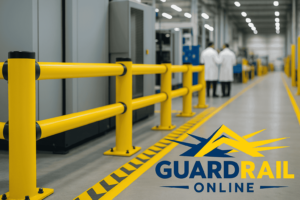
Warehouse guardrail is one of the few safety upgrades most facilities can install in-house. The systems are modular: steel posts bolt to the concrete floor and steel rails bolt between them. Getting the details right still matters, because a guardrail that is anchored poorly or laid out in the wrong place will not stop a forklift the way it was designed to.
This guide walks through a standard installation of our heavy-duty warehouse guardrail, using the specifications printed on our product pages. Always follow the drawings and instructions supplied with your order, and the anchor manufacturer’s instructions for drilling and torque.
Before you start: floor and layout checks
Most installation problems start before anyone picks up a drill. Work through these checks first.
- Confirm the floor is sound concrete. Wedge anchors need solid concrete to grip. Do not anchor into asphalt, broken or spalled concrete, or across expansion and control joints. If you are unsure about slab thickness or strength, ask the anchor manufacturer or a structural engineer before you start.
- Keep anchors away from slab edges and joints. Anchors placed too close to an edge or joint can crack the concrete under impact. The anchor manufacturer lists minimum edge distances.
- Check for buried services. Find out whether there is radiant heating, conduit or post-tensioned cable in the slab before drilling. Drilling into a post-tensioned slab without a scan is dangerous.
- Decide what you are protecting. Guardrail goes between forklift traffic and the thing you need to protect: people, racking ends, equipment, columns or walls. Our guide on where to install warehouse guardrails first helps you prioritize.
- Leave room behind the rail. Steel guardrail is designed to flex a little and absorb energy on impact. Do not set the rail tight against the equipment or wall it protects. Read why guardrail deflection is not a weakness for the reasoning.
- Keep aisles and exits clear. The finished guardrail must not narrow forklift aisles below what your trucks need, or block exits, fire equipment or electrical panels.
Tools and parts you need
Tools
- Tape measure, chalk line and a marker or paint pen
- Rotary hammer drill with a 5/8″ carbide masonry bit (wedge anchors are drilled at the same diameter as the anchor)
- Hammer or mallet to set the anchors
- Vacuum, blow-out bulb or compressed air to clean the holes
- Wrenches or sockets for the anchor nuts and the M12 rail bolts, plus a torque wrench
- Level, safety glasses, hearing protection, gloves and a dust mask
What comes in the kits
| Part | Specification |
|---|---|
| Single-height post | 19″ high, 4.72″ x 4.72″ x 3/16″ steel, rail at 17.61″ high |
| Double-height post | 41.5″ high, rails at 17.61″ and 40.16″ high |
| Base plate | 10″ x 10″ x 5/8″ thick, welded to the post |
| Post hardware kit | (4) 5/8″ x 5″ wedge anchors, (1) black post cap, (8) yellow hole plugs |
| Rail | 12.2″ high, 11-gauge (0.118″) pre-galvanized steel, safety yellow powder coat (RAL 1023) |
| Rail hardware kit | (4) M12 x 160 mm Grade 8.8 hex bolts, (8) washers, (4) hex nuts |
A starter kit includes two posts, one rail and the hardware for both. Each add-on kit adds one post and one rail to extend the run. A 30 ft straight run with 10 ft rails, for example, needs one starter kit and two add-on kits: four posts, three rails and sixteen anchors.
How to install warehouse guardrail in 8 steps
Step 1: Mark the guardrail line
Measure out from the racking, wall or equipment you are protecting, leaving clearance for the rail to flex. Snap a chalk line along the full run. Mark both ends and any corners.
Step 2: Mark post centers
Our rail lengths are nominal lengths measured center to center of the posts. For 10 ft rails, mark a post center every 10 ft along the line. For a short final section, choose the rail length (2 ft to 10 ft, in 1 ft steps) that fits the remaining distance. Double-check every measurement before drilling, because moved anchor holes weaken the floor.
Step 3: Set the posts and mark the anchor holes
Stand each post on its mark with the base plate square to the chalk line. Check that the rail mounting faces line up with the run. Mark all four anchor holes through the base plate.
Step 4: Drill the anchor holes
Move the post aside if needed and drill each hole with a 5/8″ carbide bit, keeping the drill straight. Drill deeper than the anchor’s required embedment so dust has somewhere to go. Follow the anchor manufacturer’s depth instructions.
Step 5: Clean the holes
Blow or vacuum the dust out of every hole. Dust left in the hole reduces how well the wedge grips the concrete. This step is easy to skip and one of the most common reasons anchors pull out.
Step 6: Install the wedge anchors
Put the post back in position. With the nut and washer threaded on the end of the anchor, tap each anchor through the base plate and into its hole until the washer sits on the plate. Tighten the nuts to the torque given by the anchor manufacturer, working across the plate. Use all four anchors in every post.
Step 7: Bolt the rails between the posts
Each rail is welded to a plate at each end with two slotted holes, and it mounts between the inside faces of the posts. Lift the rail into place (a two-person job on longer rails), line up the holes and fit four M12 bolts per rail with a washer on each side. Tighten every nut.
Step 8: Finish and check the run
Fit a black cap on top of every post and push yellow plugs into any unused holes. Walk the full run and check that every anchor and bolt is tight, the rails are level and nothing blocks an aisle, exit or panel.
Installing double-height guardrail
Double-height guardrail follows the same steps with taller 41.5″ posts and two rails per bay, at 17.61″ and 40.16″. The lower rail stops forklift forks and wheels, and the upper rail adds a barrier at a height people can see and cannot easily step over. Install the bottom rail first, then the top rail, with four bolts on each. Double-height posts use the same 10″ x 10″ base plate and four 5/8″ x 5″ wedge anchors.
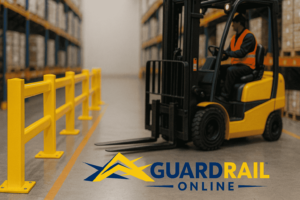
Not sure which you need? Single-height rail suits protecting racking, equipment and walls from forklift strikes. Double-height is the usual choice along pedestrian walkways and work areas.
Corners, lift-out sections, gates and angles
- Corners: Because every post mounts on all four sides, you turn a 90 degree corner by attaching the next rail to a different face of the same post. You do not need a special corner post.
- Lift-out sections: If you need to open a section for occasional equipment access, use a lift-out adapter pair in place of bolting the rail. On double-height guardrail, adapters must be used on both the top and bottom rails. Our guides on how lift-out adapters work and bolt-on vs lift-out guardrail explain the trade-offs.
- Pedestrian gates: An adjustable pedestrian gate lets people pass through a guarded walkway at a controlled point.
- Angles other than 90 degrees: An adjustable angle adapter attaches to a post so the guardrail can follow the shape of what it protects without wasting floor space.
7 installation mistakes that weaken guardrail
- Using fewer than four anchors per post. The impact rating assumes every anchor is installed.
- Not cleaning the holes. Dust left in the hole reduces the anchor’s grip.
- Drilling oversized holes. A worn or wrong-size bit leaves the wedge with nothing to bite into.
- Anchoring into weak floors or near edges. Asphalt, cracked concrete, joints and slab edges can break out under impact.
- Setting rail tight against what it protects. The rail needs room to flex without pushing into racking, walls or machines.
- Leaving bolts loose or missing. Each rail needs all four M12 bolts tightened.
- Blocking aisles, exits or equipment. Plan the layout around forklift turning room, exits, fire equipment and electrical panels. See layout mistakes that create built-in risk.
Guardrail kit prices
Prices below are current online prices for our kits, by rail length. Shipping and tax are calculated at checkout.
| Kit | 2 ft rail | 10 ft rail |
|---|---|---|
| Single-height starter kit (2 posts, 1 rail) | $273 | $420 |
| Single-height add-on kit (1 post, 1 rail) | $167 | $314 |
| Double-height starter kit (2 posts, 2 rails) | $473 | $766 |
| Double-height add-on kit (1 post, 2 rails) | $297 | $591 |
Example: a 30 ft single-height run with 10 ft rails is one starter kit ($420) and two add-on kits ($314 each), or $1,048 before shipping and tax. The same run in double-height is $766 plus two add-ons at $591, or $1,948. Spare single-height post kits are $106 and double-height post kits are $175. Orders over $10,000 can qualify for volume pricing, so contact us for larger projects.
Most orders ship within 2 to 3 business days from Farmers Branch, Texas, so teams in Dallas-Fort Worth can usually plan installation within the same week. We also ship across Texas, including to warehouses in Houston, Austin and San Antonio.
Inspecting guardrail after installation
- Recheck anchors and rail bolts after the first few weeks of traffic, then as part of your regular safety walk.
- After any impact, check the post base plate, anchors and the concrete around them. A post that has moved, or concrete that has cracked around the plate, needs attention before the next hit.
- Replace bent rails and damaged posts instead of straightening them. Spare posts and rails are sold separately.
- Touch up chipped powder coat to slow rust, and keep the safety yellow visible.
Guardrail works best as part of a wider traffic plan. Painted lines show people where to walk, but floor markings alone will not stop a forklift. To understand what the rating means in practice, read what 10,000 lb at 4 mph really means.
Installing guardrail near a mezzanine, dock edge or platform? Forklift guardrail is not fall protection, so check our guide to OSHA guardrail requirements first.
FAQs
Can I install warehouse guardrail myself?
Yes. Our guardrail kits are designed for in-house maintenance teams or a general contractor. Every kit ships with the bolts, nuts, washers and wedge anchors it needs, and posts bolt straight to a concrete floor. You need a hammer drill, a 5/8" masonry bit, wrenches and at least two people to set the rails.
What anchors hold the guardrail posts down?
Each post is welded to a 10" x 10" x 5/8" base plate that is fixed to the floor with four 5/8" x 5" wedge anchors. The anchors are included in every post hardware kit. Always install all four anchors and tighten them to the torque given by the anchor manufacturer.
How far apart should guardrail posts be?
Post spacing equals the nominal rail length, measured center to center of the posts. Our rails come in nominal lengths from 2 ft to 10 ft in 1 ft steps, so a 10 ft rail means the post centers are 10 ft apart.
Do I need separate end posts, line posts and corner posts?
No. Every post has mounting points on all four sides, so the same post works at the end of a run, in the middle or at a 90 degree corner. Unused holes are closed with the yellow hole plugs included in the kit.
Can warehouse guardrail be installed outside?
It can, but moisture will eventually cause the steel to rust, and we do not provide a guarantee for systems installed outdoors. The guardrail is designed for indoor warehouse and plant floors.
Can I anchor guardrail to asphalt or a cracked slab?
No. Wedge anchors need sound concrete to hold. Do not anchor into asphalt, broken concrete or across joints and slab edges. If you are unsure about slab thickness or strength, check with the anchor manufacturer or a structural engineer before installing.
Does Guardrail Online offer installation services?
No. We focus on supplying guardrail, forklift barriers and rack protection. Most orders ship within 2 to 3 business days from Farmers Branch, Texas, and this guide covers the steps your team or contractor will follow.
What does "10,000 lb at 4 mph when properly installed" mean for installation?
The impact rating depends on the system being installed as designed: posts on sound concrete, all four anchors in every base plate, every rail bolted with its four M12 bolts and all fasteners tightened. Skipping anchors or bolts means the rating no longer applies.
Written by the Guardrail Online team. Reviewed and updated in October 2026.