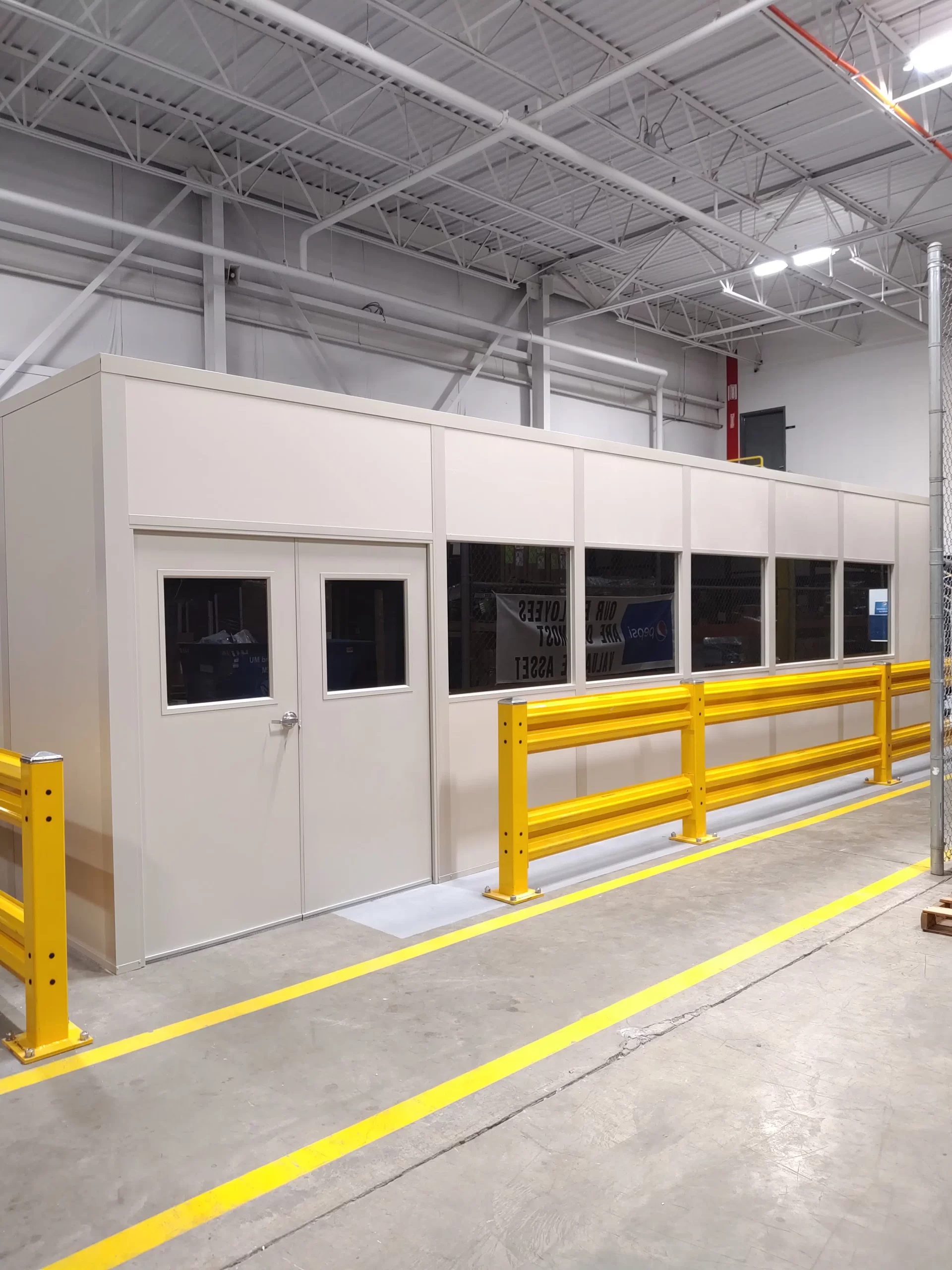
A painted line can show a forklift where to drive. It cannot stop that forklift from crossing the line.
The same applies to warning signs on the wall and floor markings in your warehouse. They can tell people where to walk, but they cannot physically stop a person from entering a dangerous area or prevent equipment from reaching a protected space.
Warehouse guardrails provide the physical protection those warnings cannot. They create a barrier between people, moving equipment, and areas that need additional protection. They can also help protect critical areas from accidental impacts and exposed edges. Some warehouse applications also require guardrail protection under OSHA. That makes compliant guardrails an important part of both workplace safety and regulatory compliance.
But how do warehouse guardrails improve safety? When does OSHA require guardrail protection, which type works for different warehouse areas, and what should you consider before buying one? This guide covers all of it.
What Are Warehouse Guardrails and Why Are They Important?
Warehouse guardrails are physical barriers designed to protect people, equipment, and designated areas from workplace hazards. They create a clear physical boundary where additional protection is needed.
Unlike signs or floor markings, guardrails provide a physical barrier between people, vehicles, equipment, and other potential hazards. They can also help protect valuable infrastructure from accidental impacts. The need for these protections is clear when you look at the latest U.S. workplace data.
The Warehouse Safety Risks Behind the Need for Guardrails
Warehouse safety risks become clearer when you look at the numbers. Recent U.S. data highlights several hazards that deserve attention:
- Warehouse injuries: The U.S. transportation and warehousing sector recorded 232,000 injuries in 2024, with an injury rate of 4.5 cases per 100 workers. The national private industry average was 2.7 cases per 100 workers.
- Forklift accidents: Forklifts cause approximately 7,500 injuries and nearly 100 fatalities each year across the U.S. About 11% of operational forklifts are involved in an accident annually.
- Pedestrian fatalities: Workers on foot face a serious risk around moving equipment. Pedestrians account for 36% of forklift-related fatalities, highlighting the need for better separation between people and vehicles.
- Forklift tip-overs: Tip-overs are among the most serious forklift incidents. They account for approximately 42% of forklift deaths and 25% of forklift-related injuries.
- Loading dock incidents: Loading docks are another major warehouse hazard. They account for an estimated 25% of warehouse accidents, with approximately 600 near-misses reported for every injury.
These figures show why warehouse safety requires more than employee training alone.
Warehouse Guardrails Are Essential for Safety and OSHA Compliance
Warehouse guardrails help protect people, equipment, and facility areas from serious workplace hazards. But that’s not all! They can also play an important role in meeting safety requirements where OSHA requires fall protection or other guarding.
That makes guardrail selection about more than protection alone. In fact, if a workplace is subject to an OSHA requirement and fails to provide the required protection, the employer may face an OSHA citation and financial penalties.
Did you know you may be asked to pay a maximum federal OSHA penalty of $16,550 for a serious violation and $165,514 for a willful or repeated violation in 2026?
What OSHA Requires for Warehouse Guardrails
OSHA sets specific requirements for guardrail systems used for fall protection in covered workplace applications. These requirements are primarily found under 29 CFR 1910.29.
The standard provides specific specifications for guardrail design and performance. These requirements help ensure that a guardrail can withstand expected forces and provide effective protection where it is required.
Key OSHA specifications include:
- Height: The top edge of the guardrail must generally be 42 inches, plus or minus 3 inches, above the walking-working surface.
- Top-rail strength: The top rail must withstand at least 200 pounds of force applied downward or outward.
- Intermediate protection: Midrails, screens, mesh, or equivalent members may be required. Openings generally cannot exceed 19 inches.
- Deflection: Under the required 200-pound downward load, the top rail cannot deflect below 39 inches.
- Intermediate-member strength: Midrails and equivalent members must withstand at least 150 pounds of force without failure.
- Surface design: Guardrail surfaces must be smooth enough to reduce the risk of punctures, lacerations, or snagging clothing.
These are not optional design suggestions when the OSHA standard applies. Employers are in fact responsible for providing and maintaining the required protection before employees begin work that requires it.
The requirements also depend on what the guardrail is protecting against. For instance, a guardrail used for fall protection is not automatically subject to the same requirements as a warehouse barrier designed to protect equipment from forklift impact.
That distinction matters a lot when choosing a system. The right warehouse guardrail should match the hazard, location, and purpose of the installation.
Which Warehouse Guardrail Is Right for Your Facility?
The right warehouse guardrail depends on what you need to protect, where it will be installed, and how your facility operates. Different areas may require different levels of protection.
Understanding the main guardrail options can help you choose a system that fits your warehouse instead of selecting a barrier based on appearance or price alone.
 Single-Height Guardrails for Floor-Level Protection
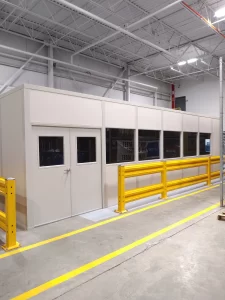
Single-height guardrails provide a strong physical barrier around floor-level areas that need protection from accidental impacts. They work well where businesses need to define protected areas without adding unnecessary height to the barrier.
These systems can be used around equipment, work areas, traffic boundaries, and other areas where floor-level impact protection is needed.
Advantages:
- Provides a strong physical barrier at floor level.
- Suitable for various warehouse applications.
- Modular systems can be extended as requirements change.
- Starter and add-on kits make system expansion easier.
Things to consider:
- The barrier height should match the protection required.
- The layout should allow enough space for safe movement around the barrier.
- Larger impact risks may require a heavier or taller system.
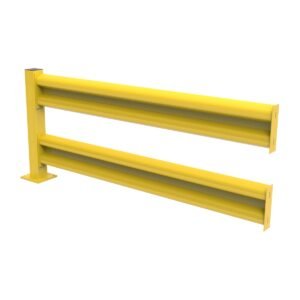
 Double-Height Guardrails for High-Traffic Areas
Double-height guardrails provide additional barrier coverage compared with standard single-height systems. They are suited to areas where equipment, infrastructure, or other assets need greater protection from impacts.
These systems can be useful in busy industrial environments where additional barrier height provides another level of protection.
Advantages:
- Provides greater coverage than a single-height system.
- Suitable for demanding warehouse environments.
- Helps protect larger or more exposed areas.
- Modular components allow systems to be expanded when required.
Things to consider:
- The additional height may not be necessary for every application.
- The available floor space should be considered before installation.
- The system should be selected according to the expected impact risk.
Rack Protectors for Pallet Racking
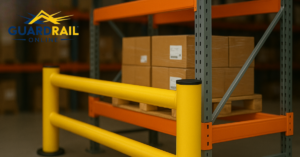
Rack protectors are designed to provide targeted protection around vulnerable pallet-racking areas. They help create a physical barrier between moving equipment and exposed rack components.
This makes them useful where businesses want focused protection rather than installing a larger barrier system around an entire area.
Advantages:
- Provides targeted protection around pallet-racking areas.
- Helps reduce the risk of direct impact to exposed rack components.
- Uses less space than a larger perimeter barrier.
- Can complement other warehouse barrier systems.
Things to consider:
- Protection should cover the areas most exposed to impact.
- Placement should account for the rack layout and surrounding traffic.
- Damaged components should be replaced rather than left in service.
Guardrails for Loading Docks and Elevated Areas
Loading docks and elevated areas require careful consideration because the risks can include both vehicle impacts and falls. The type of guardrail required depends on the specific application and applicable safety requirements.
A suitable system should provide a secure physical boundary without interfering with normal warehouse operations.
Advantages:
- Creates a defined barrier around exposed areas.
- Can help protect people and infrastructure from accidental movement.
- Supports safer separation around areas with increased hazards.
- Can be selected according to the layout and protection required.
Things to consider:
- Fall-protection requirements may apply to elevated areas.
- OSHA requirements depend on the specific application.
- Guardrail height, strength, openings, and installation must be considered where applicable.
- Loading and unloading operations should remain practical after installation.
Which Warehouse Guardrail Should You Choose?
| Warehouse Application | Guardrail Type | Best For | Main Advantage | Key Consideration |
| Floor-level protection | Single-height guardrail | Equipment, work areas, and protected zones | Strong physical barrier with flexible applications | Choose the height and configuration based on the hazard |
| High-traffic areas | Double-height guardrail | Busy industrial areas and larger assets | Greater barrier coverage | Additional height may not be necessary for every application |
| Pallet-racking protection | Rack protectors | Exposed rack areas | Targeted protection without a large perimeter system | Placement should match the rack layout |
| Loading docks and elevated areas | Application-specific guardrail | Exposed edges and higher-risk areas | Creates a defined protective boundary | Applicable OSHA requirements must be considered |
What Should You Consider Before Choosing Warehouse Guardrails?
If you are planning to buy safety barriers for a warehouse or industrial space, consider several factors before choosing a system. Think about what you need to protect, the traffic around the area, and the potential impact risk. Available space, future layout changes, replacement needs, and applicable OSHA or state requirements also matter. Considering these factors can help you choose a warehouse guardrail system that fits your facility and provides the protection you need.
Ask yourself these questions before selecting a system:
What are you protecting?
Are you protecting employees, pallet racking, machinery, loading areas, workstations, or another part of your facility? The answer will help determine the type of barrier you need.
How much traffic moves through the area?
A quiet storage area has different requirements from an aisle with forklifts operating throughout the day. Consider the type, frequency, and direction of traffic around the protected area.
What level of impact could the barrier face?
Think about the equipment operating nearby and what could happen if it leaves its normal path. Higher impact risks may require a stronger or taller guardrail system.
How much space do you have?
Your guardrail should protect the area without creating a new obstacle. Check aisle widths, turning paths, access points, and clearance before installation.
Will your warehouse layout change?
Warehouses grow, equipment moves, and work areas change. A modular guardrail system can make it easier to extend or modify your protection later.
Could the guardrail be damaged over time?
Impacts can damage individual rails or posts. Check whether replacement components are available so you can repair the affected section without replacing the entire system.
Do OSHA or state requirements apply?
Check the requirements that apply to your city or region before choosing a guardrail. The rules can vary based on the hazard, application, and state.
Taking a few minutes to answer these questions can help you avoid choosing a system that does not fit your facility. It also gives you a clearer idea of the protection your warehouse actually needs.
Conclusion
A warehouse guardrail should not be an afterthought once an accident exposes a weak point in your facility. It should be part of how you plan protection around the areas where people, equipment, and operations interact. That planning also needs to account for the safety requirements that apply to your facility.
At Guardrail Online, we take the same approach to the products we offer. Our warehouse barrier systems are built for different applications, with modular options that give facilities room to adapt their protection as their needs change.
Explore our range of safety barriers today!
FAQs
1. Are warehouse guardrails required by OSHA in the United States?
OSHA requires guardrail protection for certain workplace applications, particularly where fall hazards exist. The exact requirements depend on the area, hazard, and type of protection needed.
2. Do warehouse guardrails protect against forklift impacts?
Yes, heavy-duty warehouse guardrails can help protect people, pallet racking, equipment, and other areas from accidental forklift impacts. The system should match the expected impact risk.
3. What is the difference between a warehouse guardrail and a rack protector?
A warehouse guardrail provides broader protection around areas such as walkways, equipment, and work zones. A rack protector provides targeted protection around vulnerable pallet-racking components.
4. Can warehouse guardrails be installed without professional help?
Many standard guardrail systems can be installed with basic tools when the layout is straightforward. More complex installations may require professional help to ensure proper placement and secure installation.
5. How often should warehouse guardrails be inspected or replaced?
Inspect guardrails regularly for bent rails, damaged posts, loose fasteners, or other signs of impact. Replace damaged components promptly rather than waiting for routine maintenance.