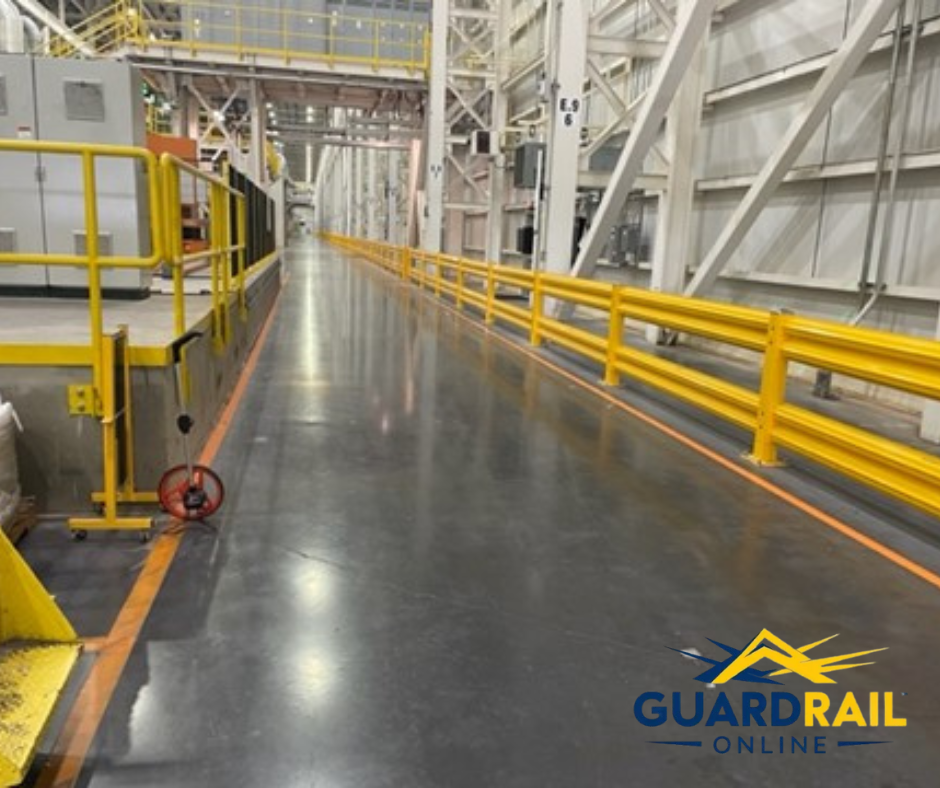
Forklifts are essential in modern warehouse operations — but they also pose one of the biggest safety risks in industrial environments. One misjudged turn or a moment of distraction can lead to thousands of dollars in damages or worse, serious injury. That’s why installing a forklift barrier system isn’t just smart — it’s essential.
At Guardrail Online, we specialize in industrial-strength guardrails designed specifically to stop forklifts before they become a hazard. Whether you’re managing a high-volume distribution center or a compact manufacturing floor, understanding the role of forklift barriers can dramatically improve your safety strategy.
Quick answer: Forklift barriers are steel guardrail systems anchored to the floor that stop or redirect forklifts before they hit people, racking, equipment or walls. Every warehouse with forklift traffic benefits from them, especially beside walkways, at rack ends, around docks and near machinery. Our heavy-duty guardrail systems are rated to withstand a 10,000 lb impact at 4 mph when properly installed.
Table of Contents
ToggleKey takeaways
- Forklift barriers physically stop vehicles; paint and signs only warn.
- Protect walkways, rack ends, docks and equipment first.
- Choose barriers built for repeated impacts, with the right height and solid anchoring.
- Our heavy-duty guardrails are rated for a 10,000 lb impact at 4 mph when properly installed.
In this guide
- What Is a Forklift Barrier?
- Why Forklift Accidents Happen
- Risks to Equipment, Inventory, and People
- The Role of Forklift Barriers in Accident Prevention
- 11 Reasons to Install Forklift Barriers in Your Facility
- Guardrail Online Forklift Barrier System Features
- Understanding Compliance and Safety Standards
- Difference Between Guardrails and Handrails
- Cost vs. Risk: Why Forklift Barriers Pay for Themselves
- How to Choose a Strong Forklift Barrier
- Frequently Asked Questions
- Conclusion: Protect What Matters with Guardrail Online
What Is a Forklift Barrier?
Basic Definition
A forklift barrier is a heavy-duty guardrail system engineered to withstand the impact of industrial equipment, primarily forklifts. These systems are surface-mounted and typically installed in high-risk zones throughout a facility — like near pedestrian walkways, machinery, or loading docks.
Common Use Cases in Warehouses
- Separating forklift lanes from pedestrian traffic
- Protecting expensive equipment or racking systems
- Creating designated loading and staging areas
- Preventing accidental roll-offs at dock doors
Why Forklift Accidents Happen
Common Causes
- Obstructed visibility around corners and intersections
- Operator inattention or fatigue
- Tight space constraints in dense warehouse layouts
- Lack of visual and physical traffic control
Risks to Equipment, Inventory, and People
Forklifts are powerful machines. Even at low speeds, they can cause:
- Injury or fatality to personnel
- Collapse of entire racking systems
- Extensive equipment and building damage
- Disruption of daily operations and shipments
The Role of Forklift Barriers in Accident Prevention
Physical Separation
A forklift barrier offers a clear, non-negotiable boundary. Unlike floor tape or signs, barriers physically prevent vehicles from entering restricted or dangerous areas.
Traffic Flow Management
Properly installed barriers help organize forklift and pedestrian movement. This reduces bottlenecks, prevents surprise encounters, and increases overall operational efficiency.
11 Reasons to Install Forklift Barriers in Your Facility
- Worker Safety
Barriers protect workers stationed near active forklift zones. By preventing accidental entry or contact, they significantly reduce the risk of injury.
- Protecting Equipment
Barriers serve as the first line of defense for expensive machinery and control systems. Preventing impact damage saves repair costs and production delays.
- Inventory Security
High-value inventory stored on pallet racks can be knocked down or crushed during collisions. Forklift barriers maintain a buffer zone and protect your stock.
- OSHA Compliance
While OSHA doesn’t specify barrier types, it requires physical separation between pedestrians and powered vehicles. Barriers help meet these guidelines reliably.
- Insurance Premium Reduction
A well-documented safety program that includes physical barriers may qualify your facility for lower insurance premiums or reduce liability after incidents.
- Operational Continuity
Forklift accidents can shut down operations for hours or days. Barriers help keep your facility up and running without interruptions.
- Visual Guidance
Our powder-coated yellow barriers are easy to see and serve as visual cues for drivers and pedestrians alike, supporting safe navigation.
- Improved Pedestrian Safety
Handrails combined with guardrails offer layered protection for foot traffic, especially in zones with shared forklift activity.
- Modular Layout Flexibility
Our systems are modular, allowing you to reconfigure layouts as your facility evolves or production lines shift.
- Durability and ROI
Constructed of solid steel and built for impact, Guardrail Online’s forklift barriers are engineered to last — with little maintenance required.
- Professional Appearance
Safety infrastructure shows your team and visitors that you prioritize safety. It also contributes to a more organized and professional-looking facility.
Guardrail Online Forklift Barrier System Features
We don’t just sell barriers — we offer reliable, impact-rated safety systems trusted by facility managers across the U.S.
Steel Construction
Our guardrails are made of heavy-gauge steel and, when properly installed, are rated to withstand a 10,000 lb impact at 4 mph.
Powder-Coated Yellow Finish
The bright yellow coating offers maximum visibility and resists scuffs, making your facility both safer and cleaner-looking.
Indoor Use Design
Our forklift barriers are specifically made for indoor use only. They are not weatherproof and should not be installed in outdoor or corrosive environments.
Impact Rating
Both single- and double-rail guardrail systems carry the same impact resistance rating. Choose based on height and visual coverage, not strength.
Installation and Placement Tips
Proper placement maximizes protection and minimizes disruption to your workflows.
Entry Points and Walkways
Install barriers at all access points, entrances, and along designated walkways where pedestrians and forklifts may intersect.
Rack Ends and Machinery
Always protect the ends of pallet racks and sensitive machinery to avoid catastrophic damage during tight turns or load drops.
Corners and Dock Doors
These are common accident zones due to blind spots. Barriers can help create turning buffers or stop vehicles before they reach structural walls or overhead doors.
Understanding Compliance and Safety Standards
OSHA Guidelines
OSHA’s General Duty Clause requires employers to protect workers from recognized hazards, including being struck by forklifts. OSHA does not require specific guardrail products, but physical separation is one of the most effective ways to reduce struck-by risk.
ANSI Recommendations
ANSI MH31.2 provides a voluntary test method for measuring how industrial guardrail and barrier systems perform under impact.
Difference Between Guardrails and Handrails
Function and Rating
- Guardrails are crash-rated and installed to stop forklifts
- Handrails are for pedestrian guidance only and not rated for vehicle impact
When to Use Each
Use guardrails where forklift contact is possible. Use handrails in pedestrian-only zones to create walkways or maintain traffic flow.
Cost vs. Risk: Why Forklift Barriers Pay for Themselves
Upfront vs. Post-Incident Costs
Forklift barriers are a preventative investment. The cost of one serious accident often exceeds the total price of an entire barrier layout.
Long-Term Benefits
Beyond injury prevention, barriers help:
- Lower insurance costs
- Increase employee morale
- Reduce product and infrastructure damage
- Maintain business continuity
How to Choose a Strong Forklift Barrier
- Built for repeated impacts. Forklifts rarely hit a barrier once. Choose heavy-gauge steel with a stated impact rating, and replaceable rails and posts so repairs are simple.
- The right height and coverage. Single rail protects walls and equipment at bumper height. Double rail covers more height for walkways, taller loads and high-traffic areas.
- Solid anchoring. A barrier is only as strong as its connection to the floor. Check that your concrete is in good condition where posts will be anchored.
- Room to grow. Starter and add-on kits let you extend runs as your layout changes, instead of replacing the system.
Compare single height guardrail and double height guardrail to find the right fit.
Frequently Asked Questions
Are Guardrail Online's barriers forklift-rated?
Yes. When properly installed, our heavy-duty guardrail systems are rated to withstand a 10,000 lb impact at 4 mph.
Can I install forklift barriers myself?
Many layouts can be installed with standard tools. Each kit includes the hardware kits listed on its product page, and posts anchor into the concrete floor, so check your slab condition before you start.
Do I need single-rail or double-rail guardrails?
Both carry the same impact rating. Double-rail systems give more coverage, which helps beside walkways, in high-traffic areas and where loads sit higher.
Are these barriers suitable for outdoor use?
No. Our guardrails are designed for indoor industrial environments only and are not corrosion-resistant.
What is the difference between a guardrail and a handrail?
A guardrail is impact-rated to stop forklifts. A handrail guides foot traffic and offers no protection against vehicle impacts.
How is rail length measured?
Rail lengths are nominal and measured center-to-center between posts. Check each product page for exact dimensions.
Conclusion: Protect What Matters with Guardrail Online
A forklift barrier system is more than a safety upgrade — it’s a strategic decision that protects your people, your property, and your productivity. With high-quality steel construction, a 10,000 lb at 4 mph impact rating when properly installed, and simple installation, Guardrail Online offers forklift barriers you can count on.
Don’t leave warehouse safety up to chance. Explore our full line of guardrail systems today and fortify your facility the smart way.
Written by the Guardrail Online team. Reviewed and updated in October 2026.