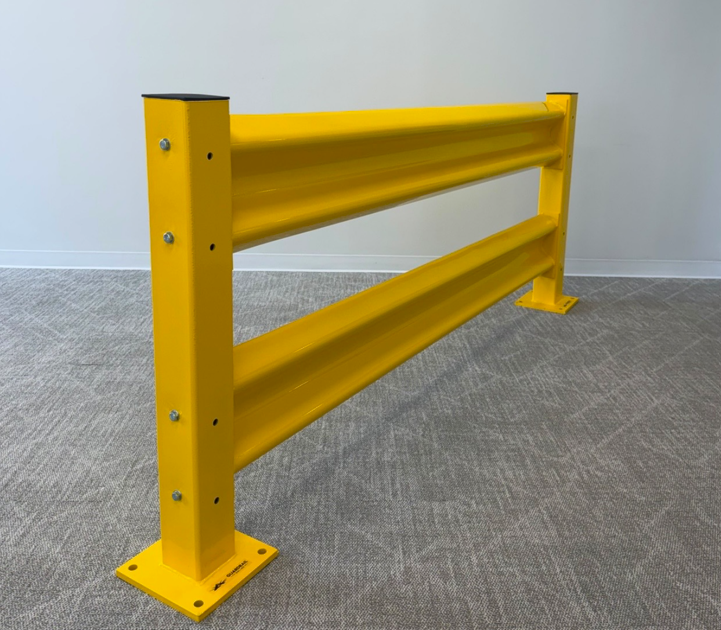
Quick answer: OSHA requires a guardrail, safety net or personal fall protection wherever workers are exposed to an unprotected side or edge 4 feet or more above a lower level (29 CFR 1910.28). Under 1910.29(b), the top rail must be 42 inches, plus or minus 3 inches, above the walking surface. It must hold at least 200 pounds without dropping below 39 inches, and it needs midrails or equivalent protection rated for 150 pounds. Forklift barriers are a different product: OSHA has no impact rating for them, but 1910.176(a) requires safe aisle clearances and marked aisles where forklifts run. Our double-height forklift guardrail kits start at $473 and ship from the Dallas area.
Table of Contents
ToggleKey takeaways
- OSHA guardrail rules in 1910.29 are fall protection rules. They exist to stop people falling off edges, not to stop forklifts.
- The core numbers are a 42 inch (plus or minus 3 inch) top rail, a 200 pound top rail load, midrails rated for 150 pounds and openings no wider than 19 inches.
- In warehouses, fall protection guardrails are usually needed at mezzanines, raised platforms, loading dock edges, dockboards, runways and floor holes.
- OSHA does not set an impact rating for forklift barriers. Impact ratings such as 10,000 lb at 4 mph come from manufacturers, so check how each rating was tested.
- Forklift guardrail is not a substitute for fall protection guardrail at an edge.
In this guide
- OSHA guardrail requirements at a glance
- When OSHA requires a guardrail
- Guardrail specifications in 1910.29
- Toeboard requirements
- Where warehouses need fall protection guardrails
- What OSHA says about forklift barriers
- Fall protection guardrail vs forklift guardrail
- Warehouse guardrail compliance checklist
- FAQs
“OSHA guardrail” is one of the most searched warehouse safety terms, and one of the most misunderstood. The guardrail rules in OSHA’s walking-working surfaces standard describe barriers that keep people from falling. The heavy steel rail that protects racking and walkways from forklifts is a different product with a different job. This guide covers both, using the text of the regulations, so you can tell which rules apply where in your facility.
OSHA guardrail requirements at a glance
| Requirement | General industry rule | Source |
|---|---|---|
| When protection is required | Unprotected sides and edges 4 ft or more above a lower level | 1910.28(b)(1) |
| Top rail height | 42 in, plus or minus 3 in (39 to 45 in) | 1910.29(b)(1) |
| Top rail strength | At least 200 lb, downward or outward, within 2 in of the top edge | 1910.29(b)(3) |
| Top rail deflection | Must not drop below 39 in under the 200 lb downward load | 1910.29(b)(4) |
| Midrails | Midway between top edge and walking surface, if no wall or parapet at least 21 in high | 1910.29(b)(2)(i) |
| Openings | Balusters no more than 19 in apart, other openings no more than 19 in wide | 1910.29(b)(2)(iii)-(iv) |
| Midrail strength | At least 150 lb | 1910.29(b)(5) |
| Rail size | Top rails and midrails at least 0.25 in in diameter or thickness | 1910.29(b)(9) |
| Toeboards | At least 3.5 in high, 50 lb, no more than 0.25 in gap at the floor | 1910.29(k)(1) |
When OSHA requires a guardrail
The trigger is in 29 CFR 1910.28. Employers must protect workers on a walking-working surface with an unprotected side or edge that is 4 feet or more above a lower level. A guardrail system is one way to do it. Safety nets and personal fall protection systems are the others.
The same 4 foot trigger applies to several situations that are common in warehouses:
- Holes: workers must be protected from falling through any hole, including skylights, 4 feet or more above a lower level. Holes below that height still need covers or guardrails so people cannot trip or step into them.
- Dockboards: workers on a dockboard must be protected from falling 4 feet or more by a guardrail system or handrails, with limited exceptions for dockboards used only by motorized equipment.
- Runways and similar walkways: workers must be protected from falling 4 feet or more by a guardrail system.
Guardrail specifications in 1910.29
Once a guardrail is the chosen protection, 29 CFR 1910.29(b) sets the design criteria.
Height
The top edge must be 42 inches, plus or minus 3 inches, above the walking-working surface. It may be higher than 45 inches if every other guardrail requirement is still met.
Midrails, screens and balusters
Where there is no wall or parapet at least 21 inches high, the space below the top rail needs protection. Midrails are installed midway between the top edge and the walking surface. Screens and mesh must run from the walking surface to the top rail. Vertical members such as balusters must be no more than 19 inches apart, and any other openings no more than 19 inches wide.
Strength and deflection
The top rail must withstand a force of at least 200 pounds applied downward or outward within 2 inches of the top edge, without failure. Under that downward load, the top rail must not deflect to less than 39 inches above the walking surface. Midrails, screens and other intermediate members must withstand at least 150 pounds.
Surface, size and materials
- Guardrails must be smooth-surfaced to protect workers from cuts, punctures and snagged clothing.
- Top rails and midrails must be at least 0.25 inches in diameter or thickness.
- Steel or plastic banding cannot be used for top rails or midrails.
- Rail ends must not overhang the terminal posts, unless the overhang does not create a projection hazard.
Holes, hoist areas and access openings
Guardrails around holes go on all unprotected sides. Where materials pass through a hole, no more than two sides may be removed, and only while materials are moving. Ladderway and similar access openings need a self-closing gate that swings or slides away from the hole, or an offset entry so nobody can walk straight in. Hoist areas need a removable guardrail section across the opening when hoisting is not happening. Ramps and runways need guardrails along each unprotected side.
Toeboard requirements
Toeboards stop tools and materials from being kicked off an edge onto people below. Under 1910.29(k)(1), a toeboard must be at least 3.5 inches high, leave no more than 0.25 inch of clearance above the walking surface, and withstand at least 50 pounds applied downward or outward at any point.
Where warehouses need fall protection guardrails
In a typical warehouse or distribution center, these are the places to check against 1910.28 and 1910.29:
- Mezzanines and raised storage platforms, including the open edge where pallets are loaded on and off.
- Loading dock edges when the dock door is open and no trailer is present, and dockboards.
- Elevated walkways, catwalks and runways around conveyors and equipment.
- Floor holes and pits. OSHA’s materials handling standard, 1910.176(g), also calls for covers or guardrails around open pits, tanks, vats and ditches.
- Ladderway openings onto upper levels.
These locations need guardrails designed and tested as fall protection. Forklift guardrail is the wrong product for them unless the system has been confirmed to meet 1910.29.
What OSHA says about forklift barriers
OSHA does not have a standard that requires forklift impact barriers by name or sets an impact rating for them. Several rules still point warehouses toward physical separation:
- 1910.176(a) requires sufficient safe clearances for aisles, at loading docks, through doorways and wherever turns or passage must be made where mechanical handling equipment is used. Aisles must be kept clear and in good repair, and permanent aisles and passageways must be marked.
- The General Duty Clause, Section 5(a)(1) of the OSH Act, requires employers to keep the workplace free from recognized hazards likely to cause death or serious harm. Forklift strikes on pedestrians are a well-known hazard.
- The powered industrial truck standard, 1910.178, covers forklift operation and training.
Floor markings meet the marking requirement, but they do not physically stop a truck. That is the gap forklift guardrail fills. Read why floor markings alone do not protect against forklift impacts and our guide to types of warehouse pedestrian barriers.
Impact ratings come from manufacturers, not OSHA. Ours is rated to withstand a 10,000 lb impact at 4 mph when properly installed. Our article on what 10,000 lb at 4 mph really means explains how to read ratings, and our ANSI MH31.2 explainer covers the industry standard for testing industrial guardrail.
Fall protection guardrail vs forklift guardrail
| Fall protection guardrail | Forklift guardrail | |
|---|---|---|
| Purpose | Stops people falling from an edge | Stops or absorbs vehicle impacts |
| Governing rule | OSHA 1910.28 and 1910.29 | No OSHA impact standard; manufacturer ratings and industry standards |
| Height | Top edge 39 to 45 in, with midrail | Low rail at forklift bumper and fork height; double-height adds an upper rail |
| Strength measure | 200 lb top rail, 150 lb midrail | Vehicle impact, for example 10,000 lb at 4 mph |
| Typical locations | Mezzanines, dock edges, platforms, holes | Racking ends, walkways, walls, columns, equipment |
Our single-height guardrail uses 19 inch posts with the rail at 17.61 inches. It is built to stop forklifts at floor level and is not a fall protection guardrail. Our double-height guardrail uses 41.5 inch posts with rails at 17.61 and 40.16 inches, which makes it the usual choice along pedestrian walkways. It is still designed and rated for vehicle impact, so do not use it as edge protection without confirming it against 1910.29.
Warehouse guardrail compliance checklist
- Walk the facility and list every edge, platform, dock, runway and hole 4 feet or more above a lower level.
- For each one, confirm a guardrail, safety net or personal fall protection system is in place.
- Measure guardrail height (39 to 45 inches), check for midrails or 19 inch maximum openings, and check toeboards where materials could fall on people below.
- Check that aisles have safe clearances for your trucks, are kept clear and that permanent aisles are marked (1910.176(a)).
- Map where forklifts and pedestrians share space, and decide where physical barriers are needed. Our guide on where to install warehouse guardrails first helps prioritize.
- Install forklift guardrail correctly, with every anchor in place. See how to install warehouse guardrail.
- Inspect guardrails after every impact and during regular safety walks, and replace damaged posts and rails.
Facilities in North Texas can also use our forklift barrier compliance checklist for Dallas-Fort Worth distribution centers, and our broader overview of OSHA and industry standards for warehouse guardrails.
This guide summarizes federal OSHA general industry rules as published on osha.gov in October 2026. It is not legal advice. Texas follows federal OSHA, but always check the current regulation text and your own facility conditions, and consult a qualified safety professional for site-specific decisions.
FAQs
How high does a guardrail need to be under OSHA?
For general industry, OSHA 1910.29(b)(1) requires the top edge of a guardrail to be 42 inches, plus or minus 3 inches, above the walking-working surface. That means 39 to 45 inches. It can be higher than 45 inches if all the other guardrail requirements are still met.
How much force must an OSHA guardrail withstand?
The top rail must withstand at least 200 pounds applied downward or outward within 2 inches of the top edge, and it must not deflect below 39 inches under that downward load. Midrails and other intermediate members must withstand at least 150 pounds.
When does OSHA require a guardrail?
Under 1910.28, employers must protect workers from falls at unprotected sides and edges 4 feet or more above a lower level. Guardrails are one option, alongside safety nets and personal fall protection. Holes, dockboards and runways 4 feet or more above a lower level have similar rules.
Does OSHA require forklift barriers in warehouses?
OSHA does not have a standard that names forklift impact barriers or sets an impact rating for them. Rule 1910.176(a) requires safe clearances for aisles where mechanical handling equipment is used, and permanent aisles must be marked. Employers also have a general duty to protect workers from recognized hazards, which is why many facilities separate forklifts and pedestrians with barriers.
Is forklift guardrail the same as an OSHA fall protection guardrail?
No. A fall protection guardrail is built to stop a person from falling off an edge, with a top rail at 39 to 45 inches and a midrail. A forklift guardrail is built to absorb vehicle impacts low to the floor. Our single-height guardrail stands 19 inches tall, so it is not a fall protection guardrail. Do not use forklift guardrail as edge protection unless the system has been checked against 1910.29.
What is the OSHA requirement for midrails and openings?
If there is no wall or parapet at least 21 inches high, the guardrail needs intermediate protection. Midrails go midway between the top edge and the walking surface. Balusters must be no more than 19 inches apart, and other openings no more than 19 inches wide.
How tall do OSHA toeboards need to be?
Under 1910.29(k), toeboards must be at least 3.5 inches high, have no more than 0.25 inch of clearance above the walking surface, and withstand at least 50 pounds applied downward or outward.
Is construction guardrail different from general industry guardrail?
Construction sites follow 29 CFR 1926.502(b), which also uses a 42 inch, plus or minus 3 inch, top rail height and a 200 pound top rail strength. Warehouses, distribution centers and manufacturing plants generally fall under the general industry rules in 1910.
Written by the Guardrail Online team. Reviewed and updated in October 2026.