Table of Contents
ToggleExecutive Summary
- Before 2021, there was no standardized way to crash test industrial barriers in the United States.
- Different testing methods made it difficult to compare barrier performance across manufacturers.
- ANSI MH31.2 introduced a common crash testing methodology for industrial barriers.
- Understanding this standard is one of several things that helps warehouse managers make more informed barrier purchasing decisions.
What Exactly Is ANSI MH31.2?
ANSI MH31.2 is a voluntary American National Standard for crash testing industrial barriers. It was first published in 2021; check MHI for the current edition before you rely on it. The standard was developed by the Protective Guarding Manufacturers Association (ProGMA) under MHI (Material Handling Industry), in collaboration with the Texas A&M Transportation Institute (TTI).
It establishes one standardized testing method for warehouse guardrail barriers and barrier posts used in industrial facilities. Unlike OSHA, the ANSI crash testing standard isn’t a workplace regulation. Instead, it provides manufacturers with a common testing methodology that makes barrier performance easier to compare across different products.
Quick Overview
| Official Name | ANSI MH31.2 – Test Method for Crash Testing Industrial Guardrail Barriers and Barrier Posts |
| Developed By | ProGMA under MHI, in collaboration with the Texas A&M Transportation Institute (TTI) |
| Purpose | Standardize crash testing for industrial barriers |
| Mandatory? | No. It is a voluntary standard. |
This crash testing standard doesn’t tell you which warehouse guardrail beam to purchase or where to install barriers. Instead, it tells manufacturers how those barriers should be crash tested. That gives buyers a fair way to compare barrier performance using the same testing methodology — one input among several in a purchasing decision.
Why Was ANSI MH31.2 Introduced?
Before ANSI MH31.2, there was no standardized way to crash test industrial barriers in the United States. Every manufacturer could follow its own testing process, which made product comparisons much more difficult. Different guardrail manufacturers often used different testing approaches, including:
- Different vehicle weights
- Different impact speeds
- Different testing procedures
- Different methods for reporting performance
That created a problem. A warehouse guardrail beam tested by one manufacturer couldn’t always be fairly compared with another barrier, because the results were often based on completely different testing conditions.
Before vs. After ANSI MH31.2
| Before | After |
|---|---|
| Different testing methods | One standardized testing methodology |
| Different impact conditions | Consistent testing parameters |
| Difficult product comparisons | Easier barrier performance comparisons |
| Manufacturer-specific testing | Common industry benchmark |
The ANSI crash testing standard addressed this by introducing one standardized crash testing methodology. Manufacturers that choose to test now evaluate products using a common framework, which gives warehouse managers a clearer basis for comparing barrier performance.
How Does ANSI MH31.2 Crash Testing Work?
The ANSI crash testing standard evaluates industrial barriers by recreating controlled forklift impacts under standardized conditions. Every manufacturer that tests follows the same process, which makes barrier performance easier to compare across products. These crash tests are conducted by ISO/IEC 17025-accredited laboratories, so results are generated using recognized testing procedures.
Step 1: A Standardized Test Vehicle Replaces a Real Forklift
The standard doesn’t use a random forklift during testing. Instead, it uses a surrogate test vehicle designed specifically for crash testing — a controlled stand-in for a real forklift. It’s built to represent the size, weight, and impact characteristics of powered industrial trucks, so testing conditions stay consistent from one test to the next.
Step 2: Every Barrier Is Tested Under the Same Conditions
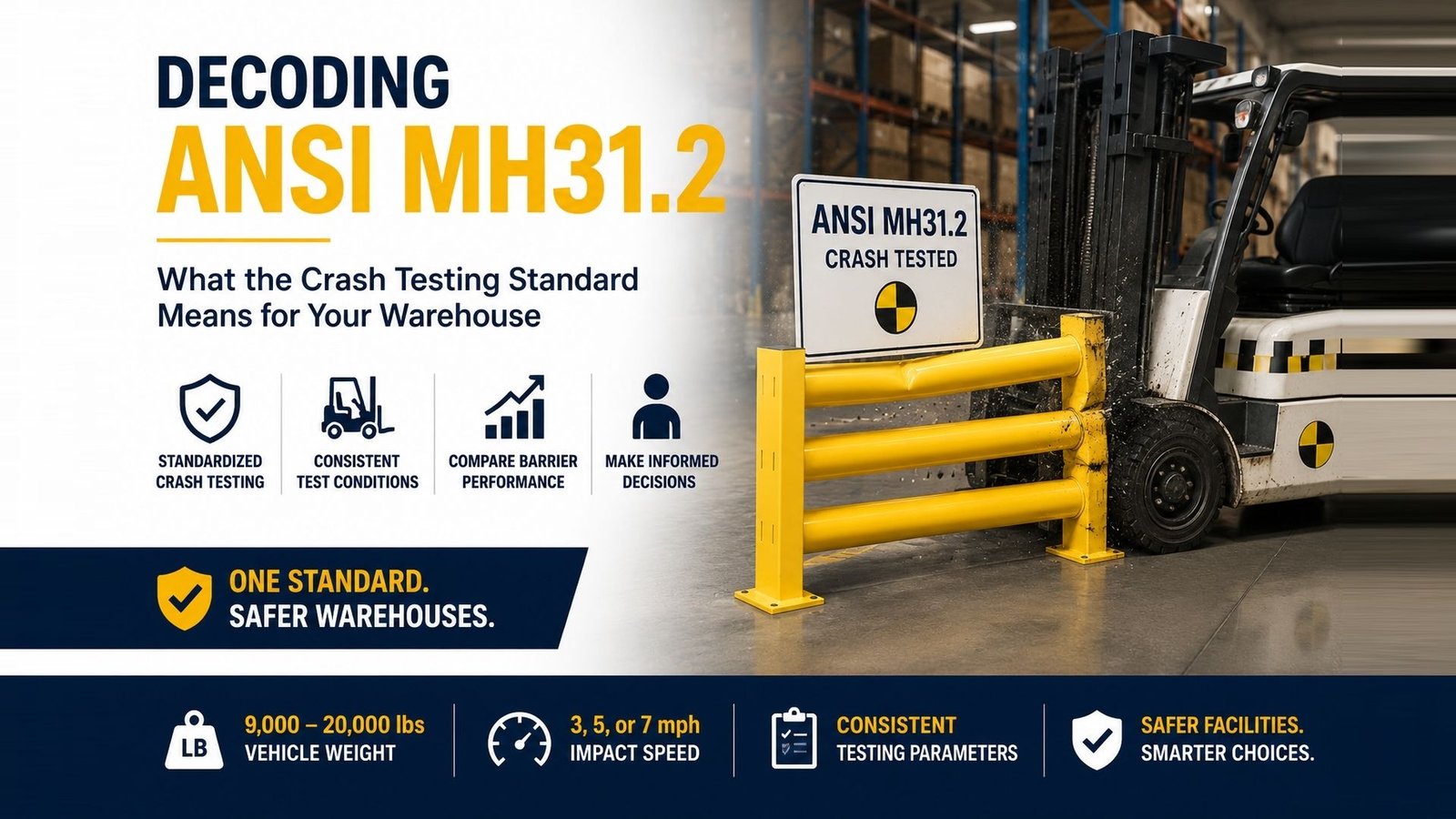
ANSI MH31.2 specifies the key testing parameters every manufacturer must follow: the test vehicle’s gross weight, the impact speed, and the test setup. Using the same parameters makes results comparable across barrier systems.
| Parameter | ANSI MH31.2 Testing Conditions |
|---|---|
| Gross vehicle weight | 9,000 – 20,000 lbs |
| Impact speed | 3, 5, or 7 mph |
| Test vehicle | Standardized surrogate vehicle |
Each weight-and-speed combination produces a standardized impact rating — for example, a “9-5” rating reflects a 9,000 lb vehicle at 5 mph. This is worth understanding as a buyer: an MH31.2 rating is not a single pass/fail badge. It describes the specific impact energy a barrier was tested against, so two “MH31.2 tested” products can be rated very differently.
What Does ANSI MH31.2 Actually Measure During a Crash Test?
The standard doesn’t simply check whether a barrier stays standing after an impact. It evaluates how the entire barrier system performs during and after a controlled forklift collision, which gives warehouse managers a clearer picture of real-world behavior. Factors evaluated during a crash test include:
| Performance Factor | What It Measures | Why It Matters |
|---|---|---|
| Dynamic Penetration / Deflection | How far the barrier and vehicle move at impact. | Under the standard, deflection beyond 24 inches is a test failure with no rating assigned — so this number tells you whether the area behind the barrier stays protected. |
| Impact Rating | The weight-and-speed combination the barrier withstood. | Lets you match a barrier to the actual forklift weights and speeds in your facility. |
| Anchor Integrity | Whether posts and anchors stay attached to the floor. | Confirms the complete system stays stable after a hit, not just the beam. |
Looking at these factors together gives a fuller view of how a warehouse safety barrier performs — rather than judging a guardrail beam by its appearance alone.
Why Does ANSI MH31.2 Use Independent Crash Testing?
ANSI MH31.2 testing is performed by an ISO/IEC 17025-accredited laboratory. These labs follow internationally recognized testing and quality standards, so each crash test follows a consistent, documented process. Independent testing matters because it:
- Builds trust in the results — testing is carried out by an independent laboratory rather than relying only on a manufacturer’s own data.
- Creates consistency — barriers are evaluated using recognized procedures instead of different in-house methods.
- Makes comparisons easier — buyers can compare rated systems using standardized performance data.
That’s why independent testing is a central part of the standard. It gives warehouse managers confidence that a published rating was generated using recognized procedures.
What to Ask Before Choosing a Warehouse Safety Barrier
A crash-test rating is one useful data point — but it’s not the only thing that determines whether a barrier is the right fit for your facility, or whether you can protect a site quickly and within budget. Ask a fuller set of questions:
Has the barrier been crash tested to ANSI MH31.2 — and at what rating?
If a product carries an MH31.2 rating, ask which rating. A rating tied to a 5 mph, 12,000 lb impact is a very different thing from one tied to a 3 mph, 9,000 lb impact. Match the rating to the forklift weights and speeds that actually operate in your aisles, rather than treating “tested” as a single yes/no.
What are the verifiable physical specifications?
You don’t need a test lab to compare steel. Ask for the steel thickness, and the actual weight of the rails and posts. Component weight and material are physically verifiable and easy to compare side by side across suppliers — often a more practical comparison than headline impact figures.
Does the system meet the dimensional requirements of OSHA 1910.29 where fall protection is needed?
At elevated edges, mezzanine perimeters, and pit or dock edges, guarding has to satisfy OSHA’s dimensional requirements — top-rail height within the required band and opening sizes below the allowable maximum. Confirm the system’s geometry meets those requirements for the specific application, and that a toeboard is included where the edge is elevated.
What is the lead time, and is it in stock?
A barrier only protects people once it’s installed. Build-to-order systems can run weeks or months before they ship. In-stock inventory can be on site in days. If you have an open hazard now, availability is a safety factor, not just a convenience.
What is the delivered cost to your site?
Freight on heavy steel can be a large share of the total, and it varies enormously by lane. Always compare delivered cost product plus freight to your dock not just the unit price. A supplier close to you can change the math significantly.
Key Takeaway: The right questions reveal more than a product brochure. They let you weigh crash-test data, verifiable specs, code compliance, availability, and delivered cost together — so you choose a barrier that fits both your facility’s risk and your timeline.
Conclusion
ANSI MH31.2 changed how industrial barriers are evaluated by introducing one standardized crash testing methodology. It gives warehouse managers a more reliable way to compare rated barriers one important input alongside verifiable specifications, code compliance, availability, and delivered cost. Understanding how the standard works helps you look past marketing claims and make a decision grounded in real information.
Looking for warehouse guardrail you can put to work quickly?
Guardrail Online holds warehouse guardrail beams and posts in stock in Dallas, so you can protect a site in days rather than waiting on a build-to-order queue. Our components are robust, heavy steel with weights you can verify against any competitor, and our double-height system meets the dimensional requirements of OSHA 1910.29 for guarding height. Contact our team with your project and we’ll help you spec the right protection and get it delivered.
Frequently Asked Questions
Is ANSI MH31.2 mandatory?
No. ANSI MH31.2 is a voluntary American National Standard. It establishes a standardized method for crash testing industrial guardrail barriers and posts, but it is not a legal requirement like OSHA regulations.
Which version of ANSI MH31.2 is current?
The standard was first published in 2021. Check MHI for the current edition.
Does OSHA require ANSI MH31.2?
OSHA does not require compliance with ANSI MH31.2. However, OSHA requires employers to protect workers from recognized hazards. ANSI MH31.2 supports that objective by providing a consistent way to compare barrier performance when selecting protective systems.
Why is standardized crash testing important?
Standardized crash testing lets warehouse managers compare rated barrier systems using the same methodology. That makes it easier to evaluate performance fairly and choose barriers appropriate to a facility’s operational risks as one factor among several in the buying decision.