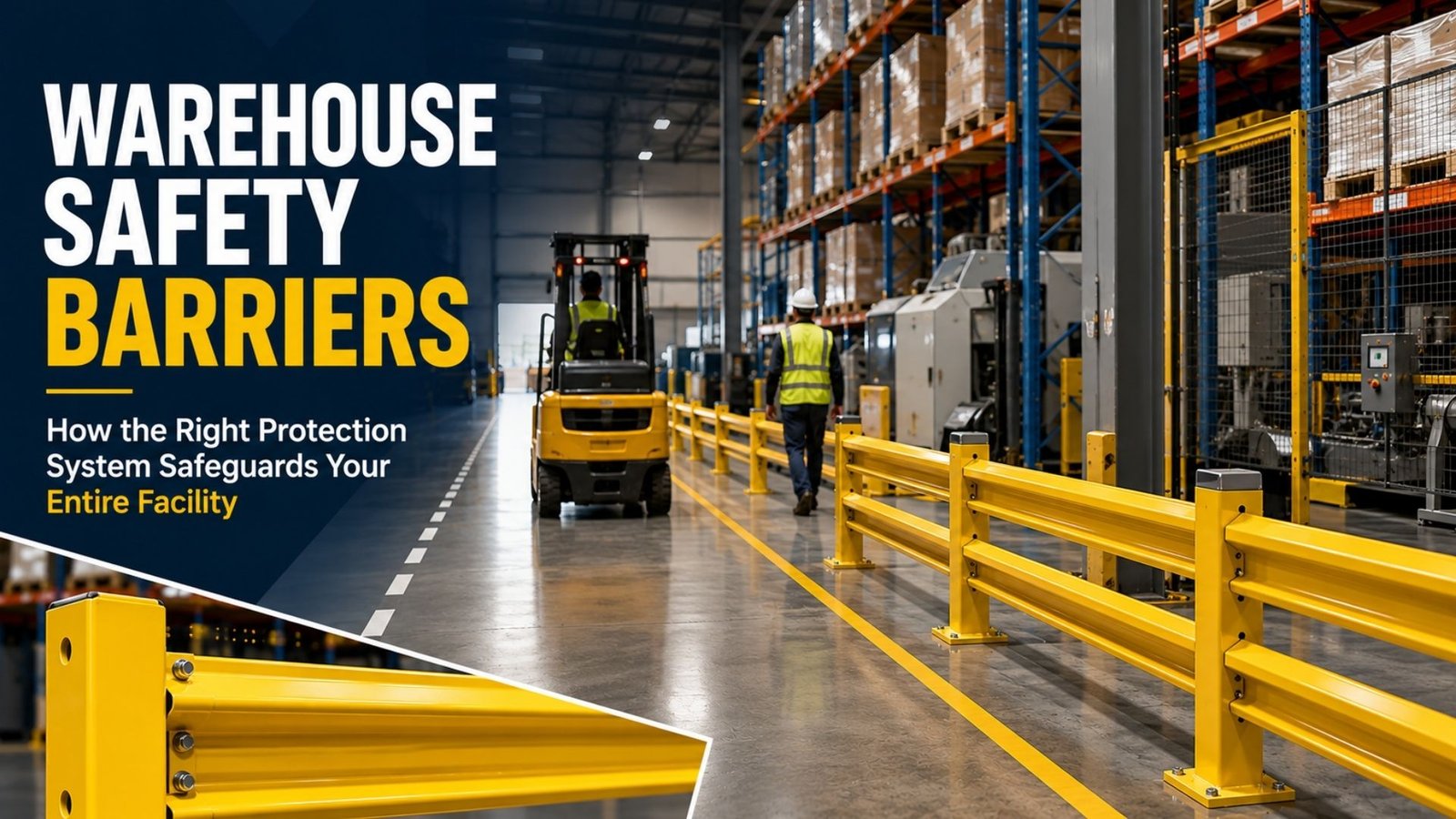
Most people think warehouse safety barriers exist for one reason: to stop a forklift hitting something. That’s part of the job, but a well-designed system does far more. It keeps employees clear of moving equipment, shields valuable racking and machinery, and brings order to warehouse traffic across the whole floor.
This guide walks through how our Heavy Duty Warehouse Guard Rail is built and why each detail, from the steel gauge to the finish, earns its place.
Table of Contents
ToggleWhat Are Warehouse Safety Barriers?
Warehouse safety barriers are physical protection systems that separate forklifts, pedestrians, equipment, and building infrastructure. Their job isn’t only to reduce accidental vehicle contact it’s to keep the whole operation running safely and predictably.
At Guardrail Online, our Heavy Duty Single Height Warehouse Guard Rail is designed to be part of a complete system, not a standalone product. Paired with adjustable pedestrian gates, expansion kits, and accessories, it lets facilities build protection that fits their exact layout. Here’s how that plays out across the main areas of a warehouse.
How Our Barriers Protect Your Facility
Different zones need different protection. Some areas are about keeping people safe; others are about shielding expensive assets or keeping traffic flowing. The same guardrail platform covers all of it.
Protecting Employees Around Forklift Traffic
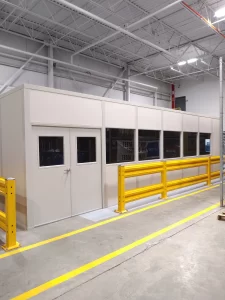
A loaded forklift crossing a busy aisle while an employee steps into the same space is one of the most common risk moments in a warehouse. A physical barrier removes the guesswork by keeping the two apart:
- A genuine physical barrier between forklift lanes and walkways, built from 11-GA (0.118″) corrugated ASTM A1011 steel rails.
- A rigid, connected system held together by heavy structural posts and four M12 Grade 8.8 bolts per rail, so sections stay locked in place under load.
- High visibility from a Safety Yellow (RAL 1023) finish that makes protected routes obvious to operators and pedestrians alike.
- Controlled crossings where adjustable pedestrian gates give staff safe, defined points to pass through.
Protecting Equipment and Infrastructure
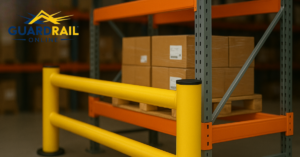
A slight steering error at the end of an aisle is all it takes to strike a rack upright, conveyor, or dock. Even low-speed impacts damage costly equipment and stall operations. The guardrail is built to take that hit first:
- A 12.2″ corrugated rail profile that spreads impact force across the barrier rather than concentrating it at the point of contact.
- Welded end plates that strengthen every rail-to-post connection.
- A stable foundation of 4.75″ x 4.75″ structural posts welded to 10″ x 10″ x 5/8″ base plates and anchored with four 5/8″ wedge anchors.
- A 10,000 lb @ 4 mph impact rating when properly installed — sized to stop a loaded forklift before it reaches your infrastructure.
That means real protection for pallet racking, machinery, conveyors, loading docks, and other critical assets.
Keeping Warehouse Traffic Organized
During a shift change forklifts moving pallets, staff crossing between stations, goods arriving at the dock movement gets busy fast. Defined routes keep it safe:
- Rail lengths from 2 ft to 10 ft so protection fits aisles, docks, workstations, and walkways without awkward gaps.
- A modular design that reconfigures as layouts change, rather than forcing a rebuild.
- Simple expansion through starter kits, post kits, and add-on sections whenever a new area needs guarding.
- Clear separation of foot and forklift traffic when combined with pedestrian gates and guardrail runs.
Protecting Your Long-Term Investment
When you expand in a few years new racks, new routes, new work areas — you shouldn’t have to tear out and replace your whole barrier system to suit the new layout. Ours is built to grow with you instead:
- Add to it easily with compatible starter kits, add-on kits, and post kits as the facility grows.
- Reconfigure it using the same 2 ft to 10 ft rail lengths to cover new aisles, docks, and machinery.
- Replace sections, not systems — swap or add individual pieces instead of rebuilding the run.
- Keep it durable with pre-galvanized steel under a powder-coated finish that stands up to everyday industrial wear.
The result is a protection system that evolves with your business instead of being scrapped every time the floor plan changes.
In Stock and Ready When You Need It
Most guardrail comes with a lead time weeks or months while it’s built and freighted in. That’s a problem when a failed inspection, a near-miss, or a new install can’t wait. We carry our range in stock at our Dallas-area facility, so orders ship quickly with no manufacturing queue to sit through. When you need protection in place fast, having it on the ground is the difference between hitting your schedule and slipping it.
Ready to Protect Your Warehouse with Confidence?
Protecting a warehouse takes more than a single barrier. It takes a system that guards people, shields infrastructure, keeps traffic organized, and grows with the facility built from 11-GA steel rails, heavy structural posts, Grade 8.8 hardware, and dual-layer corrosion protection throughout.
Looking for guardrail that combines strength, flexibility, and fast availability?
Explore the full range, or talk to our team about the right setup for your warehouse and how quickly we can get it to you.
FAQs
What are the different types of safety barriers?
Common types include warehouse guardrails, pedestrian safety barriers, forklift impact barriers, rack protectors, adjustable pedestrian gates, and modular barrier systems. Most facilities combine several into one connected system.
What are the 7S principles in a warehouse?
The 7S principles are Sort, Set in Order, Shine, Standardize, Sustain, Safety, and Spirit. Together they support a clean, organized, efficient, and safer warehouse — with physical safety barriers underpinning the Safety element.
What are warehouse impact barriers?
Impact barriers are protective systems that absorb accidental forklift impacts before they reach people, machinery, racking, or building structure, helping minimize damage and improve safety.
What are the key safety precautions for a warehouse?
Core precautions include installing safety barriers, keeping traffic routes clear, separating pedestrians from forklifts, wearing PPE, inspecting equipment regularly, and training staff on safe operating procedures.