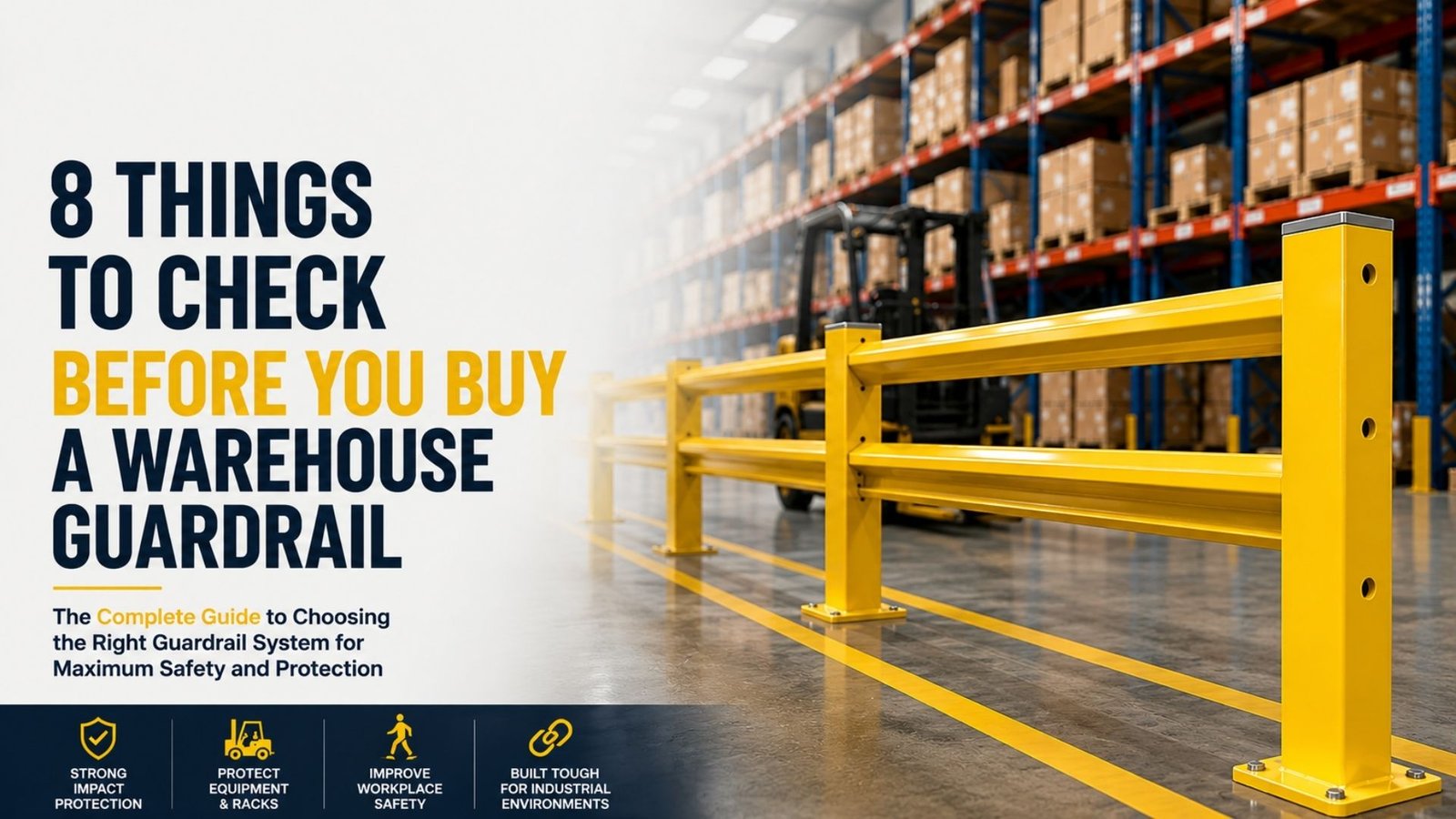
Two steel guardrail systems can look identical in a product photo and quote at very different prices. The difference is almost always in a handful of details that never make it into the picture and that most buyers never think to check. Here is what actually separates a system that holds up from one that folds on the first real hit, and the questions to ask before you spend the money.
Table of Contents
ToggleStart with the weight
This is the simplest test, and the hardest one to fake. Steel is steel a heavier system has more steel in it. Two posts that look the same in a photo can weigh very differently on a scale, and the lighter one got there by using a thinner wall, a smaller base plate, or a shorter post.
When you compare quotes, ask each supplier for the shipping weight of a single post and a single rail. It cuts through the marketing faster than any spec sheet. Our single-height post-and-rail set weighs about 35 lbs; the double-height set is about 57 lbs. If a competing system weighs noticeably less for the same footprint, there is less steel doing the work.
Rail thickness and how to read the gauge
Rail thickness is quoted in gauge (GA), and the numbers run backwards from what you would expect: a lower number means thicker steel. 11-GA is thicker than 12-GA, which is thicker than 14-GA. Our rails are 11-GA (0.118″) with a corrugated profile that adds rigidity.
Thinner rails cost less and ship lighter, but they deform and tear more easily when a loaded forklift catches them. On impact you want the rail to take the hit and keep its shape, not fold. Ask for the gauge in writing — “heavy-duty” on its own tells you nothing.
Post size
The post carries the load down into the floor, so its size matters as much as the rail. A bigger cross-section resists bending and gives the base plate and welds more to work with. Our posts are 4.75″ × 4.75″ with a 3/16″ wall. Compare that number directly between systems — a post that is an inch smaller across has meaningfully less resistance to a side impact, even when the rail looks the same.
How the rail bolts to the post the part nobody checks
This is where two systems that look identical really differ, and it is worth understanding before you buy. There are two ways to attach a rail to a post.
Bolt-through. The bolt passes all the way through both walls of the post and is held by a nut on the far side. The strength of the connection comes from the full bolt and the nut, not from the post wall.
Threaded or pre-tapped. The bolt threads into a hole tapped into a single wall of the post, or into a welded insert. Its holding strength depends entirely on how many threads bite into that one wall.
Our rails bolt all the way through the post — four M12 Grade 8.8 bolts per rail, each secured with a nut.
Here is why it matters. With a pre-tapped connection, if the post wall is not thick enough there simply are not enough threads to grip, and under a hard impact those threads can strip and let the rail pull away from the post. A bolt-through connection does not rely on wall thickness for its grip — the nut on the far side does the holding. It is a stronger and more forgiving connection, and it is one of the first things worth asking any supplier: does the rail bolt through the post, or thread into it?
The base plate
The base plate is the steel plate welded to the bottom of the post that the anchors pass through. Its job is to spread the load from the post across the floor and into the anchors, and its size matters more than people expect. Ours is 10″ × 10″ × 5/8″.
When a forklift hits the rail, it tries to lever the post over at its base. A larger base plate puts the anchors further out from the point the post pivots on, so each anchor carries less of that load. A smaller plate does the opposite — it concentrates the same impact into a tighter group of anchors and a smaller patch of concrete, and both end up working harder. Ask for the base plate dimensions, not just the anchor spec — the plate and the anchors work as a pair.
The anchors
A strong rail, post and base plate do nothing if the anchors let go of the floor. Look at three things: the number of anchors per post, their diameter, and how deep they set into the concrete. Our posts use four 5/8″ × 5″ wedge anchors. Fewer or smaller anchors, or shallow embedment, and the post can lift at its base on a hard impact — the rail held, but the whole post pulled up.
The finish
Warehouse conditions are hard on steel over time, so how a barrier is finished affects how it holds up and how it looks a few years in. There are a few common approaches, and none of them is right or wrong — it is just worth knowing which one you are actually buying.
- Single-coat powder coat. One layer of colour over bare steel. Fine in a dry indoor space, but once it is scratched through to the steel, that spot can start to corrode.
- Two-coat powder coat. A primer coat under the colour coat, which gives more protection than a single coat on its own.
- Pre-galvanized, then powder-coated. The steel is galvanized first and then powder-coated on top. If the powder coat later gets scratched, the galvanized layer underneath still resists corrosion at that spot.
Ours is pre-galvanized and then powder-coated in Safety Yellow (RAL 1023). The point is not that one finish is the only acceptable one — it is that a quote which simply says “powder-coated” could mean any of the above, so it is worth asking which you are getting.
What an impact rating actually tells you
The impact rating is the number most buyers reach for first, and it can be the most misleading — because there is no single test that every manufacturer runs. One company’s “10,000 lbs at 4 mph” and another’s “13,000 lbs at 5 mph” come from their own test setups: how the post was mounted, where the force was measured, and what counted as a pass. Without a common standard behind them, two published ratings are not measuring the same thing, so comparing the numbers directly tells you less than it appears to.
You will sometimes see a smaller, lighter post carry a higher published rating than a larger, heavier one. That should be a flag, not a selling point — if the numbers were produced on the same basis, more steel would not test as less. What it usually means is that the two ratings came from different test conditions.
Our system is independently tested to withstand 10,000 lbs at 4 mph, and we publish that as a straight figure rather than the largest number we could generate.
Here is the more useful way to think about it. A rating is a claim you have to take on trust. Post size, wall thickness, material weight and the connection type are physical facts you can measure and weigh for yourself. Treat the rating as one input — then put real weight on the build you can actually verify.
What to ask before you buy
Get these answers in writing from every supplier and you can compare systems on the same terms instead of on adjectives:
- What does one post and one rail weigh?
- What gauge is the rail?
- What is the post cross-section and wall thickness?
- Does the rail bolt through the post, or thread into a tapped hole?
- What size is the base plate?
- How many anchors per post, and what size?
- How is it finished single-coat, two-coat, or galvanized plus powder coat?
- What test conditions is the impact rating based on?
Where our warehouse guardrail system lands
We built ours to answer every one of these: 11-GA rails, 4.75″ posts, a 10″ × 10″ base plate, bolt-through connections, four wedge anchors per post, and one of the heavier systems by weight in its class. And because we hold stock in Dallas, you are not waiting on a manufacturing lead time orders ship fast across Texas and out to the wider U.S. straight from in-stock inventory.
One thing worth being clear on is what the system is for. The standard single-height rail is impact protection it stops forklifts and protects racking, equipment and walkways. If you need fall protection at an elevated edge such as a mezzanine or a loading dock, that is a different requirement with a different rail height, and our double-height system is built for it. Work out which one your site actually needs before you spec it, and we can point you to the right configuration.
Key specifications at a glance
| Feature | Specification |
| Rail material | Pre-galvanized steel, corrugated profile |
| Rail thickness | 11-GA (0.118″) |
| Rail height | 12.2″ |
| Post size | 4.75″ × 4.75″ × 3/16″ |
| Base plate | 10″ × 10″ × 5/8″ |
| Rail connection | Bolt-through — 4 × M12 Grade 8.8 bolts per rail, secured with nuts |
| Concrete anchors | 4 × 5/8″ × 5″ wedge anchors per post |
| Available rail lengths | 2 ft to 10 ft |
| Finish | Pre-galvanized + powder-coated Safety Yellow (RAL 1023) |
| Impact rating | Up to 10,000 lbs at 4 mph when properly installed |
| System design | Modular and expandable |
Ready to spec your system?
Browse our Heavy Duty Warehouse Guardrail range to compare rail lengths, accessories and complete starter kits — or tell us what you are protecting and we will help you choose the right configuration and get it shipped from Dallas.
FAQs
How do I compare two steel guardrail systems fairly?
Ask both suppliers for the same set of numbers: the weight of one post and one rail, the rail gauge, the post size and wall thickness, how the rail connects to the post, the base plate size, the anchor spec, and how it is finished. Comparing those puts every system on the same footing.
Is a heavier guardrail always better?
Not automatically, but weight is a good proxy for how much steel is in the system, and it is hard to fake. A heavier post and rail usually means thicker steel and a more substantial base — provided the connection and anchoring are sound too.
What is the difference between a bolt-through and a threaded rail connection?
A bolt-through connection passes the bolt clean through the post and holds it with a nut, so its strength does not depend on the post wall. A threaded connection relies on the bolt biting into threads cut into a single wall — if that wall is thin, fewer threads engage and the connection can strip under a hard hit.
Why does a smaller competitor guardrail sometimes show a higher impact rating?
Because impact ratings are not tested to a single common standard. Each manufacturer publishes a figure from its own test conditions, so a larger number does not always mean a stronger barrier — it can simply mean a different test. The specs you can verify yourself, like post size, wall thickness and weight, are a more reliable comparison.
Do these guardrails meet OSHA fall protection requirements?
The single-height system is impact protection, not fall protection. For fall protection at an elevated edge, OSHA 1910.29 calls for a top rail in the 39–45″ range plus a toeboard at the edge, and our double-height system is designed around that geometry. Tell us where the guardrail is going and we will help you spec the right configuration.