Most warehouse accidents do not come from rare events. They develop during everyday movement, in familiar areas, and under routine pressure. Forklifts follow the same paths. Pedestrians use the same walkways. Over time, risk becomes invisible until something goes wrong.
This article looks at the most common and most dangerous warehouse accidents. It further talks about how they can be prevented with the right protection like the use of heavy duty guard rail beams.
Table of Contents
Toggle1. Forklift-to-Pedestrian Strikes
Forklift-to-pedestrian strikes occur most often in areas where people and equipment move side by side for extended periods. They are known to develop during routine activity, such as:
- When pedestrians walk along pick faces or shared aisles
- While forklifts pass repeatedly across those aisles under load.
In these spaces, clearance changes constantly. Loads extend wider than expected. Forklifts correct their line. Pedestrians step closer to traffic to navigate obstacles or congestion. The risk is not tied to a single mistake. It builds from repeated exposure in a shared corridor where there is no physical boundary.
When contact occurs, the outcome is serious.
- Pedestrian strikes lead to severe injury, long recovery periods, and permanent harm.
- Facilities also face investigations and liability
- Moreover, operational disruption that extends far beyond the incident itself
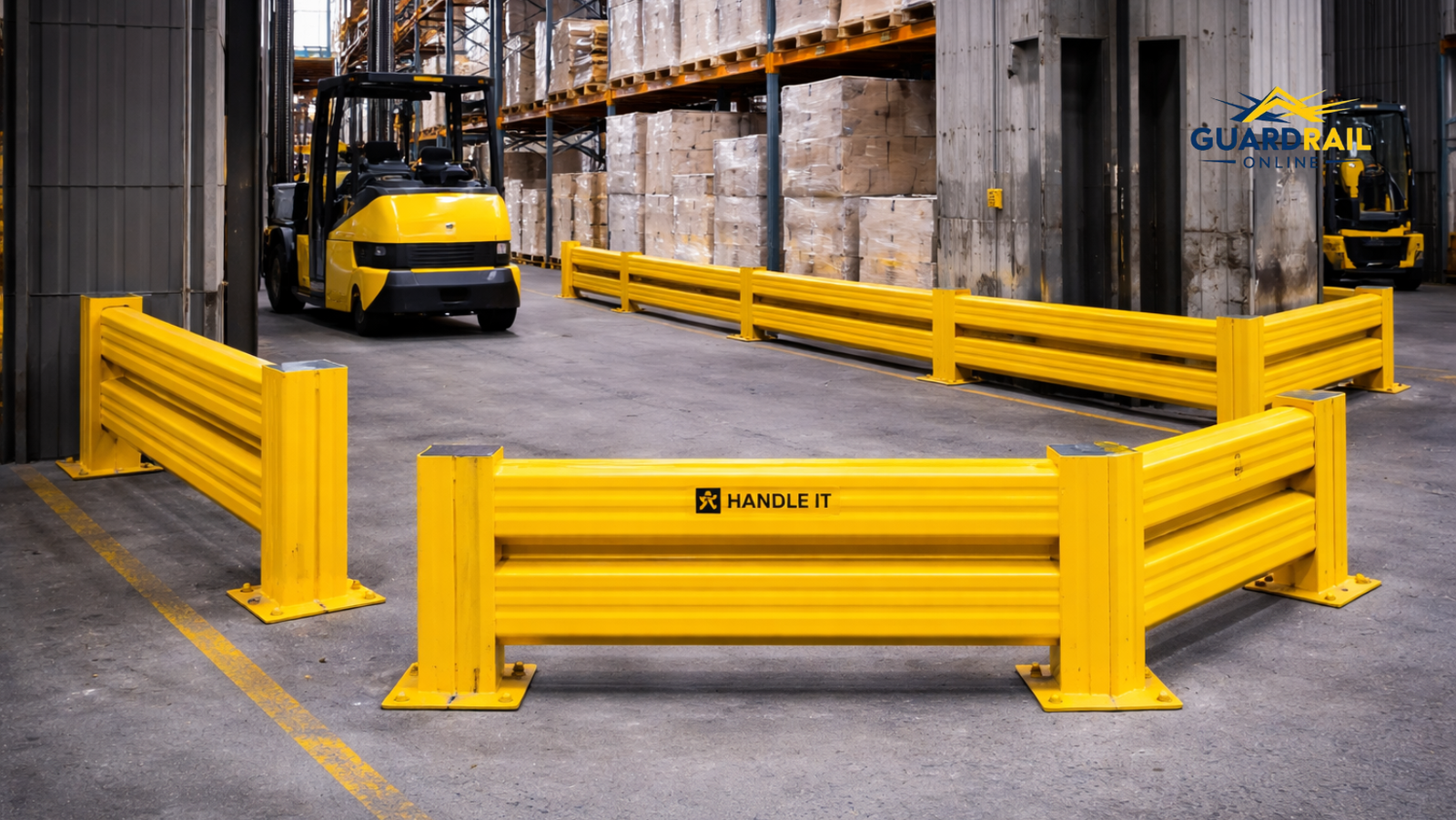
This is where heavy duty guard rail beams make a direct difference. They introduce separation where shared movement currently exists. Instead of relying on timing, awareness, or judgment, the barrier defines where forklifts can travel and where pedestrians cannot. Heavy duty guard rail beams reduce pedestrian strike risk by:
- Physically separating walkways from forklift travel lanes
- Preventing forklifts from drifting or correcting into pedestrian space
- Keeping pedestrians out of the load overhang and swing paths
- Removing last-moment decisions in high-exposure zones
This category of accident stops developing in the first place when people and forklifts no longer share the same operating space. That is why pedestrian separation is one of the most immediate and effective applications for a heavy duty guard rail beam.
2. Vehicle-to-Vehicle Collisions in Compressed Traffic Zones
Vehicle-to-vehicle collisions develop in compressed zones where forklifts are forced to slow, reverse, or adjust their path repeatedly. Tight yards, narrow aisles, blind corners, and staging congestion all increase the likelihood of such an overlap. This happens because operators need to focus on clearance, timing, and avoiding pedestrians, often while visibility is already compromised.
In these areas, a minor misjudgment is enough. A forklift reverses slightly wider than expected. Another vehicle enters the same space. What begins as a low-speed contact can quickly block lanes, damage equipment, or trigger secondary strikes involving racks or nearby workers.
This is where a heavy duty guard rail beam changes outcomes. It restores order by defining movement before conflict occurs:
- Creating clear, enforced lanes in high-traffic zones
- Preventing vehicles from crossing into opposing paths
- Reducing sudden corrections that lead to shock collisions
- Protecting adjacent pedestrian and storage areas2. Rack Strikes and Racking Collapse
Rack strikes usually begin as minor contact.
- A forklift clips a rack upright while turning.
- A pallet brushes a column during placement.
The impact looks insignificant, and operations continue. But over time, those small impacts accumulate. Rack uprights lose alignment. Beams deform slightly. The structure no longer carries the load the way it was designed to. The risk is not created by one major collision. It develops through repeated contact that weakens the racking system quietly.
When failure does occur in time and when it does, the consequences are severe like:
- Heavy pallet loads can release suddenly
- Multiple aisles may be affected at once
- Workers face crush hazards and falling inventory
- Facilities experience major product loss and prolonged downtime
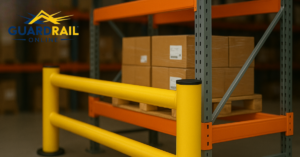
This is where a heavy duty guard rail beam plays a preventive role. Installed ahead of racking, it absorbs contact before forklifts ever reach the rack structure. Instead of force transferring into uprights and beams, impact energy is redirected into the floor through the guardrail system. Heavy duty guard rail beams protect racking by:
- Intercepting forklift contact before it reaches rack uprights
- Containing equipment within defined travel lanes
- Preventing repeated low-level strikes that cause progressive weakening
- Preserving the rack’s vertical load path by eliminating direct impact
The risk of collapse drops sharply when racking is no longer exposed to daily contact. That is why installing a guard rail beam for forklifts in front of racking is both a safety measure and a business continuity decision.
3. Forklift Impacts With Building Columns and Fixed Assets
Forklift impacts with building columns and fixed assets usually develop in areas where space is constrained, and movement is forced to change. These are not high-speed zones. They are tight zones like areas near:
- Dock approaches,
- Interior columns,
- Control panels,
- Fixed machinery
The forklifts must slow, steer, and correct their path in these zones just to get through. But the problem is that forklifts rarely move in a straight, relaxed line in these zones. Operators need to adjust steering under load. Rear ends can even swing wider than expected. Pallets, on the other hand, are known to shift slightly during turns.
With all this movement, a column or machine does not necessarily need to sit inside the aisle to be hit. Being positioned close to the travel path is often enough for repeated contact to begin.
The real problem is that such damages won’t always occur instantly. In fact, they rarely come from one obvious collision. Instead, it builds quietly through frequent, low-speed contact. Over time, structural columns weaken, machinery drifts out of alignment, and panels or utilities take damage that was never intended to occur. When these failures surface, the impact spreads quickly:
- Structural integrity is compromised
- Equipment performance is affected
- Utilities and controls are damaged
- Operations face downtime and costly repairs
This is where a heavy duty guard rail beam makes a measurable difference. Installed in front of columns and fixed assets, the guardrail takes the contact first. Instead of forklifts striking immovable structures, impact energy is absorbed by the barrier and transferred safely into the floor. Heavy duty guard rail beams prevent this category of damage by:
- Creating a physical buffer around columns and fixed equipment
- Keeping forklifts contained within defined travel paths
- Stopping repeated low-level contact before it weakens structures
- Protecting critical assets without disrupting daily movement
Damage stops accumulating in the background when forklifts no longer interact directly with building elements. That is why protecting columns and fixed assets is one of the most practical and high-value applications for a heavy duty guard rail beam in high-risk warehouse areas.
4. Loading Dock Falls and Edge Incidents
Did you know that loading dock falls usually happen during routine work, not high-risk tasks? Workers are often too focused on aligning pallets, checking paperwork, or coordinating with drivers while standing close to open dock edges. On the other hand, forklifts and trucks are always moving around in those zones, noise levels are high, and attention is constantly shifting. In that environment, a single step backward, sideways, or off balance can place a worker directly at the edge.
Even short dock drops can result in severe injury. This is where a heavy duty guard rail beam makes a direct difference. It prevents exposure instead of reacting to it by:
- Creating a physical barrier at open dock edges
- Stopping unintended step-outs during loading activity
- Channeling pedestrian movement to designated safe approach paths
- Keeping forklifts set back from edge zones
You can remove risk of falls. All you need is to place the right heavy duty guard rail beam in the docks and edges.
Conclusion
The accidents discussed here share one common trait. They develop where movement overlaps and where there is nothing physically stopping that overlap from turning into impact. Heavy duty guard rail beams work because they remove that possibility altogether. They guide traffic, protect people, and shield critical structures long before a mistake has the chance to escalate.
So, do you want to install heavy duty guard rail beams in those zones? Explore our range of safety barriers at Guardrail Online today!
FAQs
What is a W-beam guardrail?
A W-beam guardrail is a steel safety barrier with a “W”-shaped profile that allows controlled flex under impact. This design of W beam guardrail helps spread collision force along the rail, reducing damage while redirecting vehicles away from people, equipment, and structures.
What is the weight limit for guardrails?
Guardrails do not have a single weight limit. Their performance is defined by impact ratings that consider vehicle weight, speed, and installation conditions, rather than static load capacity.
What are the four general types of guardrails?
The four main types are vehicle guardrails, pedestrian guardrails, fall-protection guardrails, and equipment or structure-protection guardrails. Each type of guardrail is designed to control a specific safety risk within industrial environments.