Quick answer: OSHA sets clear rules for guardrail used as fall protection: under 29 CFR 1910.28 it is generally required where workers face a fall of 4 feet or more, and under 1910.29 the top rail must sit at 42 inches (plus or minus 3 inches) and withstand 200 pounds. OSHA has no construction specification for forklift barriers, so facilities rely on the General Duty Clause, the forklift operating rules in 1910.178 and the voluntary ANSI MH31.2 test standard.
Table of Contents
ToggleKey takeaways
- Pedestrian guardrail (fall protection) and vehicle barriers (impact protection) are covered differently by OSHA.
- Fall protection is generally required at a fall of 4 feet or more (29 CFR 1910.28).
- Guardrail top rails must be 39 to 45 inches high and withstand 200 pounds (29 CFR 1910.29).
- Forklift barriers have no OSHA construction specification; ANSI MH31.2 is the voluntary test standard.
- Some states run their own OSHA plans with stricter rules.
In this guide
- Introduction
- Definitions
- OSHA Definition of Guardrail System
- OSHA 29 CFR 1910.28: When Pedestrian Guardrail Is Required
- OSHA 29 CFR 1910.29: How Pedestrian Guardrails Must Be Built
- Warehouse Vehicle Barriers – OSHA and Industry Requirements
- Fall Protection vs. Forklift Impact: Two Different Jobs
- Frequently Asked Questions
- Final Notes
Introduction
This article outlines the federal baseline OSHA standards relevant to warehouse guardrails. Note that some U.S. states (such as California, Washington, and Oregon) operate their own state OSHA plans, which may include stricter or more specific requirements. Employers are responsible for complying with the most protective applicable regulations.
Definitions
To clarify the scope of this article, the following terms are used:
- Pedestrian Guardrail: A barrier system intended to prevent workers from falling from elevated walking-working surfaces.
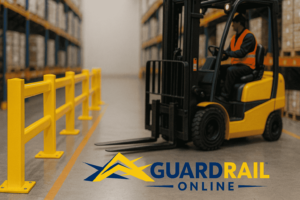
- Warehouse Vehicle Barrier: A protective structure designed to stop or redirect powered industrial trucks (e.g. forklifts) to prevent collisions with people, equipment, or infrastructure.
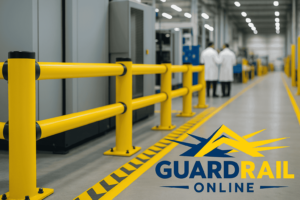
In many warehouse settings, a double-height barrier can serve both functions: the lower section provides impact protection from vehicles, while the upper rail can also act as fall protection where OSHA requires it, provided the installed system meets OSHA’s height and strength rules.
OSHA Definition of Guardrail System
According to 29 CFR 1910.21(b), OSHA defines a guardrail system as:
“A barrier erected along an unprotected or exposed side, edge, or other area of a walking-working surface to prevent employees from falling to a lower level.”
This definition applies to fall protection systems, not specifically to impact protection from warehouse vehicles.
Summary of Standards That Apply
| Area | OSHA Standard (Mandatory) | Industry Standards (Voluntary) | Comments |
| Warehouse Vehicle Barriers | General Duty Clause, 1910.178, 1910.22 | ANSI MH31.2 | OSHA does not prescribe specifications but requires protection from recognized hazards. |
| Pedestrian Guardrails | 29 CFR 1910.28, 1910.29 | – | OSHA defines when and how pedestrian guardrails must be used and constructed. |
OSHA 29 CFR 1910.28: When Pedestrian Guardrail Is Required
29 CFR §1910.28 outlines the circumstances under which employers must provide fall protection systems, including pedestrian guardrails, in general industry settings. Employers must implement fall protection whenever workers are exposed to a fall of 4 feet or more to a lower level. The standard also covers specific hazard zones such as:
- Holes/openings
- Runways
- Dangerous equipment
- Hoist areas
- Dockboards
- Fixed ladders
This standard allows for flexibility in the type of system used (e.g. guardrail, safety net, or personal fall arrest) based on the task and environment.
Summary of Requirements:
| Location / Condition | When Guardrail (or Fall Protection) Is Required | Reference |
| General Walking-Working Surfaces | When exposed to a fall of 4 feet or more to a lower level | §1910.28(b)(1) |
| Hoist Areas | Required when exposed to a fall of 4 feet or more; if a guardrail section is removed for hoisting, other fall protection is needed | §1910.28(b)(2) |
| Holes (floor openings) | Must be guarded with a cover or guardrail system | §1910.28(b)(3) |
| Dockboards (bridge plates, ramps) | Fall protection required when drop is 4 feet or more | §1910.28(b)(4) |
| Runways and Walkways | Required when exposed to a fall of 4 feet or more | §1910.28(b)(5) |
| Work Near Dangerous Equipment | Guardrail or equipment guard when working less than 4 feet above dangerous equipment; fall protection at 4 feet or more | §1910.28(b)(6) |
| Wall Openings | Guardrails required if opening edge is less than 39 inches from floor | §1910.28(b)(7) |
| Fixed Ladders (over 24 ft) | Fall protection system required | §1910.28(b)(9) |
| Stairways (≥4 ft drop) | Fall protection required | §1910.28(b)(11) |
| Low-Slope Roofs | Guardrails required if workers are within 6 feet of edge | §1910.28(b)(13) |
OSHA 29 CFR 1910.29: How Pedestrian Guardrails Must Be Built
29 CFR §1910.29 provides the design, performance, and installation requirements for fall protection systems. These apply in situations identified in the previous section under 1910.28. The intent is to ensure guardrails are structurally sound, properly positioned, and effective at preventing falls.
Summary of Requirements (Pedestrian Guardrail):
| Item | Requirement |
| 1. Top Rail Height | Must be 42 inches ±3 inches above the surface (i.e. between 39–45 inches). |
| 2. Midrail | Must be installed midway between top rail and walking-working surface. |
| 3. Strength | Top rail must withstand 200 lbs; midrail must withstand 150 lbs of force. |
| 4. Surface Finish | Must be smooth, with no sharp edges or projections. |
| 5. Openings | Must prevent passage of a 19-inch diameter object. |
| 6. Toe Boards | Required if protecting from falling objects. Must be ≥3.5 inches high. |
Warehouse Vehicle Barriers – OSHA and Industry Requirements
While OSHA does not explicitly reference “warehouse vehicle barriers” by name, several standards still require protection from powered industrial trucks:
- General Duty Clause: Requires a workplace free from recognized hazards.
- 29 CFR 1910.178: Governs the safe operation of powered industrial trucks, including how they travel around pedestrians.
- 29 CFR 1910.22: Requires walking-working surfaces to be kept free of hazards; separating pedestrians from vehicle traffic is one way to manage this.
In addition, the ANSI MH31.2-2021 standard provides voluntary guidance on crash testing and performance evaluation for warehouse guardrail and barrier systems. It introduces consistent impact testing methods to verify a product’s ability to withstand collisions from powered industrial trucks.
Summary of Requirements (Warehouse Vehicle Barriers):
| Item | Requirement |
| 1. General Duty Clause | Employers must keep the workplace free of recognized serious hazards, which can include forklift strikes. Barriers are one common control. |
| 2. 29 CFR §1910.178 | Sets rules for operating powered industrial trucks, such as yielding to pedestrians and slowing at cross aisles. |
| 3. 29 CFR §1910.22 | Walking-working surfaces must be kept free of hazards. Separating walkways from vehicle traffic is one way facilities address this. |
| 4. ANSI MH31.2 (Voluntary) | Provides testing and performance criteria for guardrails and barrier posts used in industrial facilities. |
Note: OSHA does not prescribe construction specifications for warehouse vehicle barriers. Facilities therefore rely on manufacturer impact ratings and voluntary standards such as ANSI MH31.2 when choosing vehicle barriers.
Fall Protection vs. Forklift Impact: Two Different Jobs
Pedestrian guardrail under 29 CFR 1910.29 is designed to stop people from falling off an elevated edge. A warehouse vehicle barrier is designed to stop or redirect a forklift. They address different hazards, are tested differently and are often different products.
The two overlap where an elevated edge also sees forklift traffic, such as mezzanine edges where pallets are loaded and unloaded, raised dock areas and platforms beside travel lanes. There, a heavy-duty double height system can handle both: the lower rail absorbs impacts while the top rail acts as fall protection, provided the installed system meets the 1910.29 height and strength rules.
At floor level, where there is no fall hazard, the job is impact protection only. Single height guardrail protects walls and equipment, and double height guardrail separates walkways from forklift lanes.
For the exact numbers in the regulation, including the 42 inch top rail, 200 pound load, midrails and toeboards, see our detailed guide to OSHA guardrail requirements.
Frequently Asked Questions
Can one guardrail provide both fall protection and forklift impact protection?
Yes, in some locations. At an elevated edge with forklift traffic, a heavy-duty double height system can take impacts at the lower rail while the top rail acts as fall protection, as long as the installed system meets the height and strength rules in 29 CFR 1910.29.
Does OSHA regulate forklift impact barriers?
OSHA has no construction specification for warehouse vehicle barriers. Employers must still protect workers from recognized hazards, and ANSI MH31.2 provides voluntary test methods for barrier impact performance.
Does OSHA require guardrails along forklift lanes on the warehouse floor?
There is no specific OSHA rule requiring guardrail along ground-level forklift lanes. Many facilities install barriers there to reduce forklift-pedestrian risk, alongside the operating rules for powered industrial trucks in 29 CFR 1910.178.
How high does an OSHA guardrail have to be?
Under 29 CFR 1910.29, the top rail must be 42 inches, plus or minus 3 inches (39 to 45 inches), above the walking-working surface and must withstand a force of at least 200 pounds.
When is fall protection required in a warehouse?
Under 29 CFR 1910.28, fall protection is generally required when a worker is exposed to a fall of 4 feet or more to a lower level, with specific rules for holes, dockboards, runways, wall openings and work above dangerous equipment.
Guardrail Products for Pedestrian Protection
Browse our warehouse guardrail systems to plan pedestrian protection in your facility. Double height guardrail suits walkways beside forklift lanes, and an adjustable pedestrian safety gate controls access at openings. Always confirm the requirements for your specific site with a qualified safety professional.
Final Notes
Employers should ensure compliance by:
- Conducting a workplace hazard assessment
- Determining whether fall or impact protection is required
- Installing appropriately designed pedestrian guardrails and warehouse vehicle barriers
For facilities operating in OSHA State Plan jurisdictions, always consult your state’s specific regulations.
Disclaimer: This article is for informational purposes only and does not constitute legal advice. Always consult the most current OSHA standards and a qualified safety professional when designing your facility’s safety systems.
Written by the Guardrail Online team. Reviewed and updated in October 2026.