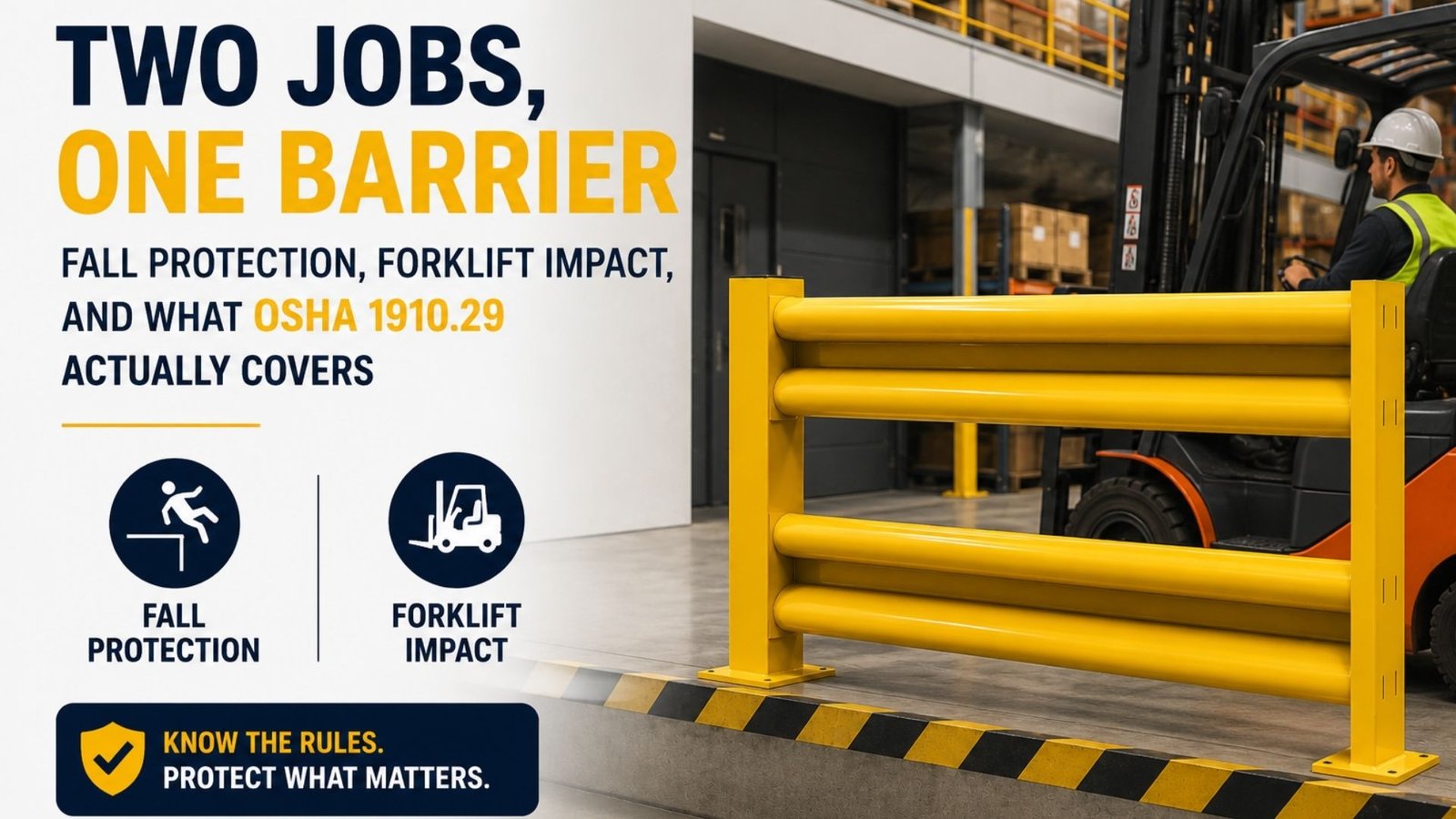
If an OSHA inspector walked your facility today, could you say which of your barriers are stopping people from falling, and which are stopping forklifts — and which are being asked to do both?
A warehouse guardrail can be asked to do two completely different jobs. One is stopping a person who trips or loses their balance from going over an elevated edge. The other is stopping a forklift. These are different hazards, they’re governed by different rules, and the barrier that solves one doesn’t automatically solve the other. Getting the two straight is the difference between real protection and a false sense of it.
This guide separates the two jobs, explains what OSHA 1910.29 does and doesn’t cover, and shows where a double-height warehouse guard rail is the right answer because it handles both at once.
Table of Contents
ToggleTwo Hazards, Two Frameworks
The most common mistake in warehouse barrier planning is treating “fall protection” and “impact protection” as the same thing. They aren’t, and they don’t sit under the same rules.
| Hazard | What governs it | The key point |
|---|---|---|
| A person falling from an elevated edge | OSHA 29 CFR 1910.29 — the fall protection criteria standard (the 42-inch rule, midrail, strength) | Required where an edge is 4 feet or more above a lower level. This is a legal requirement. |
| A forklift or vehicle striking a barrier | No OSHA design standard. OSHA’s General Duty Clause applies, alongside the voluntary ANSI MH31.2 crash-test method | This is about stopping a vehicle, not a person. Impact ratings are expressed by vehicle weight and speed. |
Two things fall out of this that matter for every purchasing decision:
- OSHA 1910.29 says nothing about forklift impact. It’s a fall-protection standard. A barrier can fully meet the 1910.29 dimensions and still be the wrong tool for absorbing a vehicle strike — and vice versa.
- There is no OSHA design standard for impact barriers. The industry’s shared reference on that side is the voluntary ANSI MH31.2 test method, which lets buyers compare rated barriers using the same crash-test conditions. It’s optional, not a regulation.
Keep both frameworks in view and the right barrier for each situation becomes much clearer.
What OSHA 1910.29 Requires (the Fall-Protection Side)
Where fall protection is required, 1910.29 sets the design criteria for the guardrail system. It doesn’t recommend a product — it tells you how a compliant system has to be built.
| OSHA Clause | Requirement | Detail |
|---|---|---|
| 1910.29(b)(1) | Top rail height | 42 inches ±3 inches above the walking-working surface (a 39–45 inch band) |
| 1910.29(b)(2)(i) | Midrail | Installed midway between the top rail and the surface, where there’s no wall or parapet at least 21 inches high |
| 1910.29(b)(2)(iv) | Maximum opening | Openings no more than 19 inches wide |
| 1910.29(b)(3) | Top rail strength | Withstand at least 200 pounds of force, applied downward or outward |
| 1910.29(b)(4) | Deflection under load | Under the 200-pound load, the top rail must not drop below 39 inches |
| 1910.29(b)(5) | Midrail strength | Withstand at least 150 pounds of force |
| 1910.29(b)(6)–(7) | Surface and ends | Smooth-surfaced; rail ends must not overhang posts as a projection hazard |
These requirements work as a set. Meeting the height alone doesn’t make a system compliant — the openings, strength, and finish all have to be right for the installation.
1910.29 fall protection only comes into play at an elevated edge — generally a walking surface 4 feet or more above a lower level, such as a mezzanine perimeter, a raised dock edge, or a pit or floor opening. On the flat warehouse floor, there’s no fall-to-a-lower-level hazard, so the 42-inch rule isn’t the question at all. There, the job is impact and traffic separation, which is a different problem entirely.
Single-Height vs. Double-Height: Two Jobs, Two Designs
A single-height barrier and a double-height guardrail both protect people. They’re just built for different jobs.
| Single-Height Barrier | Double-Height Guardrail | |
|---|---|---|
| Primary job | Forklift and vehicle impact protection | Impact protection and pedestrian fall protection |
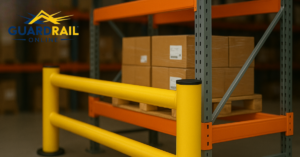
| How it works | One rail at forklift-impact height | Lower rail takes the vehicle impact; upper rail acts as the fall-protection guardrail |
| Rail height | Lower, positioned for vehicle contact | Upper rail sits within OSHA’s 39–45 inch band |
| Best suited to | Aisles, columns, racking, floor-level traffic separation | Elevated edges where forklifts also operate |
A single-height barrier isn’t a lesser product — it’s just aimed at the impact hazard. The right choice depends entirely on which of the two jobs (or both) you’re trying to cover.
Where You Genuinely Need Both: The Case for a Double-Height Guardrail
The double-height guardrail earns its place in one specific, common, and high-risk situation: an elevated edge that also has forklift traffic. Here you have both hazards stacked in the same spot — a person can fall, and a vehicle can strike the barrier — and one product resolves both.
The classic locations:
- Mezzanine perimeters where reach trucks or order pickers load and unload. Pallets move on and off the edge with a fall drop right there. The upper rail provides pedestrian fall protection at height; the lower rail stands up to the truck.
- Raised loading dock edges. Foot traffic, vehicle movement, and a drop to the drive below, all in one place.
- Pit edges and lower-level drops in production lines. Conveyors, tuggers, and forklifts working alongside an open edge.
In each of these, a single-function barrier leaves a gap: an impact barrier at floor height doesn’t protect against the fall, and a plain fall-protection rail won’t survive a forklift. The double-height guardrail is the clean single answer.
Where you need only one job covered:
- Flat-floor walkways, aisles, and blind intersections. No elevated edge means no fall hazard under 1910.29, so you’re not chasing the 42-inch rule here — this is purely impact and traffic separation. A barrier still adds real value; it’s just a different design conversation.
- An elevated edge with no vehicle traffic. A standard fall-protection guardrail is all that’s needed; impact performance isn’t the concern.
The point isn’t that bigger is always better. It’s that you should know which hazard you’re solving before you choose the barrier.
The Cost of Getting It Wrong
Choosing the wrong protection — or covering one hazard and missing the other — carries real financial exposure on top of the safety risk.
| Potential Cost | Estimated Impact |
|---|---|
| OSHA Serious Violation* | Up to $16,550 per violation |
| OSHA Willful or Repeated Violation* | Up to $165,514 per violation |
| Average total cost per medically consulted workplace injury (NSC, 2024) | $48,000 per case |
OSHA penalties are adjusted periodically for inflation; the amounts above are current. Applicable penalties depend on the circumstances of each violation.
The cost of the right barrier is a small fraction of a single serious incident or citation. When both a fall hazard and vehicle traffic are present, covering only one of them is the most expensive kind of shortcut.
Conclusion
Warehouse barrier planning isn’t about the tallest rail or the lowest price. It’s about matching the barrier to the hazard — and recognizing when there are two hazards in the same place. Falls are governed by OSHA 1910.29 at elevated edges; forklift impact is a separate problem with no OSHA design standard and a voluntary ANSI MH31.2 test method behind it. Where an elevated edge meets forklift traffic, one barrier can do both jobs.
Planning a new install or upgrading an exposed edge?
Guardrail Online’s double-height starter kit does both jobs in the one product: the lower rail takes forklift impact, and the upper rail provides pedestrian fall protection — with the top rail sitting within OSHA’s 39–45 inch band, so it meets the dimensional requirements of 1910.29 for guardrail height. It’s robust, heavy steel with component weights you can verify against any competitor, and it’s held in stock in Dallas, so you can protect an exposed edge in days rather than waiting on a build-to-order queue. Contact our team with your layout and we’ll help you spec the right barrier for each location.
Frequently Asked Questions
Can one guardrail provide both fall protection and forklift impact protection?
Yes, in the right location. A double-height guardrail uses a lower rail for vehicle impact and an upper rail for pedestrian fall protection. It’s the right choice where an elevated edge and forklift traffic occur in the same place — for example, a mezzanine perimeter used for loading.
Does OSHA regulate forklift impact barriers?
No. OSHA has no design standard specifically for impact barriers. Employers are covered by the General Duty Clause to protect workers from recognized hazards, and the voluntary ANSI MH31.2 test method gives the industry a common way to compare rated impact barriers by vehicle weight and speed.
Does OSHA require guardrails around forklift lanes on the warehouse floor?
Not as fall protection. On a flat floor there’s no fall-to-a-lower-level hazard, so 1910.29 isn’t triggered. Barriers there are about impact and traffic separation. OSHA’s general duty to control recognized hazards can still apply depending on the situation.
How high does an OSHA guardrail have to be?
The top rail must sit 42 inches above the walking-working surface, plus or minus 3 inches — a compliant range of 39 to 45 inches — provided the complete system also meets the midrail, opening, strength, and surface requirements of 1910.29(b).
When is fall protection actually required?
In general industry, generally where a walking-working surface has an unprotected edge 4 feet or more above a lower level. That’s the threshold that brings the 1910.29 guardrail criteria into play.