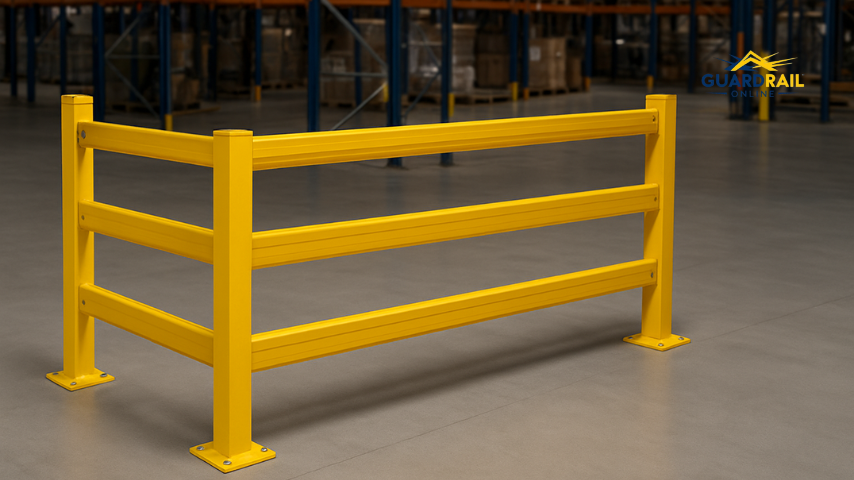
Have you ever wondered why some warehouses operate smoothly while others struggle with avoidable accidents, bottlenecks, and costly equipment damage? The answer often comes down to something surprisingly simple — the type of rail beam used to protect people, machinery, and inventory.
Inside busy warehouses across the United States, forklifts turn quickly, pallets are stacked high, and traffic never stops moving. In such environments, even a small mistake can result in serious disruption. That is why choosing the right warehouse guard rail beam is not just a safety decision. It is a strategic decision that shapes how efficiently a facility operates every single day.
The truth is that no two warehouses face the same risks. Some need barriers that stay firmly in place, while others need flexible access for maintenance teams. Some facilities deal with corrosive conditions, while others face repetitive high-speed impacts. Understanding the different types of rail systems available helps you pick protection that truly fits your environment, rather than relying on a one-size-fits-all solution.
Below are the most common types of rail beam designs used in American warehouse protection. Read on to ensure you choose the guardrails that support safer and more organized operations.
Table of Contents
Toggle1. Standard Single-Rail Beams
Do you need a simple, reliable solution to separate pedestrian walkways from equipment zones? Then a standard single-height rail beam may be the best place to start. This type of guard rail provides a clean and visible physical boundary that helps prevent cart collisions, protects lighter equipment, and guides traffic along safer pathways.
A warehouse guard rail beam in this format is ideal for workstations, low-impact aisles, or rack ends. A defined safety barrier in these locations will reduce confusion and improves movement predictability.
2. Double-Height Rail Beam Systems
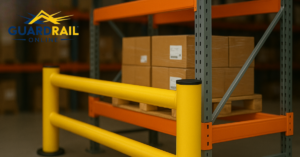
Have you ever seen forklifts carrying tall loads that rise far above the floor? In these situations, a single-rail barrier may not provide enough coverage. That is exactly why double-height rail beam systems are used.
Double-height rails offers more vertical protection, shielding stacked pallets, structural posts, and wall panels from higher collision points. These beams are especially valuable in fast distribution settings or blind-corner intersections where height visibility becomes a challenge.
A warehouse guard rail beam built in a double-rail configuration offers an added layer of strength and helps reduce the risk of costly repair incidents.
3. Heavy-Duty Impact Rail Beams
Some zones inside a facility take more abuse than others. Think about loading docks or battery-charging areas where forklifts move quickly and collide more frequently. In these spaces, a light barrier is not enough. Heavy-duty rail beam systems are ideal for such locations. They use reinforced steel and stronger post structures to absorb significantly greater levels of impact.
These systems are commonly installed in:
- High-speed forklift travel lanes
- Conveyor intersections
- Shipping and receiving routes
- High-risk industrial corridors
Heavy-duty guardrail beam will manage stronger collisions and keep operations running smoothly and prevents expensive infrastructure damage.
4. Galvanized and Corrosion-Resistant Rail Beams
Have you ever dealt with rusting barriers, peeling coatings, or safety rails that weaken after repeated wash downs? Moisture and chemicals can destroy unprotected steel over time. That is where galvanized and corrosion-resistant rail beam systems come in.
Corrosion-resistant beams are coated with protective zinc that shields metal from condensation, temperature swings, and corrosive substances. They are a smart choice for:
- Cold storage
- Food-processing environments
- Outdoor loading yards
- High-humidity facilities
5. Lift-Out Rail Beam Systems
Not all safety barriers are meant to stay in place forever. Some warehouse areas require frequent access for equipment servicing or sanitation cycles. Instead of removing bolts or dismantling hardware, lift-out rail beam configurations allow teams to remove a section by hand and reinstall it in seconds.
Lift-out systems are often used in:
- Maintenance-heavy machinery rooms
- Cleaning zones
- Seasonal inventory changes
- Narrow areas requiring temporary widening
Lift-out warehouse guard rail beam offers flexibility without sacrificing strength, giving facilities the best of both access and protection.
6. Bolt-On Rail Beam Systems
When you need long-term, unmoving protection, a bolt-on rail beam is the most dependable choice. These systems are preferred where stability cannot be compromised, such as around electrical panels, control rooms, cooling units, or key structural columns.
A warehouse guard rail beam installed in this style remains firmly anchored even after repeated heavy impacts and makes high-risk zones significantly safer.
Ready to Strengthen Warehouse Protection?
Choosing the right rail beam is not just about installing steel. It is about creating a safer, more efficient warehouse where people work confidently and equipment moves without hesitation. When each barrier is selected intentionally, accident risks drop, damage costs shrink, and daily operations flow with greater clarity.
If you are looking for durable, high-performance options designed specifically for industrial spaces, Guardrail Online is here to help. Our warehouse guard rail beam solutions include heavy-duty, galvanized, lift-out, and double-rail designs.
Explore our safety systems today and build the level of protection your facility deserves.