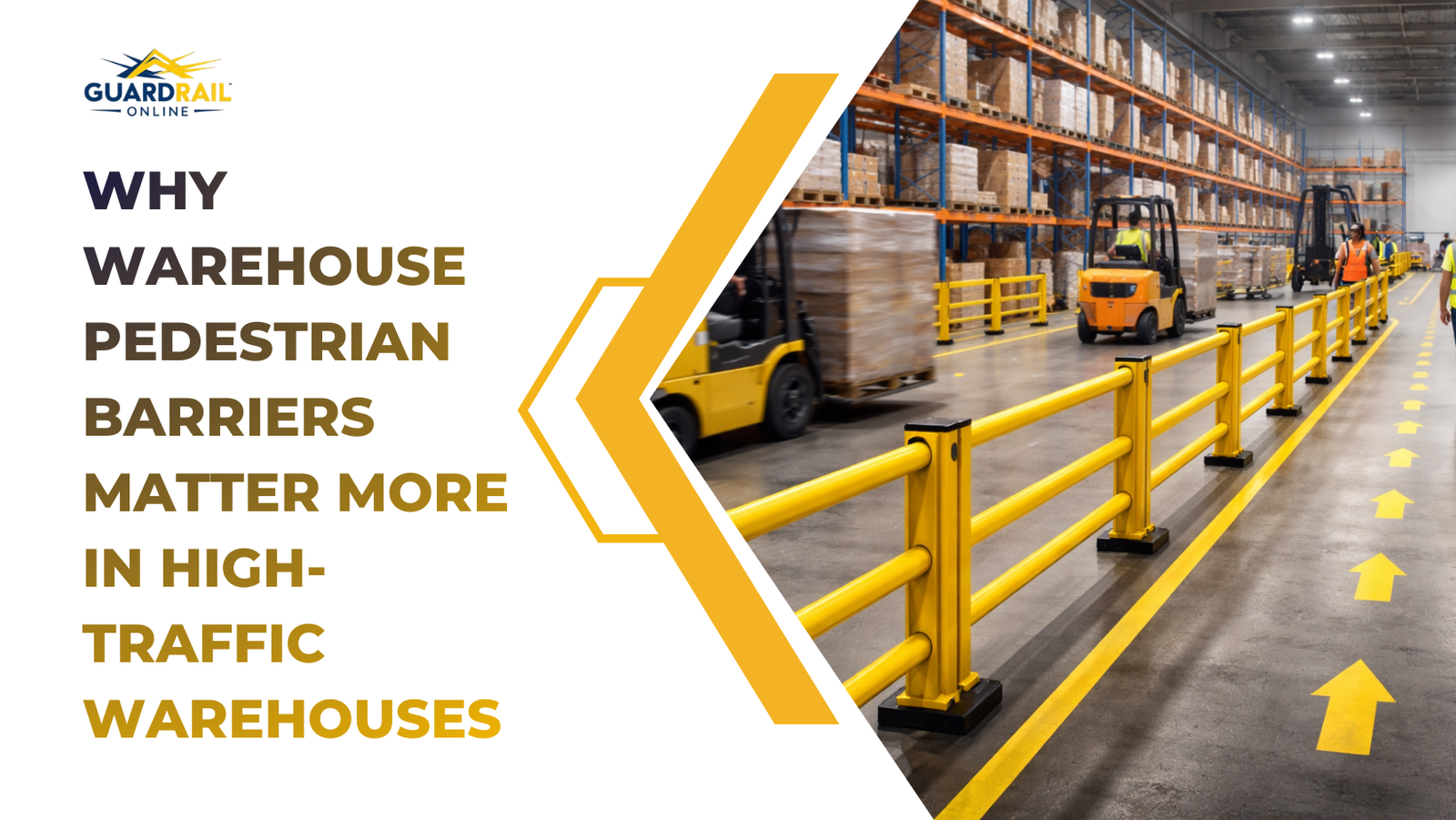
High-traffic warehouses do not fail because people ignore safety. They fail because exposure quietly becomes constant.
As forklifts, pedestrians, and processes overlap more frequently, risk stops feeling obvious and starts feeling routine. Crossings get attention. Long shared paths often do not. Over time, familiarity replaces caution, even as interaction increases. This is where many safety strategies fall short.
This article explains why warehouse pedestrian barriers play a far more critical role in high-traffic environments. It also talks about how they form the foundation of safety systems that continue working when volume, pace, and pressure rise.
Table of Contents
ToggleHigh-Traffic Warehouses Change How Risk Behaves
In warehouse environments, risk is not fixed. It evolves with volume, repetition, and operating pace. As activity increases, the way hazards develop and persist changes as well.
A high-traffic warehouse is not defined only by the number of forklifts on the floor. It is defined by conditions such as:
- Frequent, overlapping movement between people and equipment
- Tight operating cycles with minimal pause between tasks
- Repeated use of the same aisles, turns, and access routes
- Limited recovery time after near-misses or corrections
As traffic density increases, exposure becomes constant rather than occasional. Near-misses start blending into daily operations. Familiar routes feel predictable. Forklift operators follow the same patterns. Pedestrians grow accustomed to walking beside moving equipment.
Over time, this repetition reshapes perception. Risk does not feel higher, even though actual exposure clearly is. This normalization is what makes high-traffic warehouses fundamentally different from slower, lower-volume facilities. This is also why safety controls must adapt accordingly.
The Real Problem Is Continuous Exposure, Not Crossings
Most pedestrian safety planning focuses on crossings. Painted walkways, stop points, and warning signs are added where people cross forklift lanes. These controls matter, but they address only brief moments of interaction.
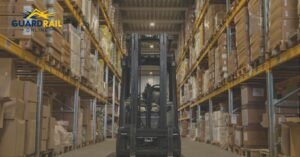
In reality, pedestrians are exposed for much longer periods. They walk parallel to forklifts along pick faces. They move through long aisles where equipment passes repeatedly. They share access routes that were never designed for mixed traffic. This continuous exposure is where most risk accumulates quietly.
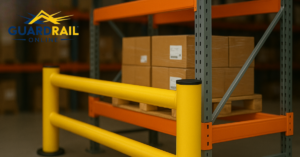
This is where warehouse pedestrian barriers become essential. They protect people not just at intersections, but along the entire length of shared movement zones where exposure is sustained.
Why Visual Controls Break Down as Traffic Increases?
Paint, mirrors, signs, and warning lights rely on attention. In busy warehouses, attention is inconsistent. Noise, fatigue, time pressure, and routine work all reduce how reliably visual cues are processed.
As traffic increases, visual systems scale poorly.
- Painted lines fade.
- Mirrors are overlooked.
- Warning lights blend into the environment.
When safety depends on constant awareness, even small lapses create an opportunity for contact.
This is why visual controls alone cannot carry pedestrian protection in high-traffic environments. They communicate intent, but they do not control movement. However, warehouse pedestrian barriers introduce physical limits where this visual guidance begins to fail.
How Warehouse Pedestrian Barriers Can Remove These Risks?
The real value of warehouse pedestrian barriers lies in what they eliminate, not what they add. They remove the need for constant judgment at moments where judgment is most likely to fail. Instead of asking people to estimate distance, timing, or intent, barriers create physical boundaries that cannot be crossed accidentally.
In high-traffic warehouses, this distinction becomes critical. As interactions multiply, even small lapses in attention can create exposure. Physical separation reduces that risk by design, not discipline.
Warehouse pedestrian barriers achieve this by:
- Guiding forklifts away from pedestrian routes before drift begins
- Keeping people out of swing paths, correction zones, and load overhang areas
- Preventing last-second decisions at tight aisles and intersections
- Creating clear, consistent separation that does not depend on visibility or attention
As traffic density increases, behavioral controls lose reliability. Physical control, on the other hand, gains importance in such situations. This is why warehouse pedestrian barriers move safety away from reactive management and toward structural prevention, where risk is reduced by layout, not luck.
But wait! Simply installing warehouse pedestrian safety systems is not going to mitigate risks. You need proper planning to ensure enhanced safety. This next section talks about just that!
Warehouse Pedestrian Barriers as the Foundation of Pedestrian Safety Systems
Warehouse pedestrian barriers are not meant to work in isolation. But they are the elements that everything else depends on. In high-traffic environments, effective warehouse pedestrian safety systems are built outward from physical separation, not layered on top of it.
A complete system should typically include:
- Thoughtful layout design that separates flows wherever possible
- Controlled crossings where interaction cannot be avoided
- Traffic flow planning that limits conflict points
- Clear operating rules that reinforce the layout
Warehouse pedestrian barriers are the one control that remains effective within this structure, even when attention drops, and traffic pressure increases. They do not rely on their attention, memory, or perfect behavior. They define the boundaries within which other controls can function effectively.
This is why barriers sit at the core of warehouse pedestrian safety systems. Visual guidance, procedures, and training work best inside a space that is already physically controlled. Without that foundation, safety systems weaken as traffic, pressure, and repetition increase.
Where Do Warehouse Pedestrian Barriers Deliver the Most Value in Busy Facilities?
High-traffic warehouses benefit most from pedestrian barriers in areas with sustained interaction, including:
- Pick faces and long aisles
- Dock approaches and staging lanes
- Packing and inspection zones
- Shared access routes
- Intersections with repeated forklift corrections
In these locations, warehouse pedestrian barriers reduce exposure time, not just impact severity. They continuously shape movement, which is exactly what busy environments require.
Conclusion
Safety cannot rely on attention, timing, or perfect behavior in high-traffic warehouses. Continuous exposure demands continuous protection. Warehouse pedestrian barriers provide that protection by creating physical separation that does not weaken as traffic increases.
When they form the foundation of warehouse pedestrian safety systems, risk is reduced through layout and structure, not reaction or reminders. This makes barrier quality, placement, and system design critical decisions, not afterthoughts.
So, are you looking for quality guardrails in the United States? If so, explore the range of products offered at Guardrail Online today!