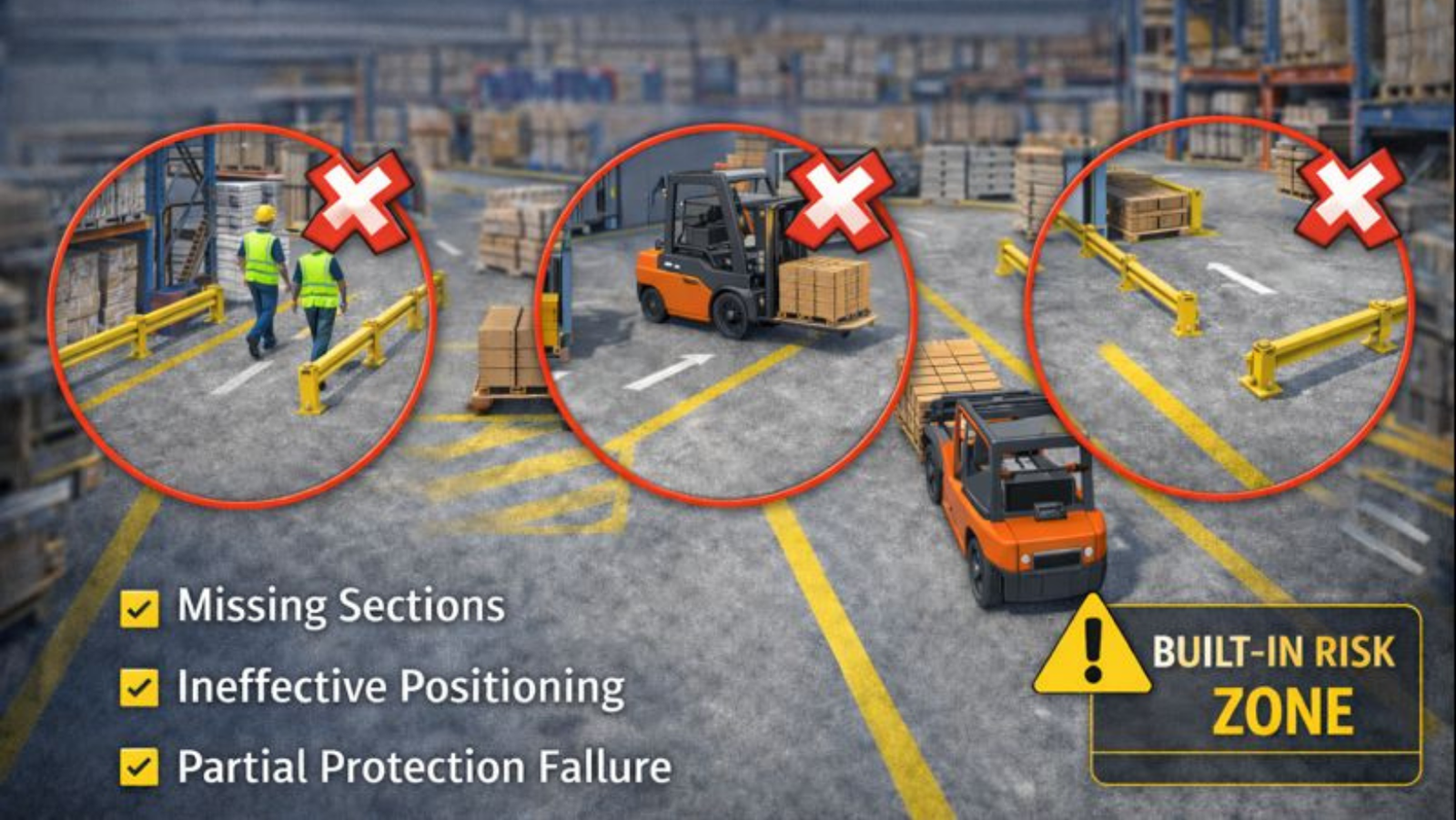
Industrial safety guard rails usually fail quietly. They stand in place. They look intact. Yet incidents keep happening. The mistake is assuming failure starts at the barrier. Most of the time, it starts much earlier, inside the layout itself.
In many facilities, routes are planned with efficiency in mind. Movement looks logical on paper. Crossings are placed where space seems available, and paths feel workable at first. Over time, however, small compromises settle in. Turning space narrows slightly. A convenient crossing becomes routine. When layouts evolve this way, risk does not appear suddenly. It becomes familiar.
Industrial safety guard rails are designed to protect people and assets when something goes wrong. They guide movement and absorb impact. However, they are not meant to compensate for layouts that repeatedly place people and equipment in competing paths. In such cases, even well-designed industrial guardrail systems are pushed into a reactive role instead of a preventive one.
That is why this article focuses on layout mistakes that quietly reduce protection, even when barriers are already installed.
Table of Contents
ToggleMistake #1: Designing for Perfect Behavior Instead of Human Error
Many layouts assume that people will always move as planned. Forklift operators will slow down. Pedestrians will stay inside marked paths. Turns will be taken cleanly. Loads will never overhang more than expected.
But real warehouses do not operate under perfect conditions. People rush. Visibility changes. Loads shift. Floors get crowded. But the truth is that failure tends to become inevitable when layouts only work if everyone behaves flawlessly.
So, the intended use of industrial safety guard rails should be to anticipate human error. They should be used to protect against the moment a forklift turns slightly too wide or a pedestrian steps out a second too early. If the layout does not acknowledge these realities, industrial guardrail systems no matter how good are forced into a reactive role instead of a preventive one.
Mistake #2: Placing Pedestrian Crossings Inside Forklift Decision Zones
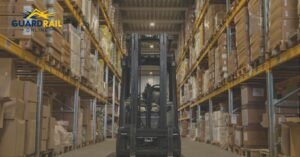
One of the most common layout errors is placing pedestrian crossings exactly where forklift operators are already making complex decisions. Tight turns, dock approaches, blind corners, and aisle entries demand full attention for speed control, load balance, and clearance. When pedestrian movement is added into these same spaces, risk increases immediately. Even with signage in place, the layout itself encourages conflict by forcing multiple decisions to happen at once.
The problem is not awareness. It is overlap. Forklifts are deciding how to move, while pedestrians are deciding when to cross. That split-second overlap is where near-misses begin. These zones should never ask operators to turn, slow, watch for pedestrians, and manage loads at the same time. Design must reduce decisions, not stack them.
This is where industrial guardrail systems begin to play a strategic role. Installing industrial safety guard rails through high-decision zones can help remove the option for pedestrians to cross at risky points. Next, the crossings can be redirected to areas where forklifts are already moving straight and predictably. This simple change in design can help reinforce safer movement and help prevent conflict before it begins.
Mistake #3: Allowing Staging Areas to Quietly Shrink Turning Space
Staging chaos is rarely intentional. It may often start with a pallet that was placed “temporarily” near an aisle. Then another follows. Over time, the space forklifts once relied on for safe turning disappears.
As turning radius shrinks, operators compensate by cutting corners or drifting closer to walls and racks. This is where industrial safety guard rails start taking repeated contact, not because of reckless driving, but because the layout no longer supports movement.
This is why industrial guardrail systems should be used to define staging limits early, not react after congestion becomes normal. Doing so helps protect both movement and structure.
Mistake #4: Treating All Aisles and Routes the Same
Another reason industrial safety barriers fail is uniform application. Many layouts use the same barrier type, spacing, and placement across every aisle, assuming consistency equals safety. But warehouses do not operate uniformly. Some routes carry constant forklift traffic. Others see occasional movement. Some zones involve speed, weight, and tight turns, while others carry minimal risk.
When barriers do not reflect these differences, the layout sends the wrong signals. High-risk forklift corridors look no different from low-risk access paths. Operators begin relying on habit instead of awareness because the environment does not tell them where risk actually increases. This is how layouts lose control, even when protection is technically present.
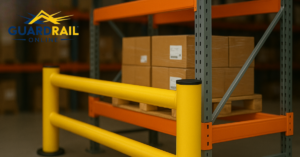
Industrial safety guard rails work best when they reinforce hierarchy. Double-height, continuous barriers belong along primary forklift routes where impact risk is highest. Single-height systems can define pedestrian-only paths without overbuilding. When each aisle uses barriers based on its role, not convenience, the layout starts guiding behavior instead of flattening it.
Mistake #5: Ignoring Doors, Exits, and Human Shortcuts
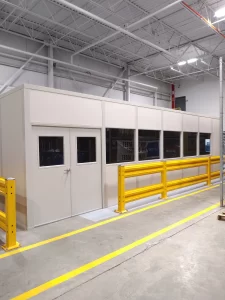
People do not move randomly inside a warehouse. They follow the fastest and easiest path available, especially when carrying items, stepping out for a break, or working under time pressure. The layout quietly forces unsafe decisions when doors open directly into forklift lanes, or when exits lead straight into active routes.
This is not a behavioral issue. It is a design issue. No amount of signage or training can override a layout that makes shortcuts unavoidable. In fact, when daily movement patterns cut across equipment paths, incidents are not a matter of if, but when.
Hence, industrial guardrail systems must account for these transitions. Barriers should block direct shortcuts while guiding people toward crossings where forklift movement is slower and more predictable. When layouts acknowledge how people actually move, barriers stop fighting behavior and start shaping it. That is when protection becomes reliable instead of reactive.
Conclusion
Industrial safety guard rails are most effective when they reinforce how movement should happen, not when they are used to intervene after layouts fail. Industrial guardrail systems can restore control instead of simply absorbing damage when planned alongside traffic flow, pedestrian behavior, and space constraints.
But you cannot just install any barriers in your warehouse. Your facility deserves the best! Hence, choosing Guardrail Online is the obvious choice. Explore our range of Industrial safety guard rails now and understand why we are among the top choices for durable, strong, and high-visible safety barriers in the United States.