Installing a barrier is often treated as the final step in warehouse safety. Once the posts are bolted down and the rails are in place, the space feels protected. But many failures do not happen because the barrier was weak. They happen because the installation quietly reduced its ability to perform.
A warehouse guard rail can be engineered for high impact and still fail prematurely if it is anchored, spaced, or positioned incorrectly. In real facilities, protection is not tested on spec sheets. It is tested by uneven slabs, repeated low-speed hits, moisture, and daily traffic patterns. This is where installation quality becomes the deciding factor between long-term protection and early failure.
Below are the most common installation mistakes that weaken even heavy-duty systems after they are put in place.
Table of Contents
ToggleMistake #1: Incorrect Anchor Installation
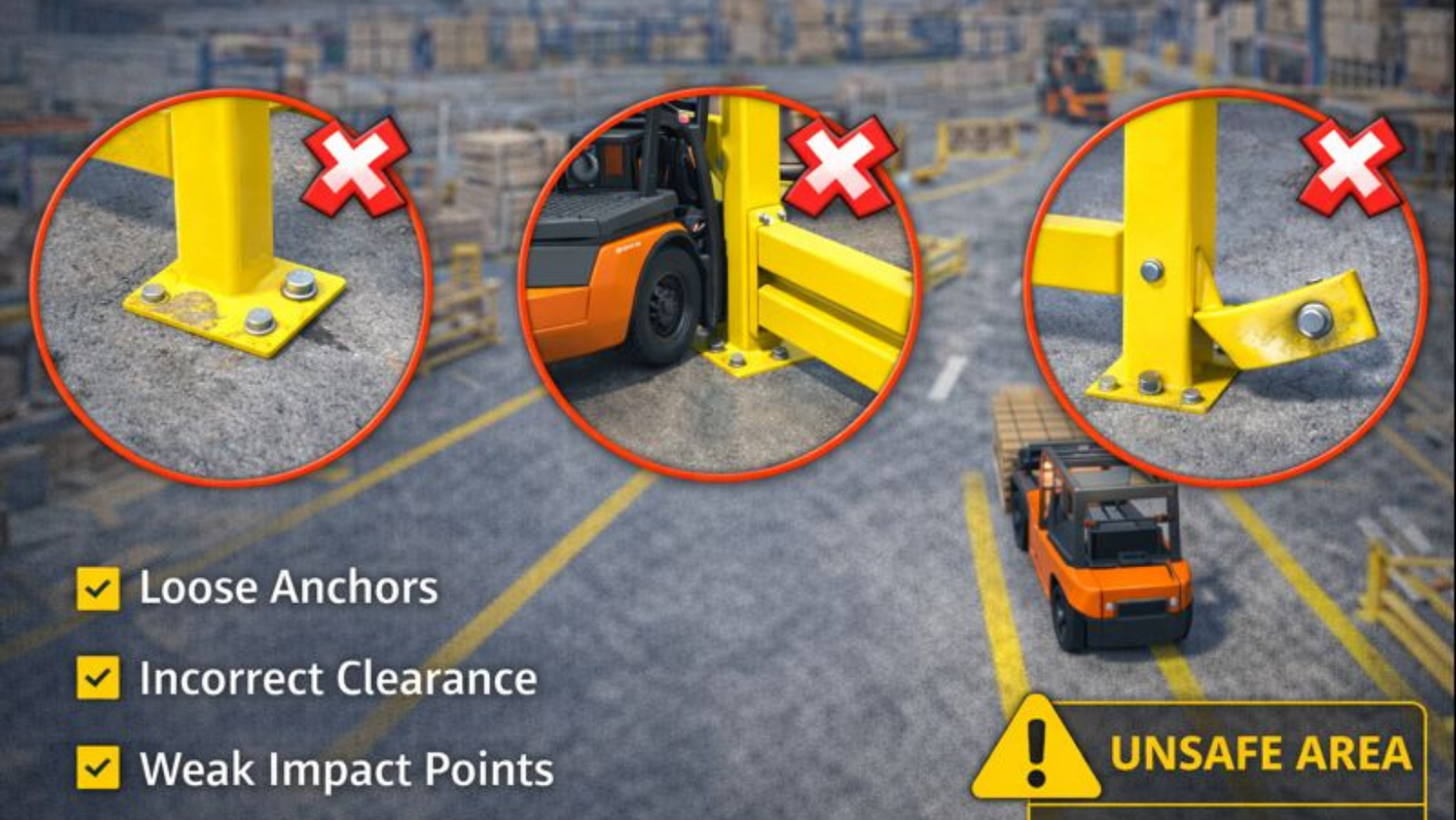
Anchors are the only connection between a warehouse guard rail and the floor beneath it. However, rushing, mismatching or tightening that connection incorrectly can introduce instability at the very base of the system
This often happens quietly. Anchors may be under-tightened, set at the wrong depth, or replaced with fasteners that were simply available on site. At first, the barrier would look secure and posts would appear straight.
Under impact, however, a poorly anchored heavy duty guard rail wouldn’t absorb or distribute force as intended. Instead, energy would concentrate at the anchors themselves. Over time, this concentration of force would begin to show. Posts might loosen slightly after repeated contact. Base plates could start shifting. What first looked like normal wear would actually be early signs of anchoring failure. This is why anchor installation cannot be treated as a routine task.
Mistake #2: Base Plates Not Fully Seated or Slab Conditions Ignored
Base plates are designed to sit flat and make full contact with the concrete beneath them. However, this assumption often breaks down during installation. Concrete floors may look level, but variations in slab thickness, surface wear, expansion joints, or uneven finishes can prevent a base plate from seating properly from the start.
When these slab conditions are not assessed, installers may unknowingly anchor plates over slight gaps, ridges, or weakened concrete. The plate gets bolted down, but it is not fully supported. At rest, the warehouse guard rail would appear secure. However, that hidden gap becomes a problem under impact.
Instead of transferring force evenly into the floor, the load would concentrate on the few anchor points that are actually bearing weight. Over time, this leads to cracked concrete, bent plates, or anchors pulling loose. The risk is even higher in older facilities, especially when slabs were never designed for repeated high-energy impacts.
Mistake #3: Poor Post Spacing and Exposed End-of-Run Sections
Post spacing for a warehouse guard rail is often treated as a measurement exercise. In reality, it is a performance decision. The distance between posts determines how impact energy moves through a heavy duty guard rail once contact occurs.
For instance, when posts are spaced too far apart, rails are forced to flex more than they were designed to. On the other hand, that force no longer spreads evenly when spacing becomes inconsistent. Instead, it begins concentrating at a few stressed points along the run. End-of-run sections suffer the most in these situations. Without lateral support, they absorb direct hits with nowhere for energy to go.
The warning signs here tend to appear gradually. Rails start bending unevenly. End posts take repeated contact. What looks like isolated damage is actually a pattern forming. At that stage, the warehouse guard rail is no longer guiding movement. It is responding to it. When a system reaches that point, failure is not sudden. Instead, it has already been building for some time.
Mistake #4: Mixing Incompatible Components
Barrier systems are engineered to work as complete units. Each post, rail, and mounting detail is designed to manage impact together. However, that coordination breaks down when components from different systems are mixed.
Using posts from one system with rails from another, or combining different mounting styles in the same run, changes how force moves through the barrier. In such situations, impact energy no longer travels as intended. Instead, it concentrates at the weakest connection. That stress builds with every contact, even when individual impacts seem minor.
Remember, heavy duty guard rail performance depends on compatibility. Energy transfer stays controlled when components are selected as part of a unified system and installed accordingly. But, protection is bound to weaken long before visible failure appears when they are not.
Mistake #5: Installing Barriers Too Close to the Asset
Placing a barrier directly against what it is meant to protect feels just right. However, in practice, it often reduces protection.
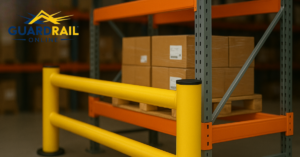
A warehouse guard rail needs space to deflect and absorb energy. So, installing them too close to racking, machinery, or walls does more damage than offering protection. During such situations, heavy duty guard rail end up transferring impact force directly into the asset instead of dissipating it. This results in damaged equipment even when the barrier itself appears intact.
So, a properly installed warehouse guard rail must always have a buffer zone. That space would allow controlled movement during impact and would protect both the barrier and the asset behind it.
Conclusion
Warehouse guard rail systems are engineered to absorb impact, guide movement, and protect assets over time. But even strong barriers can begin behaving like weak ones when installation shortcuts are taken. Correct anchoring, proper spacing, compatible components, and attention to floor conditions are not optional details. They directly determine how a barrier responds under stress. The system performs as designed when installation is done with intent and accuracy. However, the protection quietly when it is rushed or improvised. So, always pay close attention during installations. But do not forget to get your hands of heavy duty guard rail either.
Guardrail Online offers the strongest, robust, and high-visibility safety barriers. Explore our range of products to strengthen the safety within your warehouse.