Cold storage and food-grade facilities operate under conditions that are far more demanding than a typical warehouse. Temperatures fluctuate. Floors condensate. Workers move between chilled zones and processing lanes. That’s not all! Forklifts are continuously carrying heavy, often unstable loads that must arrive on time to prevent spoilage.
What makes these environments challenging is not only the constant activity, but also how much risk is concentrated within a confined area. One slip, one fast turn, or one blind intersection can disrupt workflows and compromise product integrity. That is why safety design in cold storage must go beyond standard warehouse planning.
These operations cannot rely on generic solutions. They require protection designed for moisture, low temperatures, limited visibility, and nonstop machinery movement. This is exactly where purpose-built forklift barriers come in.
Forklift safety barriers are not optional add-ons. They are engineered safety systems that absorb force, maintain physical separation, and protect sensitive refrigerated infrastructure. When chosen correctly, they help stabilize workflows and preserve the quality of temperature-controlled inventory. But if you are still unsure whether cold storage or food-grade operations truly need specialized protection, here are the factors that make purpose-built guard rail systems essential.
Table of Contents
ToggleDid You Know Cold Storage Conditions Amplify Everyday Risks?
Did you know that forklifts behave very differently on chilled surfaces? Surprising, right? But it makes perfect sense once you look closer at what really happens inside cold storage. Condensation and frost reduce traction. Floors turn slick without warning. Shrink-wrapped loads become unstable the moment moisture settles on them. All these factors increase the chance of skids, misjudged turns, and low-speed collisions.
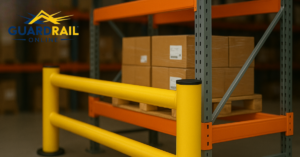
But wait, here’s the tricky part! Even a light graze from your forklift can damage insulated panels, refrigeration lines, or temperature-sensitive inventory. Small mistakes don’t stay small in low-temperature zones. That is exactly why a forklift barrier becomes more than just a physical divider. These forklift safety barriers in fact become a critical buffer that protects the heart of your operation.
That’s not all! Cold environments can also take a toll on workers. Heavy uniforms limit their movement. Goggles fog up during long shifts. In fact, people walk slower, but forklifts on the other hand still need to move fast enough to maintain throughput. It’s this mismatch that creates a predictable risk pattern, one that must be addressed proactively. Safety planning in cold storage must anticipate these conditions long before they turn into operational problems.
Why Physical Separation Matters More in Food-Grade Facilities?
Food-grade environments work under strict rules, and for good reason. Every zone from equipment areas, walkways, processing lanes, and storage aisles must stay clean, controlled, and clearly separated. Even a forklift drifting slightly off its path can create problems you never planned for. It can strike insulated walls, damage floor drains, or enter spaces that must remain contamination-free.
That is exactly why many managers choose high-durability forklift safety barriers early in the design phase. These systems don’t just stop collisions. Heavy-duty forklift barriers brings structure to movement inside the building. They help operators follow predictable routes, especially in chilled aisles where visibility drops and turning space is limited.
The integrity of food-grade spaces stays intact when forklift barriers guide traffic the right way. They also help meet compliance in your space. Doesn’t that make need for physical separation a must in food-grade facilities?
Critical Equipment Needs Stronger Protection in Cold Environments
If you think about what keeps a cold storage facility running, it becomes clear why protection cannot be an afterthought. Cooling units, insulated wall panels, evaporators, and glycol lines work nonstop to maintain stable temperatures. These systems are not just expensive, they are in fact the backbone of the operation. That’s why even a minor forklift bump can create far more damage than expected.
One small impact can knock a panel out of alignment, puncture piping, or disrupt airflow. The result? Temperature loss, product spoilage, or hours of downtime to restore stability. This is where a purpose-built forklift barrier becomes essential. It acts as a physical shield around high-value infrastructure, keeping accidental contact from turning into a costly incident.
The need for that protection becomes even more obvious in the busiest parts of the building. Dock zones, for example, are packed with constant movement, quick loading cycles, and tight corners. Inventory is often stacked close to walls or routed through narrow gaps between conveyors. Without the right physical controls, these areas become vulnerable to repeated contact.
Strategically placed forklift barriers help maintain safe clearance, reduce impact damage, and keep traffic organized. More importantly, forklift safety barriers support smoother daily operations by ensuring that critical equipment remains protected, no matter how busy the floor gets.
Small Impacts Can Trigger Big Losses in Cold Storage Facilities
What often gets overlooked in cold storage is how quickly small incidents can disrupt the entire operation. The risk isn’t always tied to major collisions. Sometimes, it’s the subtle, day-to-day bumps that create the biggest setbacks.
A slight nudge to a stacked pallet can shift weight just enough to break packaging or compromise load stability. A gentle tap against racking can loosen fasteners that were already stressed from low temperatures. Even a minor misalignment at a dock edge can slow down loading cycles and cause bottlenecks during peak hours.
These issues rarely appear dramatic in the moment. Yet, in a temperature-sensitive environment, anything that slows movement or interrupts handling can affect throughput, timelines, and product quality. This is why purpose-built forklift safety barriers play such an important role. They prevent these small disruptions from snowballing into operational delays that are difficult to recover from.
A forklift barrier also gives teams the consistency they need. Operators navigate with more clarity, workers anticipate traffic patterns better, and cold storage workflows remain steady even during high-demand windows.
But, Don’t Opt For A Standard Forklift Barrier!
A lot of facilities assume that any forklift barrier can perform well inside a cold storage or food-grade environment. In reality, these spaces challenge forklift safety barriers in ways a normal warehouse never will. Steel reacts differently at low temperatures. Surfaces contract. Moisture freezes around anchor points. Impacts feel harsher when forklifts lose traction on chilled floors. Even the most routine bumps can stress materials faster than expected. That is why relying on standard forklift barrier often leaves critical areas under protected.
This is exactly where Guardrail Online stands apart. Our solutions are not standard packages pulled from a shelf. We design and supply high-quality, robust, and durable forklift safety barriers that are engineered specifically for demanding, temperature-sensitive environments. Our forklift barriers feature reinforced steel, industry-grade powder coatings, and hardware built to withstand moisture, cold cycles, washdowns, and repeated forklift contact.
Explore our range of products today!