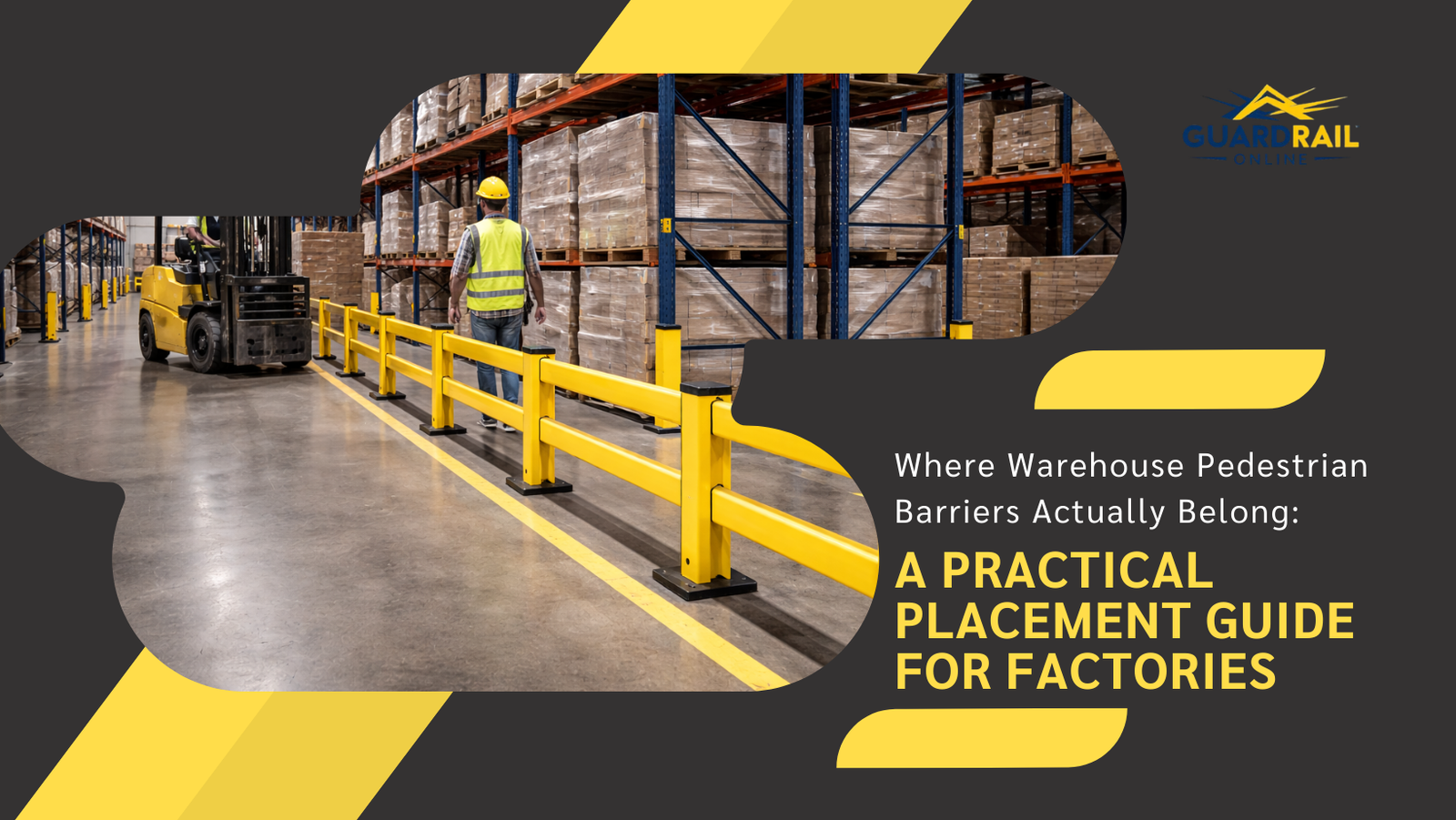
Pedestrian safety inside warehouses is rarely ignored on purpose. It is often assumed to be “managed” through paint, signage, or rules. But real movement does not follow diagrams.
People take shortcuts. Forklifts drift. Doors open unexpectedly. Over time, these small interactions create exposure that layouts were never designed to handle. This is exactly where warehouse pedestrian barriers matter. Not everywhere. Not randomly. Only where pedestrian movement repeatedly overlaps with equipment risk.
This guide breaks down where industrial pedestrian safety barriers actually belong and why correct placement makes the difference between assumed safety and real protection.
Table of Contents
ToggleZone 1: Pedestrian walkways that run parallel to forklift travel
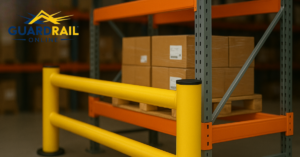
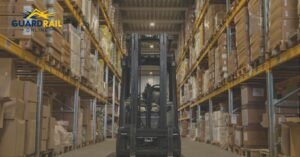
Take a moment and observe your floor. Do pedestrians walk along the same aisle where forklifts travel? If they do, physical separation is no longer optional. Paint may already exist to guide movement, but paint cannot correct a drift, absorb a skid, or stop a turn taken too wide. That is why warehouse pedestrian barriers are essential along these paths.
They should be placed:
- Along long, straight forklift aisles with frequent travel
- Beside pick faces where workers stop, turn, and step back
- Near racking lines where pedestrians naturally “hug the edge” to let equipment pass
Why it matters: These are not “crossing” events. They are sustained exposure zones. The risk is not one dramatic impact, but repeated low-clearance contact that eventually leads to injury. Physical separation via Industrial pedestrian safety barriers remove that exposure entirely, instead of asking people to manage it moment after moment.
Zone 2: Intersections and blind corners
Intersections and blind corners are where warehouse layouts place the highest mental load on people. Forklift operators are already managing turning radius, load swing, and clearance. At the same time, pedestrians are deciding when to cross and how fast to move. When both groups are forced to make decisions in the same space, risk escalates quickly.
These zones demand too many judgments at once. Moreover, layouts that allow pedestrian movement directly through turning paths leave no margin for error. This is exactly where warehouse pedestrian barriers become critical. They are not meant to react after a near-miss. They are meant to prevent one from forming in the first place.
Industrial pedestrian safety barriers should be placed:
- Before the corner begins, not at the corner itself
- In a way that prevents pedestrians from cutting the corner line
- To funnel pedestrians toward a controlled crossing point
You can perform a simple test to reveal layout weakness: If a pedestrian can appear suddenly at a corner without warning, the layout is still relying on luck instead of design. Properly placed pedestrian barriers can remove that uncertainty and turn blind corners into controlled, visible transitions.
Zone 3: Doorways That Open Directly Into Active Travel Lanes
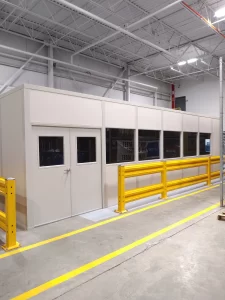
Doorways that open into forklift lanes create one of the most underestimated risks inside a warehouse. A door swings open. Imagine a pedestrian exiting a doorway at the exact moment a forklift has already committed to its route. Without a transition zone or visual buffer, both movements meet unexpectedly, creating a situation where reaction time is severely limited.
This is exactly why these zones deserve more attention than they usually receive. The danger here is not speed. It is surprise. Forklift operators cannot react to what they cannot see. On the other hand, pedestrians exiting a doorway are often focused on their next task, not on scanning for equipment. When layouts allow doors to open straight into traffic, they quietly normalize blind entry into active lanes.
Warehouse pedestrian barriers help correct this design flaw by reshaping how movement begins at these transition points.
So, place warehouse pedestrian barriers:
- To create a short protected buffer outside the doorway
- To force a slight “pause point” before entering the lane
- To guide pedestrians toward visibility, not convenience
Separating pedestrian-only doors from equipment routes is among the safest option. But when such shared openings cannot be avoided, barriers are no longer optional. Here, barriers actually become the element that turns an unpredictable exit into a controlled, visible transition.
Zone 4: Crossings That Cannot Be Eliminated
Some pedestrian crossings are unavoidable in warehouses. So, the goal is not to eliminate them completely, but to make sure they are placed and designed with intention.
A safer crossing usually has a few consistent qualities:
- Forklifts approach the crossing along a straight, predictable path
- Pedestrians are guided toward one clearly defined crossing point
- Visibility remains clear, without pallet stacks or racking shadows blocking sightlines
Warehouse pedestrian barriers play a key role in achieving this. They help guide pedestrians to cross only where forklift movement is simplest and most controlled. This reduces last-second decisions and removes the need to rely on signage alone. Interaction becomes more predictable for everyone involved when crossings are physically guided instead of loosely suggested.
Zone 5: Fixed Hazards That Pedestrians Pass Daily
Not every pedestrian risk involves moving equipment. Electrical panels, charging areas, machine perimeters, and pinch-point corridors are all spaces pedestrians pass repeatedly during a shift. Industrial pedestrian safety barriers are especially important in these zones. Hence, you must place barriers:
- Between walking paths and fixed hazards
- Around areas where people stop to scan, check, or wait
- Near equipment that creates noise, vibration, or visual distraction
These are the locations where “small contact” can quickly turn into serious consequences. Warehouse pedestrian barriers add a consistent layer of protection when attention naturally drops during routine movement.
Conclusion
So, are you planning to install warehouse pedestrian barriers in these zones? Then strength, visibility, and engineering cannot be an afterthought. You cannot rely on just any barrier to protect people who move through risk every day.
This is where Guardrail Online stands apart. Our industrial pedestrian safety barriers are engineered for real warehouse impact. They are tested for high-force contact, built with high-visibility finishes, and designed to maintain performance after repeated interaction. Trusted by facilities across the United States, our systems are built to protect movement, not just mark space. Explore our range of barriers today!