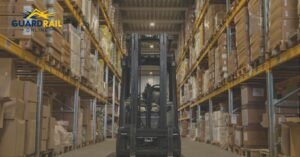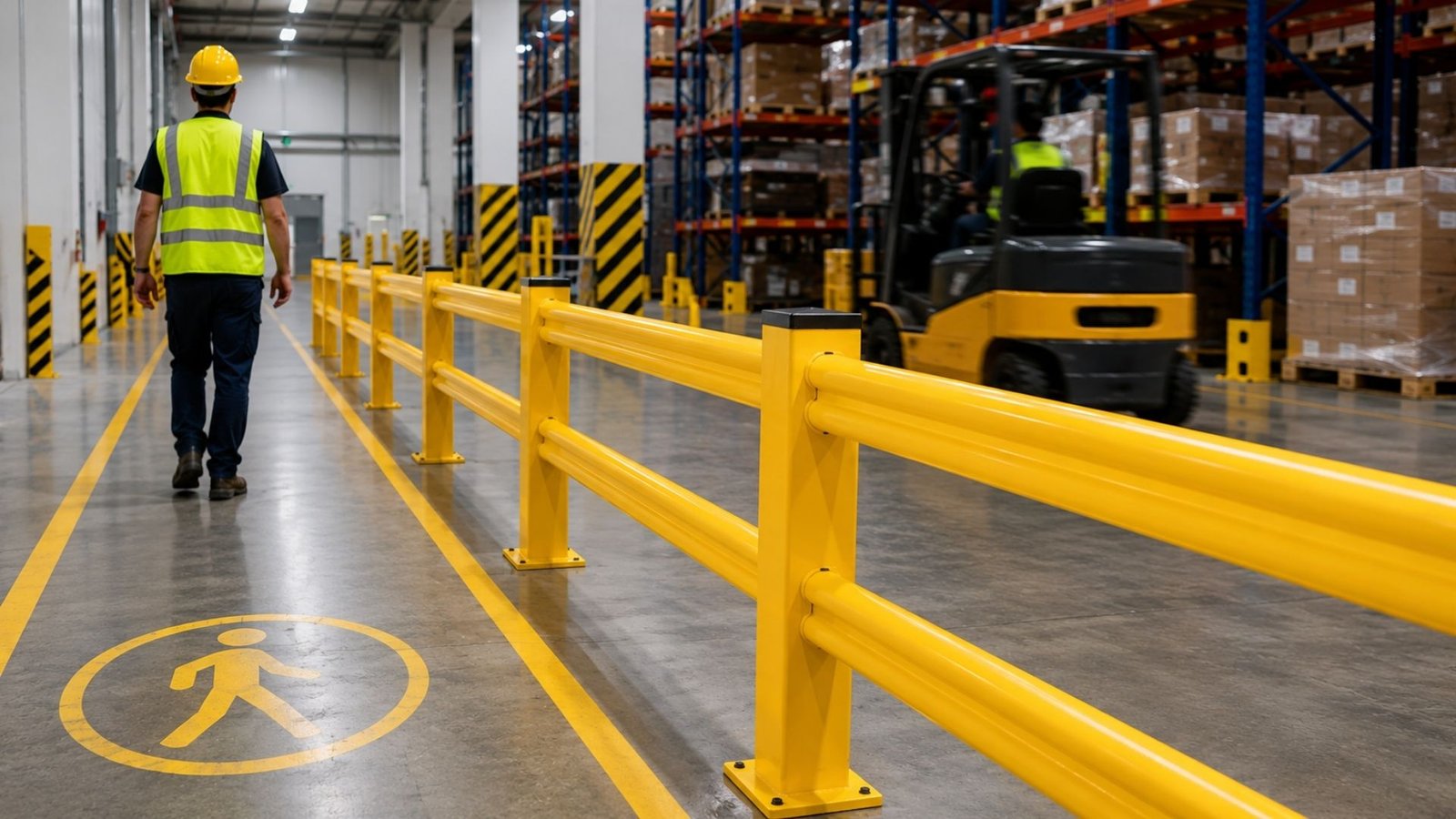
People and forklifts share the same warehouse every single day. In fact both people and operators are expected to move quickly and efficiently throughout the day when the facilities become busier. As movement increases across the warehouse floor, the chances of people and equipment operating in close proximity naturally increase as well.
The challenge now is not simply the volume of traffic. It is ensuring both can move safely without their paths unnecessarily overlapping. But that could be a problem because workers may choose the shortest path to reach another operational area without any clearly defined pedestrian routes. On the other hand, forklifts might continue following established travel lanes.
Over time, these everyday movement patterns can create avoidable risks that many facilities fail to recognize until an incident occurs. But warehouse pedestrian barriers can be a game changer when this happens.
Table of Contents
ToggleIndustrial Pedestrian Barriers Define Where People Should Walk
Employees rarely remain in one location throughout an entire shift. They move between production areas, storage zones, offices, and loading docks as operational demands change. Forklifts, on the other hand, continue moving through the same facility, often carrying heavy loads across busy travel routes. The challenge is ensuring both can operate safely without constantly relying on awareness or judgement alone.
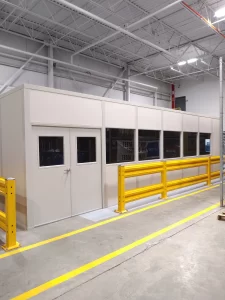
Facilities that rely only on painted lines often find those boundaries are respected under normal conditions but ignored when the pace picks up. A steel barrier holds its position regardless of shift activity. This is exactly why warehouse pedestrian barriers deliver the greatest value.
This difference becomes even more important as warehouse traffic continues to increase. They create a permanent physical boundary between people and equipment, making safe travel routes easier to recognize and follow.
Pedestrian protection barriers are particularly effective around:
- Main pedestrian walkways alongside forklift aisles
- Production areas with frequent employee movement
- Loading dock approaches
- Storage rack corridors
- Machinery and equipment zones
One of the biggest advantages of pedestrian safety barriers is consistency. Once installed, they continue defining pedestrian routes regardless of traffic levels or operational demands. Employees know where they should walk, while operators gain greater confidence knowing pedestrian routes remain clearly separated from equipment movement.
But Do All Warehouse Pedestrian Barriers Deliver the Same Level of Protection?
At first glance, many pedestrian safety barriers appear similar. They all create physical separation between people and equipment. However, the long-term performance of a barrier depends on far more than its appearance.
Material quality, engineering, component compatibility, and installation all influence how well the system performs in demanding warehouse environments. Choosing the right barrier is not simply about adding protection. It is about investing in a solution designed to support safer movement for years to come.
We Believe Physical Separation Should Guide Everyday Movement
Not all pedestrian protection barriers are engineered to the same standard. While many systems create physical separation, the quality of that protection depends on the materials, construction, and engineering behind every component. That is exactly why we design our pedestrian safety barriers as heavy-duty industrial systems built for demanding warehouse environments.
At Guardrail Online, we believe warehouse pedestrian barriers should do more than stand between people and forklifts. They should become part of the way people move throughout the facility. Once installed, they should create routes that feel natural to follow while establishing clear and consistent physical separation across everyday warehouse operations.
That philosophy shapes every warehouse pedestrian barrier we develop at Guardrail Online. It influences the engineering decisions behind every system we manufacture, including features such as:
Adaptable Protection for Every Pedestrian Route
We offer guard rail sections from 2 feet to 10 feet in one-foot increments. Availability of these specs allows facilities to create pedestrian routes that match the way employees actually move throughout the warehouse instead of forcing layouts around fixed barrier lengths.
Dual-Layer Protection for Long-Term Performance
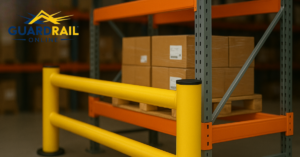
Every 12.2-inch-high rail is manufactured from 11-gauge pre-galvanized steel. It is then finished with a durable RAL 1023 Safety Yellow powder coating. This dual-layer protection supports long-term corrosion resistance while maintaining high visibility across busy warehouse environments.
Engineered Connections That Strengthen the Entire Barrier Run
Every rail is welded to connection plates with pre-punched slotted holes. Each connection is secured using four M12 × 160 mm Grade 8.8 bolts, creating a standardized system that delivers dependable performance across the entire pedestrian barrier installation.
Heavy-Duty Construction Built for Industrial Environments
Our 19-inch posts are manufactured from 4.72-inch × 4.72-inch × 3/16-inch steel and welded to 10-inch × 10-inch × 5/8-inch base plates. Each post is anchored using four 5/8-inch × 5-inch wedge anchors. When properly installed, the complete system is engineered to withstand a 10,000-pound impact at 4 mph.
Every engineering detail at Guardrail Online serves a practical purpose. Together, these features help create pedestrian routes that remain clear, consistent, and dependable throughout years of everyday warehouse activity.
Warehouse Pedestrian Barriers Work Best When Planned Around Everyday Movement
The conversation around pedestrian protection barriers often focuses on the barrier itself. Discussions usually revolve around material strength, visibility, or installation. While all these factors matter, they are only one part of the overall solution.
The real question is whether the pedestrian protection barriers support the way people actually move throughout the facility. Employees naturally follow the routes that feel most convenient during a busy shift. If protected walkways do not reflect those everyday movement patterns, informal shortcuts can gradually become part of normal operations.
This is exactly why the placement of warehouse pedestrian barriers deserves just as much attention as their engineering. The core objective should be to create protected routes that feel natural to follow while maintaining clear and consistent physical separation from forklift traffic. Achieving that level of organization begins with understanding factors such as:
- Existing pedestrian movement patterns across the facility
- Daily forklift travel routes and traffic volume
- Shared operational areas where people and equipment interact
- Future layout changes that may affect pedestrian movement
- High-traffic zones requiring stronger physical separation
That is why our team works closely with businesses to develop barrier layouts around their operational requirements instead of relying on standard configurations alone. Every recommendation is guided by the way the facility actually operates, helping businesses create warehouse pedestrian barrier systems that continue delivering value as operations evolve.
The right barrier can strengthen pedestrian safety. The right layout allows that barrier to perform exactly as intended. Consult the experts at Guardrail Online to develop a warehouse pedestrian barrier system designed around your facility, your traffic patterns, and your long-term operational requirements.