Choosing between a bolt-on system and a lift-out adapter for guard rail posts is rarely a simple decision. One promises permanence and certainty. The other offers flexibility without fully sacrificing protection.
For many warehouse managers, the dilemma sits right at the intersection of safety, access, and cost. This article is written to resolve that tension. It explains how each system truly behaves in daily operations and where its differences matter most. Moreover, we talk about how to choose the right industrial safety guard rail solution based on how your facility actually works.
Table of Contents
ToggleHow Bolt-On Guard Rail Systems Work and Why They Remain the Standard
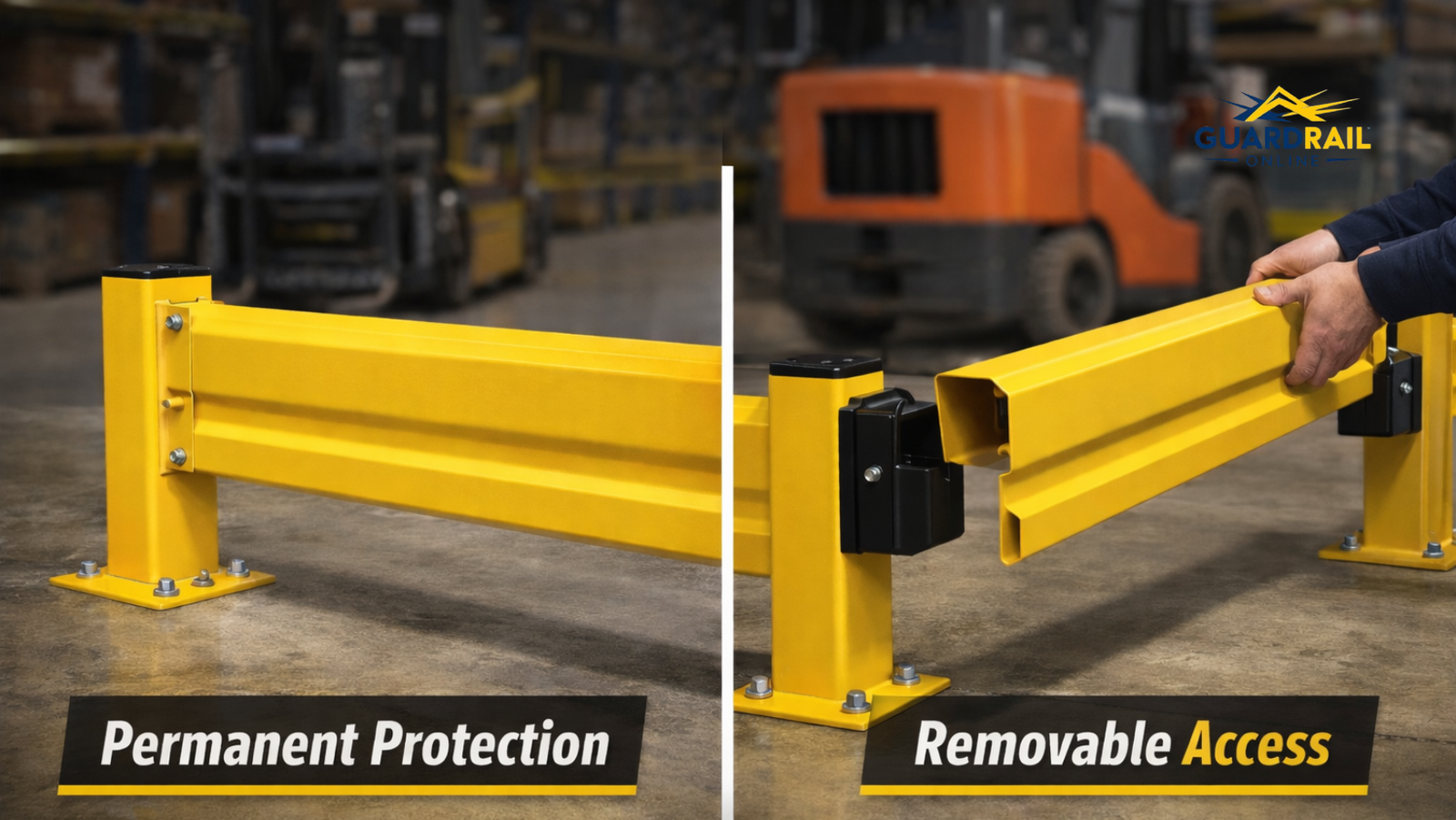
Bolt-on guard rail systems are designed with one clear intention: permanence. Once installed, the rails are physically secured to posts using fixed hardware. This design creates a safety barrier that is meant to stay exactly where it is, day after day, without adjustment or compromise. These systems are not built for convenience or frequent change. They are built to hold their line.
That fixed nature is precisely why bolt-on systems continue to be the standard choice in many warehouses. They perform best in environments where
- Forklift traffic is constant
- Impacts are an everyday concern
- Protection can never be optional
- Consistency matters more than flexibility.
Bolt-on guard rail systems offer operators the confidence to move without fear because the barrier is always in the same place. Safety teams trust the protection because it cannot be removed casually. Maintenance teams know that any modification requires intent, tools, and planning. Over time, that reliability becomes part of how the space functions.
This is why bolt-on guard rail systems remain the backbone of industrial safety guard rail layouts where access patterns are stable, and protection must remain uninterrupted.
What Lift-Out Adapter For Guard Rail Posts Do Differently?
Lift-out adapter for guard rail posts are built around a different operational reality. They do not assume that protection must remain fixed at all times. Instead, they acknowledge that some zones can and may require controlled access without permanently breaking the safety line. This is where the lift-out adapter for guard rail posts comes into play.
These guardrail systems are designed to offer access by allowing the removal of a part without tools. Once the task is complete, the rail is returned to its original position, restoring the barrier exactly as it was before. The goal of these industrial safety guard rails is continuity without rigidity.
This approach works best in areas where protection is needed most of the time, but not all of the time. Hence, installing lift-out adapter for guard rail posts can be beneficial in:
- Loading points
- Maintenance access zones
- Pallet runs that must occasionally open fully
These systems empower facilities to maintain a strong industrial safety guard rail layout while still accommodating real operational needs.
What makes these systems effective is control.
- The removal is deliberate.
- The opening is temporary.
- When properly specified, the rail returns to the same alignment and load path every time.
That balance between accessibility and discipline is what sets lift-out systems apart.
When used correctly, lift-out systems do not weaken protection. They localize flexibility to the few points where it is genuinely required. The best part is that all this is done while keeping the rest of the guardrail system continuous, predictable, and intact.
The Practical Differences Between Bolt-On and Lift-Out in Everyday Use
The real difference between a bolt-on and a lift-out adapter for guard rail posts rarely shows up on a specification sheet. It shows up after installation, when forklifts start moving, access requests begin piling up, and teams interact with the barrier as part of daily work. This is where design intent meets operational reality, and where the right choice becomes clear.
-
Permanence vs. Adaptability
Bolt-on industrial safety guard rails are designed to be immovable. Once installed, the protection is fixed by intent, not habit. That makes them ideal for zones where access should never change and where protection must remain uninterrupted.
Lift-out systems approach the problem differently. They introduce controlled adaptability by using a lift-out adapter for guard rail posts. The safety barrier remains present and effective, but it can be temporarily removed when a task genuinely requires open access. The difference is flexibility applied with intention.
-
Installation and Labor Impact
Bolt-on systems demand time and precision at every connection point. Each rail section is mechanically secured, and any future change requires tools, labor, and downtime.
Lift-out systems still require accurate installation upfront. However, rail sections can be removed and replaced without repeating that work once the adapters are set. Over time, this reduces disruption in areas where access changes are part of normal operations.
-
Operational Discipline in Daily Use
Bolt-on systems enforce discipline structurally. A rail cannot be moved without effort, which removes temptation and error from the equation.
Lift-out adapter for guard rail posts depends on procedural discipline instead. The design assumes that teams will remove rails deliberately and restore them immediately after use. This is not a weakness, but it does require clear ownership, training, and accountability from day one.
-
Cost vs. Long-Term Value
A bolt-on industrial safety guard rail usually has a lower upfront cost. Their simpler construction and standard hardware make them economical. Once installed, they deliver stable, long-term protection with minimal ongoing intervention.
A lift-out adapter for guard rail posts adds upfront cost due to additional fabrication and locking features. This is reflected in the guard rail lift-out adapter price. That added cost often pays off where access is needed regularly. The ability to remove rails without repeated disassembly reduces downtime, labor, and layout compromises over time.
Conclusion
There is no universal answer when choosing between bolt-on systems and a lift-out adapter for guard rail posts. The right choice actually depends on how often access must change, how critical uninterrupted protection is, and how you evaluate long-term value against upfront cost.
Bolt-on systems excel where permanence is non-negotiable. Lift-out systems, on the other hand, earn their place where controlled flexibility justifies the guard rail lift-out adapter price. So, do you know which industrial safety guard rail is the right choice for you? Guardrail Online supplies high-quality bolt-on and lift-out guardrail systems to facilities across the United States. Explore our range of products and order online today!
FAQs
What are the three main parts of guardrails?
A guardrail system typically consists of the rail beam, vertical posts, and anchoring hardware. Together, these components manage impact force and transfer it safely into the floor or structure.
What is the maximum gap between guard rails?
The maximum gap between guardrails depends on the application and standards being followed. Gaps are minimized in most industrial and pedestrian systems to prevent pass-through and maintain continuous protection.
What are the four general types of guardrails?
Pedestrian and vehicle guardrails are the most common and popular safety systems. Along with these, fall-protection guardrails and equipment or structure-protection guardrails are the next two general types of safety barriers.