Installing a warehouse guard rail often feels like the finish line. The posts are in place. The rails look straight. The site looks protected. But the truth is that installation alone does not guarantee performance.
What actually matters is how that guard rail behaves once forklifts, traffic, and repetition enter the picture. Small installation details that seem insignificant on day one can quietly determine whether the system controls force or starts accumulating it in the wrong places. Slight anchor issues, imperfect base plate seating, or subtle alignment errors rarely stand out early, but they shape how the barrier performs over time.
This is exactly why post-installation QA exists and it is what this article focuses on. The sections ahead break down how to verify, test, and document a warehouse guard rail on site, so protection is confirmed by behavior, not assumed by appearance.
Table of Contents
ToggleWhy QA Matters for a Warehouse Guard Rail?
Post-installation QA matters because a warehouse guard rail can look finished long before it is truly reliable.
Once a guardrail is installed, most teams shift their attention elsewhere. The assumption is simple. If the materials are correct and the barrier is standing, protection must already be in place. In reality, this is where many failures quietly begin.
But the truth is that a warehouse guard rail does not fail because steel is weak. It fails because small installation variables change how force travels through the system. Those variables are easy to miss during installation, and almost invisible once daily operations resume.
Post-installation QA is crucial to catch those issues before traffic, repetition, and time turn them into failures. It typically reveals problems such as:
- Anchors that are incompatible with the slab or installed at incorrect depth
- Posts that appear straight but are already carrying uneven stress
- Base plates that do not seat fully, altering load transfer
- Alignment that looks acceptable but encourages movement under repeated contact
QA is not about confirming that installation is complete. It is about confirming that the warehouse guard rail will behave predictably when forklifts begin interacting with it every day.
Finding and correcting these issues early prevents downtime, secondary damage, and reactive repairs later. More importantly, it ensures the barrier controls risk instead of reacting to it.
The Three Outcomes Warehouse Guard Rail Qa Must Prove Before Sign-Off
Post-installation QA is not about checking boxes. It has one purpose: to confirm that the warehouse guard rail will behave the way it was engineered to behave once real contact begins.
Every QA review should resolve three non-negotiable questions. If even one remains uncertain, the system is not ready to be signed off.
1. Is the system installed as designed?
This confirms that post spacing, rail height, base plates, anchors, and hardware match the engineered specification. Even small deviations can change how force travels through the barrier.
2. Will the rail transfer load into the slab correctly?
A guardrail only performs when impact energy moves cleanly from rail to post to base plate and into the concrete. Warehouse guard rail QA must confirm full base plate seating, correct anchor type, embedment depth, and edge distance.
3. Does the assembly behave predictably under contact?
The safety system should return to position after controlled loading. No rocking. No shifting. No residual movement that compounds with repetition.
If the answer to any of these is no, the warehouse guard rail is not yet protecting the facility. Hence, it should not be approved until it does.
Here’s A Practical Post-Installation QA Sequence That Actually Works
Once the purpose of QA is clear and the three outcomes are defined, the next step is execution. The key is not doing everything, but doing things in the right order.
Step 1: Start With a System-Level Visual Review
Before tools, torque wrenches, or test plans come into play, take a step back and assess the system as a whole. This first pass helps identify issues that no measurement will explain later.
During this walk-through, confirm:
- Rails run straight and remain continuous along the full length
- Post spacing looks consistent without visual drift or compression
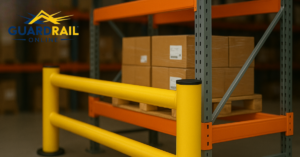
- Base plates sit flat against the slab with no visible gaps
- Anchor types and quantities appear consistent across the run
- No visible dents, twists, or pre-existing deformation are present
If anything looks off at this stage, it is already a signal. Flag it and move into targeted checks before traffic begins.
Step 2: Verify Anchors and Base Plates Before Anything Else
Anchors and base plates control how force leaves the warehouse guard rail and enters the slab. If they are wrong, nothing above them will perform as intended.
A proper anchor check should confirm:
- Anchor type and embedment depth match the approved specification
- Torque values are verified using a calibrated wrench where required
- Concrete around the base plate shows no hairline cracking or spalling
- Plates are fully seated, not rocking or bridging uneven surfaces
A simple tap test around the base plate can help. Hollow or inconsistent sound may indicate poor concrete consolidation or voids beneath the plate.
Additionally, make sure all anchor models, embedment depths, and torque readings are recorded. This data becomes critical if behavior changes later.
Step 3: Confirm Alignment and Geometry Against the Design Intent
A warehouse guard rail does not fail only because of impact. It often fails because geometry allows movement to concentrate in the wrong places. This step ensures the system matches how it was engineered to behave.
Validate:
- Rail heights at regular intervals (typically every 10–20 meters)
- Post spacing consistency across the run
- Tightness and fit at splice and rail connections
- Clearances to racking, columns, walkways, and traffic lanes
Even small misalignments can redirect load into anchors or posts unevenly. Fixing them now is far easier than correcting stress patterns later.
Step 4: Perform a Controlled, Low-Risk On-Site Load Check
Conduct a slow, controlled verification to observe how the warehouse guard rail responds to contact. The goal is simple:
- Does the system flex and recover?
- Do posts remain stable?
- Do anchors stay seated?
This typically involves:
- A known vehicle or test mass with documented weight
- Very low speed (1–2 mph)
- Contact at an approved location, such as an end run or sacrificial section
Stop immediately if anchors loosen, plates shift, or posts fail to return to position. Ensure to mocument speed, mass, impact point, and observations clearly.
Step 5: Monitor Early-Stage Behavior During the Settling Window
Many issues do not appear on day one. They emerge after repetition. The first 30–90 days after installation are hence critical.
During this period:
- Re-check anchor torque after one week and again after one month
- Watch for new scuff or dent patterns and map where contact repeats
- Inspect splice bolts and connections for loosening
- Compare behavior against initial QA records
Catching micro-movement during this window prevents full-scale repairs later.
Step 6: Build a QA File That Protects You Later
A complete warehouse guard rail QA file should include:
- Project details and installation date
- As-built drawings and product identifiers
- Anchor types, embedment depths, and torque readings
- Measured rail heights and post spacing
- Results of any on-site verification checks
- Photographic records before, during, and after testing
- Signed approvals from installer, supervisor, and QA reviewer
Store this file with site safety and maintenance records. It becomes your reference point for future inspections.
How the Right Guardrail Partner Supports QA
A quality supplier does not disappear after delivery. A strong guardrail partner will:
- Provide clear engineering data and test documentation
- Offer guidance on anchor selection and slab conditions
- Support post-installation verification or third-party QA
- Provide clear retrofit or replacement paths if performance is weak
Guardrail Online supports warehouse guard rail QA from specification through post-installation verification, helping facilities confirm that protection works as a system, not just as installed steel. Choose our safety barriers for enhanced protection!