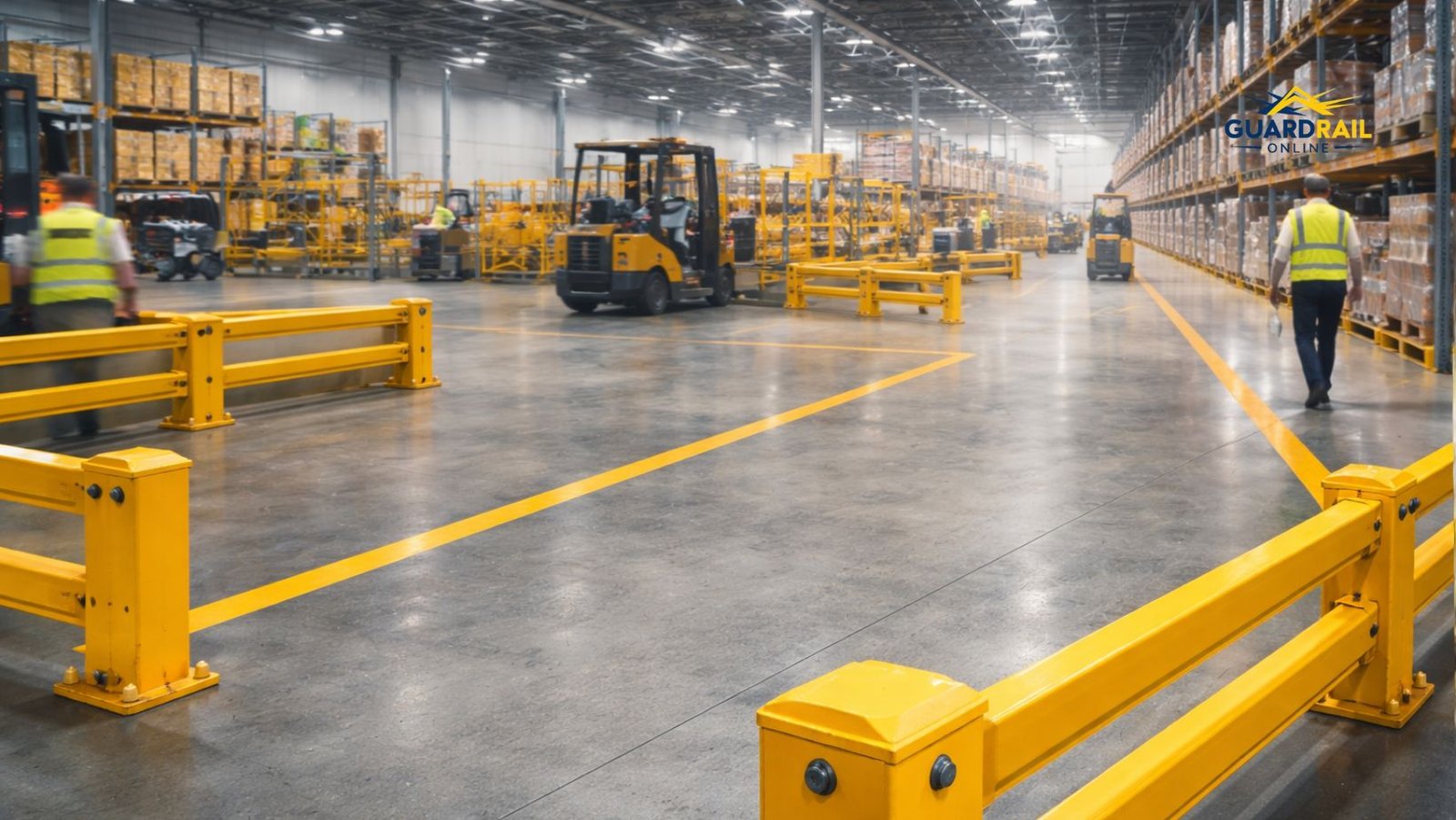
Most warehouses install barriers for one clear reason: safety. The assumption is simple. Add protection, reduce accidents, and move on. But that assumption misses something important.
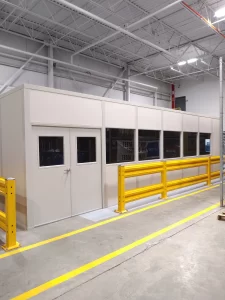
In high-activity facilities, safety infrastructure does far more than absorb impact. It shapes how people move, how equipment behaves, and how efficiently work gets done. When you look closely at daily operations, it becomes clear that guardrail posts for warehouse safety are not passive safety elements. They are physical decision-makers that influence traffic flow, spacing discipline, and operational rhythm across the floor.
This is why facilities that treat barriers as layout tools often outperform those that treat them as last-line protection. The difference is not just fewer incidents. It is smoother movement, less hesitation, and fewer disruptions during peak hours.
Table of Contents
ToggleEfficiency Is a Layout Problem Before It Is a Speed Problem
When productivity drops inside a warehouse, the first reaction is often to look at labor, equipment speed, or training gaps. Yet many slowdowns start earlier than that. They begin with uncertainty.
- Operators hesitate when they are unsure how close they can drive to a rack.
- Pedestrians slow down when boundaries are unclear.
- Forklifts overcorrect at corners where spacing feels inconsistent.
None of this shows up as a major incident. But over time, it adds friction.
This is where guardrail posts for warehouse safety quietly change outcomes. They remove micro-decisions from daily movement by defining fixed edges and consistent spacing. With them:
- Drivers no longer guess where lanes end.
- Pedestrians no longer negotiate space informally.
- Movement becomes predictable, not because people try harder, but because the environment guides them.
Guardrail Posts Are Not Just Supports. They Set the Rules of Movement
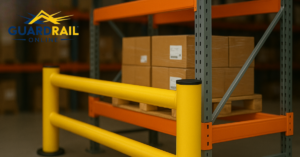
Most people think of guardrails as horizontal systems. Rails get the most attention, while guardrail posts rarely get any attention when it comes to warehouse safety. In reality, it’s the posts that do most of the work. They determine:
- Lane width consistency
- Visual rhythm along travel paths
- Where equipment slows naturally
- How force transfers during contact
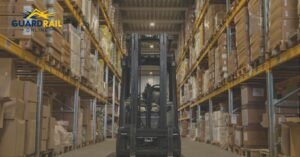
When industrial guard rail posts are spaced intentionally, they create a physical rhythmic pattern that operators subconsciously follow. This rhythm regulates speed without signs, reminders, or enforcement. Drivers instinctively maintain alignment because the environment reinforces it.
That is one reason why facilities using well-planned guardrail posts for warehouse safety often report calmer traffic behavior, even during high-pressure shifts.
Heavy Duty Posts Reduce Downtime You Never See on Reports
Downtime is not always dramatic. It often hides in small interruptions.
- A rack needs adjustment after repeated nudges.
- A floor anchor loosens and needs repair.
- A supervisor pauses work to realign a damaged barrier.
Individually, these events feel manageable. Collectively, they drain time.
Facilities that rely on lightweight or mismatched posts often see the same damage repeating in the same locations. They think that the reason behind such reoccurrences is operator behavior. However, the actual reason is structural fatigue.
This is where heavy duty guard rail posts make a measurable difference. Designed to manage repeated contact, they maintain alignment over time instead of slowly shifting. These rails offer a number of benefits when their posts stay rigid and anchored correctly. Managers notice:
- Layouts stay intact
- Aisles do not creep wider
- Turning zones do not shrink
- Staging does not spill into the travel space
That stability preserves efficiency long after installation. This is why guardrail posts for warehouse safety should always be evaluated as long-term operational assets, not short-term fixes.
Predictable Layouts Create Faster Learning and Fewer Corrections
Training is one of the most underestimated efficiency costs in a warehouse. New operators take time to adapt, not because they lack skill, but because environments often contradict written rules.
- Aisles look wide in one zone and narrow in another.
- Boundaries shift between departments.
- Some barriers feel solid, others feel decorative.
This inconsistency forces people to learn through trial and error.
When industrial guard rail posts are used consistently across the facility, they turn policies into physical habits. A driver learns lane limits once and applies them everywhere. A pedestrian understands walkways instantly, even in unfamiliar zones.
In fact, it is noted that facilities using standardized guardrail posts for warehouse safety often see faster onboarding and fewer verbal corrections on the floor. The reason behind this is predicable environment. Guardrail posts help create such a predictable environment that does the teaching. This kind of environment reduces supervisory load and keeps work moving.
Efficiency Depends on Keeping Layouts From Drifting Over Time
Warehouse layouts rarely fail overnight. They drift.
- A pallet sits closer to an aisle “for now.”
- A turning zone tightens without notice.
- A temporary workaround becomes permanent.
Without physical enforcement, these changes slowly undermine efficiency.
However, well-anchored industrial guard rail posts prevent that drift. They lock clearances into place. They define where staging stops and travel begins. Once installed, they hold the line even when pressure builds during peak demand.
This is why guardrail posts for warehouse safety are often the only elements that preserve original layout intent months or years after commissioning.
Conclusion
Barriers are often installed with one goal in mind! Managers want to enhance protection but the truth is that protection is only the beginning.
When planned and executed correctly, guardrail posts for warehouse safety become one of the most powerful efficiency drivers in an industrial environment. They reduce hesitation, stabilize layouts, speed up learning, and prevent the small disruptions that quietly erode productivity. This is why high-performing facilities no longer treat guardrail posts as accessories. They treat them as structural controls that shape how work happens every day.
If you are looking to strengthen safety while improving flow, selecting the right industrial guard rail posts is not a secondary decision. It is a strategic one. Guardrail Online designs and supplies guardrail systems with this reality in mind. Our post-engineered solutions are built to handle real warehouse pressures while preserving the movement patterns that keep operations efficient.
FAQs
What are guard rails in a warehouse used for?
Guard rails in a warehouse are used to create physical separation between people, equipment, and infrastructure. They guide movement, absorb accidental impact, and help keep traffic predictable in high-activity areas.
What are the 7S rules in a warehouse?
The 7S rules focus on sorting, setting in order, shining, standardizing, sustaining, safety, and spirit. Together, they create organized spaces where movement is clear, risks are reduced, and efficiency becomes easier to maintain.
What is guardrail in safety?
A guardrail in safety is a physical control designed to prevent unintended access, falls, or collisions. It works by defining boundaries that influence behavior before an incident occurs, not just during impact.
What is the OSHA standard for guardrails?
Occupational Safety and Health Administration standards require guardrails to meet minimum height, strength, and load conditions where fall or impact risk exists. The intent is to ensure consistent edge protection and controlled separation in hazardous areas.