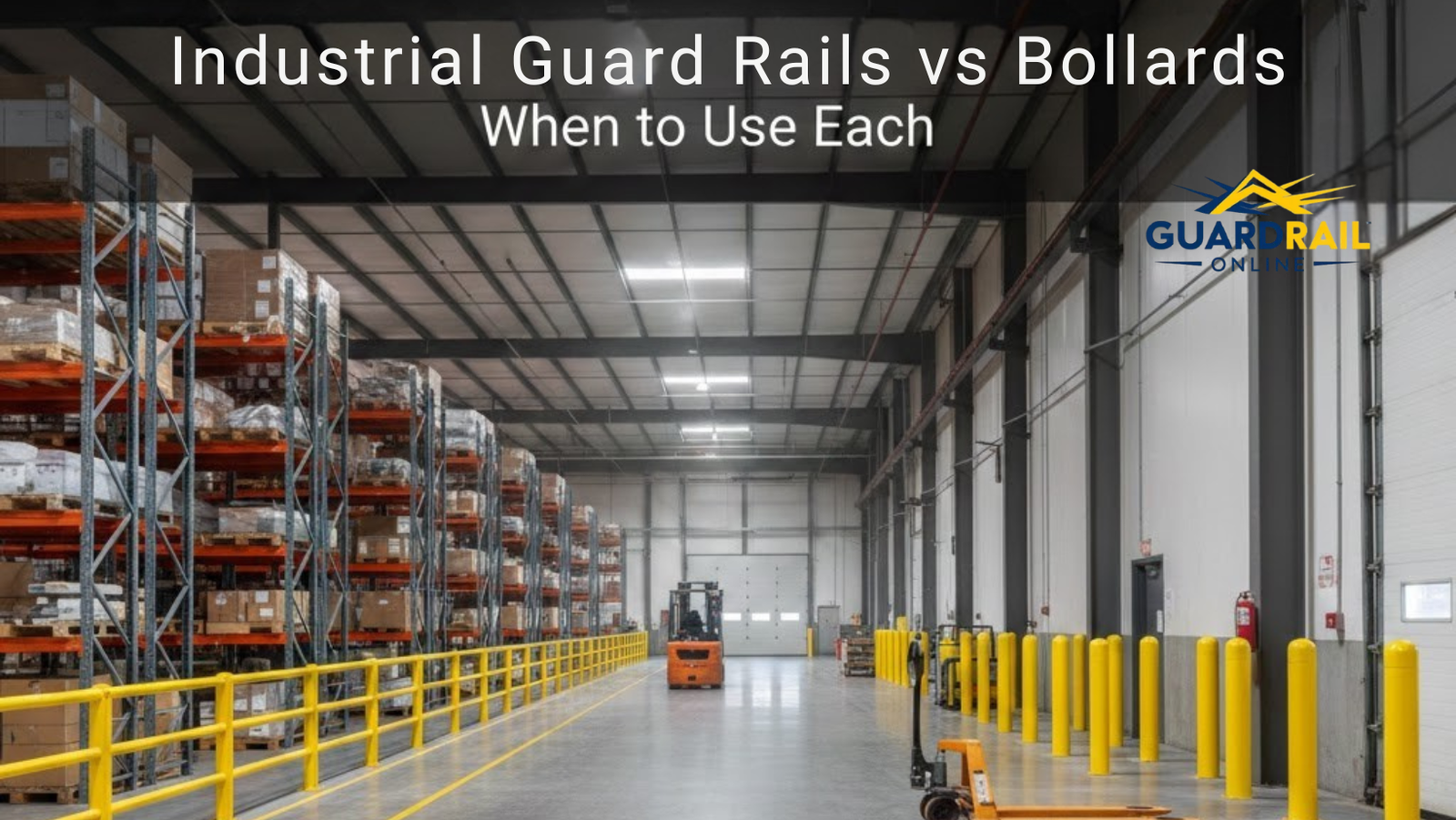
When planning industrial safety, many facilities arrive at the same crossroads. Should you install guardrails, or would bollards do the job better? On the surface, both appear to serve a similar purpose. They create physical barriers. They prevent impact damage. They guide movement! But in practice, these warehouse safety systems solve very different problems.
Understanding the difference between industrial guard rails and bollards is not just a design choice. It directly affects traffic flow, equipment protection, and long-term safety performance. This is why experienced guardrail suppliers always start by asking how a space actually functions before recommending one over the other.
Let’s break this down in a very practical way.
Table of Contents
ToggleUnderstanding the Core Difference Between Industrial Guard Rails and Bollards
At a glance, bollards and industrial guard rails may appear to serve the same purpose. Both are safety barriers. Both are designed to reduce impact damage. But their roles inside a working facility are very different. Bollards are point-protection systems. They stand in one fixed location and are built to stop a direct hit at that specific spot. Industrial guard rails, in contrast, are designed by guardrail suppliers to offer linear protection. They extend across space and guide movement rather than reacting to a single impact.
This difference becomes much clearer once you think about how a warehouse actually functions. A facility is not just protecting individual assets. It is managing constant, overlapping motion. Forklifts turn through aisles, pallets shift during handling, pedestrians cross shared zones, and equipment follows repeatable routes throughout the day. In an environment like this, safety is not only about stopping collisions. It is about shaping how movement happens in the first place.
That is why the choice between industrial guard rails and bollards depends on what you are trying to achieve. One focuses on stopping force at a fixed location. The other focuses on managing flow across an operating space. Understanding this difference early makes it much easier to decide which solution fits your layout, your traffic patterns, and your long-term safety goals.
When Installing Bollards Make the Most Sense?
Bollards work best when protection is needed at a single, fixed point. Think about structural columns, door frames, electrical panels, or building corners. These areas do not require guided traffic. They need a solid stop.
Facilities often use bollards to protect:
- Entry points and roll-up doors
- Electrical cabinets and control panels
- Structural columns
- Fire suppression equipment
In these scenarios, a bollard absorbs direct impact and prevents equipment from striking something critical. It does its job quietly and effectively. However, bollards do not guide forklifts. They do not define lanes. They also do not prevent glancing collisions that occur along longer travel paths. This is where their limitation becomes clear and why many people choose to contact guardrail suppliers instead.
When Does Installing Industrial Guard Rails Make More Sense?
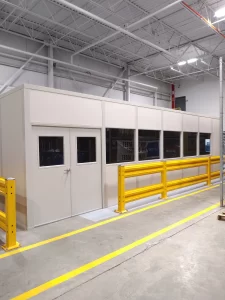
Industrial guard rails are designed for environments where movement must be controlled, not just blocked. They guide forklifts along predictable paths. They separate pedestrians from equipment. They protect racking, machinery, and infrastructure across longer distances.
Experienced guardrail suppliers recommend industrial guard rails in areas where traffic flow is continuous and directional. These include:
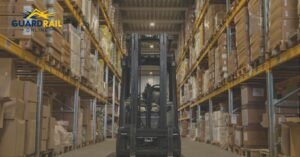
- Forklift aisles
- Pedestrian walkways
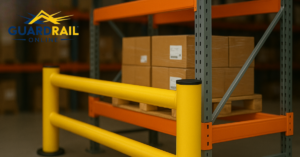
- Rack row ends
- Loading and staging zones
Unlike bollards, guardrails reduce the chance of impact in the first place. They do this by creating visual and physical boundaries that influence driver behaviour. Operators slow down earlier. Turns become more controlled. Blind spots feel less risky.
This is an important distinction! Bollards react to impact. Industrial guard rails help prevent it.
Conclusion
Bollards and industrial guard rails are both essential safety tools, but they are not interchangeable. Bollards stop impact at specific points. Industrial guard rails manage movement, protect across distances, and shape how people and equipment interact.
The most effective facilities work with experienced guardrail suppliers who understand these differences and design protection around real-world behaviour, not assumptions.
At Guardrail Online, we provide engineered industrial guard rails designed for demanding environments. We are among the top guardrail suppliers who strive to provide the most robust safety systems. Along with this, we are always ready to offer expert guidance to help facilities choose the right protection in the right place.
Reach out to Guardrail Online when seeking reliable guardrail suppliers in the United States.