Heavy duty guard rails are designed to stay in place for a reason. They control movement, absorb impact, and create clear boundaries on the floor. However, warehouses are not static environments.
There are moments when access is necessary without compromising protection everywhere else. That is exactly where lift-out brackets for guardrails come into play. They allow a section of guardrail to be removed temporarily while keeping the rest of the system intact and aligned.
This article explains how lift-out guardrail brackets work, why facilities use them, and what separates a reliable solution from one that introduces new risks.
Table of Contents
ToggleWhat Is a Lift-Out Guardrail Bracket For Guardrails?
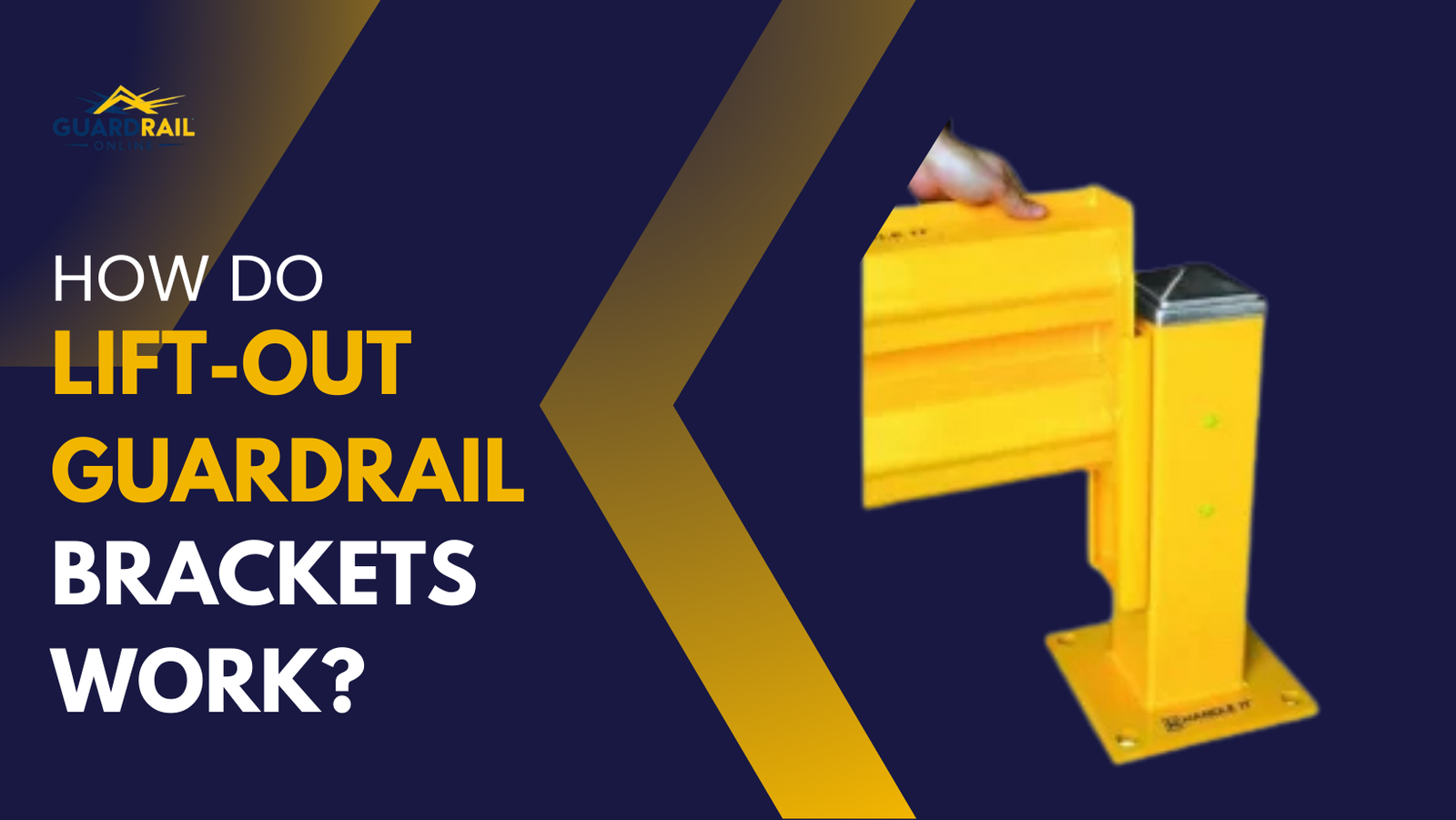
A lift-out bracket is a pair of matched fittings. One side is a fixed receiver. The other is a removable post or rail end that slides into the receiver.
A lift-out guardrail bracket is basically designed to solve a simple operational problem: how do you keep a guardrail continuous, but still allow access when you need it?
Instead of fixing every heavy duty guard rail permanently in place, a lift-out bracket creates a controlled removal point within the guardrail line. One part of the bracket remains fixed to the floor or post. The matching section is attached to a removable rail or post. Together, they form a secure connection that behaves like a standard guardrail when installed.
When the rail is seated inside the bracket, it functions as part of the full guardrail system.
- Alignment is maintained.
- Load transfers as expected.
- From an operational standpoint, the barrier feels permanent.
When access is required, the removable rail section can be lifted out intentionally. This creates a clear opening for pallets, vehicles, or equipment to pass through. Once the task is complete, the rail is placed back into the bracket, restoring the barrier to its original position without re-measuring or re-aligning.
A well-designed lift-out bracket system focuses on a few critical principles:
- Secure receiving points that hold the rail firmly in position during normal operation
- Precise fit and repeatable alignment so the rail seats the same way every time
- Positive locking mechanisms that prevent accidental lift-out or vibration-related movement
- Optional hinge or guided lift designs where frequent access or limited space requires controlled motion
When these elements work together, lift-out brackets allow flexibility without sacrificing the integrity of the heavy duty guard rail system.
Why Facilities Choose Lift-Out Brackets for Guardrail Systems?
Most warehouses are designed for continuous protection, not constant access. Guardrails define paths, separate risk zones, and prevent equipment from drifting into places it should never reach. But real operations are rarely static. At certain points in the workflow, access becomes unavoidable.
This is the tension lift-out brackets for guardrails are designed to resolve.
Facilities often need a wide, unobstructed opening for specific tasks. That might include moving oversized pallets, servicing equipment, or repositioning inventory near dock edges or long pallet runs. Permanently removing a section of heavy duty guard rail solves the access problem, but it creates a new risk by leaving an open gap that invites shortcutting and uncontrolled movement.
Lift-out brackets for guardrails offer a controlled alternative. They allow a section of heavy duty guard rail to be removed intentionally. This happens only when access is required and restored immediately afterward. With this, protection remains continuous for normal operations, without relying on temporary fixes or improvised barriers.
Facilities choose lift-out brackets because they provide:
- Fast, intentional access without cutting, unbolting, or delaying operations
- No permanent openings that weaken the protective line or invite unsafe behavior
- Consistent reinstallation that preserves rail height, spacing, and alignment every time
- Lower complexity and cost compared to full swing gates or automated systems in many use cases
This balance matters for heavy duty guard rail installations. The lift-out option preserves the integrity of the protective system while acknowledging that occasional access is part of real warehouse life. That is why lift-out brackets for guardrails are commonly specified near loading bays, maintenance zones, and areas where long or irregular loads must pass through without compromising safety the rest of the time.
Core Mechanics: How Lift-Out Brackets In Guardrails Manage Load and Alignment
Lift-out brackets for guardrails may look simple in use, but their performance depends on careful engineering. When designed correctly, they allow removability without introducing weakness into the line of heavy duty guard rail.
A well-built lift-out bracket must do three things consistently:
First, it must locate precisely
The removable post needs to sit in the exact same position every time it is placed back into the receiver. That consistency is what keeps the rail straight, aligned, and visually continuous, instead of slowly drifting out of line with each removal and return.
Second, it must lock reliably
Under contact, the bracket cannot allow the removable section to lift, rotate, or creep upward. A secure locking detail ensures that impact behavior remains predictable rather than changing with each reinstallation.
Third, it must transfer the load correctly
The receiver and removable post have to work together to pass impact energy into the fixed posts and anchors. This depends on properly sized contact faces, welds, and plates that are built to manage force, not just hold position.
When any of these elements fall short, the heavy duty guard rail begins showing stress at the bracket location. That stress appears as looseness, unexpected movement, or wear patterns that do not show up elsewhere in the run.
Common Lift-Out Bracket Configurations You’ll Encounter on the Floor
Lift-out brackets are not all built the same. The configuration you choose usually depends on how:
- Often access is needed
- Wide the opening must be
- Much impact exposure the guardrail line sees in that zone
In practice, most facilities encounter a few common formats of lift-out brackets for guardrail. These include:
Simple lift-out post with socket and pin
The removable post drops into a fixed receiver and is secured with a locking pin. This is straightforward to use and works well where access is occasional, and the impact demand is moderate.
Hinged lift-out sections
Here, the heavy duty guard rail swings clear on a hinge before lifting free. This option is useful where space is limited and removed components cannot be set aside easily.
Removable rail sections with fixed posts
Here, a short rail segment lifts out while the posts remain anchored. This preserves post alignment and anchorage consistency, which is valuable in higher-impact areas.
Sliding or telescopic systems
These are designed for wider or more frequent openings. They are more complex and typically reserved for heavy-duty operations where access and protection must coexist.
Each configuration of lift-out brackets for guardrail solves a slightly different problem. The right choice depends less on convenience and more on how the opening will be used and how much force the system must continue to manage.
Conclusion
Lift-out brackets work best when they are treated as part of the guardrail system, not as an add-on. When designed correctly, they preserve alignment, manage load, and restore protection the moment they are reinstalled. That is why quality and engineering matter.
At Guardrail Online, we supply high-quality lift-out adapters and heavy-duty guardrail components designed to perform as part of a complete system. Explore our range of warehouse safety systems today!