Many warehouse teams see guardrails only as “safety blocks” that stop collisions and protect assets. But here is a question worth asking. Do they also make movement on the floor smoother and more efficient? The honest answer is yes, when they are planned and installed correctly, they do.
Inside a busy facility, operators are constantly making decisions. Where to turn. How close to drive to a rack. When to slow down. Without clear visual and physical guidance, every choice takes a little more time and carries a little more risk. That is exactly where a single height guardrail can start shaping better traffic patterns instead of simply blocking access.
Well-placed guardrails help organize vehicle routes, separate pedestrians from forklifts, and remove confusion from day-to-day movement. That combination does not just reduce accidents. It also reduces hesitation, bottlenecks, and unnecessary delays. Let us look at how this works in practice.
Table of Contents
Toggle1. Turning Guesswork into Clear, Predictable Routes
Have you ever walked into a warehouse where everyone seems unsure which side of the aisle to use? Or where forklifts cut corners differently on every shift? That uncertainty slows everything down.
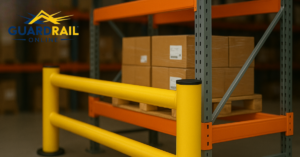
When you outline aisles and turning zones with a single height guardrail, you give operators a visible “edge” to follow. It defines the safe envelope for vehicle movement. Drivers no longer need to guess where the lane ends or how tight they can turn. That clarity naturally reduces hesitation at corners and intersections.
Over time, traffic begins to follow the same lines every day. This creates consistent patterns, fewer surprises, and smoother flow during peak hours.
2. Separating People and Forklifts Reduces Conflict Points
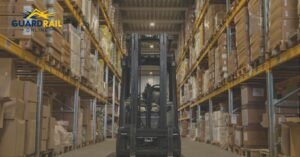
Any time pedestrians and forklifts share the same space, traffic flow slows down. Operators tap the brakes more often. Pedestrians pause or wait for gaps. Near misses trigger even more caution. All of that is understandable, but it also creates friction in the workflow.
When you use a single height guardrail to create pedestrian-only walkways, you remove much of that conflict. People know exactly where to walk. Forklift drivers know exactly where not to drive. Instead of negotiating every crossing with eye contact and hand signals, each group follows dedicated paths.
The result is calmer, cleaner traffic behavior and less stop–start movement in high-activity zones.
3. Reducing Bottlenecks at Busy Intersections
Where do delays usually happen in your warehouse? If you think about it, slowdowns often cluster around intersections, dock doors, and rack ends. In these zones, operators face merging traffic, blind corners, and last-minute corrections. That is where layout and safety barrier design matter most.
When a single height guardrail outlines approach paths and turning zones, it helps shape how forklifts enter and exit key areas. Instead of wide, unstructured openings, you get guided routes that control the angle of entry and exit. This has two main effects:
- Fewer sudden stops due to unexpected cross traffic
- More consistent speeds because drivers can anticipate how other vehicles will move
Over time, that structure helps break up congestion in hot spots and keeps flow more stable across shifts.
4. Making Training Easier and Behavior More Consistent
Traffic policies on paper are useful. But real behavior is shaped by the environment people see every day. Well-placed barriers can turn written rules into physical habits.
When trainers can point to a single height guardrail and say, “This is your lane edge” or “This is the boundary for pedestrians,” expectations become much easier to understand. New operators learn quicker. Experienced drivers refresh their habits more easily when the floor layout reinforces the rules.
Additionally, since everyone is reacting to the same fixed cues, behavior becomes more consistent from shift to shift. That consistency is what ultimately improves traffic flow. It reduces unpredictable movement and helps every team share the same mental picture of how the floor is meant to work.
5. Supporting Safer Speed and More Confident Driving
Think about how people drive in a well-marked street versus an unmarked open lot. In clear lanes with curbs and signs, movement tends to be more confident and controlled. In open, undefined space, speeds swing between too fast and too slow because nobody is sure what is safe.
The same logic applies inside a warehouse. Operators get instant visual feedback about where it is safe to move and how close they are to a boundary when a single height guardrail outlines paths, turning points, and exclusion zones. This reduces over-correction and risky shortcuts.
With time, that structure supports more consistent travel speeds. Drivers no longer crawl through uncertain zones or rush through wide open areas to “make up time”. Instead, they follow familiar, protected lanes that support both safety and steady acceleration.
So, Do Guardrails Improve Traffic Flow?
Yes, single height guardrail do improve traffic flow. Not by magic and not on their own, but by shaping how people and machines share space. When planned correctly, a single height guardrail system does three things at once. It protects assets, reduces accidents, and guides movement in ways that make traffic calmer and faster.
If you are looking to enhance traffic flow while protecting workers and equipment, Guardrail Online offers engineered single height guardrail solutions built for real warehouse conditions. Our barriers are designed to organize movement, absorb impact, and support safer, smoother operations across your facility.