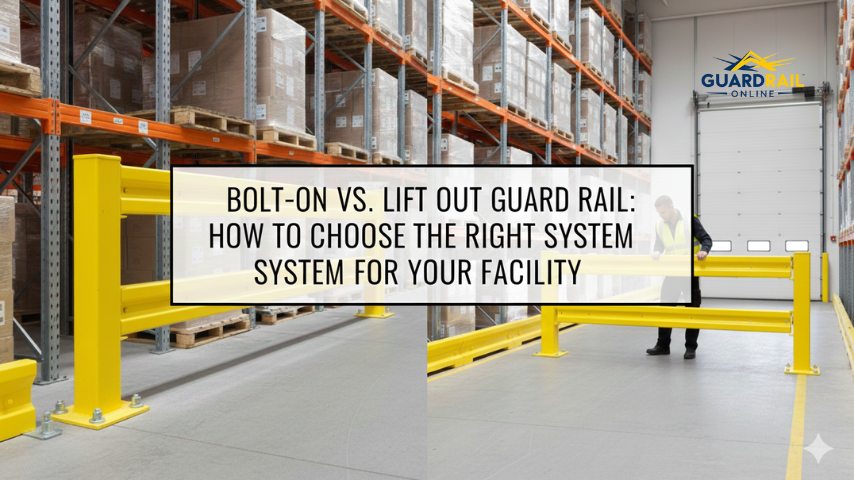
Warehouse safety is not built on equipment alone. It depends on how well people, machinery, and infrastructure are protected from everyday risks. That is why choosing the right guardrail configuration is not a small decision. It affects workflow, maintenance, flexibility, and long-term safety planning. Among the many options available today, two systems often lead the discussion. These include the lift out guard rail and the bolt-on guardrail system. While both offer critical protection, the way they function, the way they adapt to a layout, and the way they influence daily operations are very different.
Understanding these differences is the first step toward selecting guard rails for warehouse environments that support your facility’s movement patterns rather than restrict them. If you have ever wondered which system aligns better with your workflow, or how much flexibility each one can truly offer, the following guide will help you make an informed decision.
Table of Contents
ToggleWhat Makes A Lift Out Guard Rail Unique?
A lift out guard rail is built around ease of access. Instead of being permanently fixed with bolts, the horizontal rails of a lift out barriers sit securely in brackets and can be removed whenever needed. This simple mechanism creates a major advantage for facilities that require frequent access behind barriers.
Most warehouses today have zones that require regular cleaning, maintenance, or equipment replacement. In these cases, a permanent structure becomes an obstruction. A lift out guard rail solves this problem by allowing staff to temporarily remove a section, access the protected zone, and re-secure it within seconds. A lift out guard warehouse barrier eliminates that frustration. Staff can remove a section, walk through safely, and drop it back into place without tools, delays, or any disruption to the workflow.
This convenience becomes even more valuable in fast-moving environments where the layout changes often. Many warehouses adjust aisles seasonally, add temporary staging areas, or modify paths to accommodate new equipment. In such moments, a rigid barrier feels restrictive. A lift out barrier system, however, adapts naturally. You can widen access points, open temporary passages, or clear space for special handling tasks without altering the rest of your safety structure.
A lift out guard rail offers protection when needed and flexibility when work demands change. By offering these benefits, they align with real operational patterns instead of forcing your team to work around a fixed obstacle.
Where Do Bolt On Guard Rails Excel?
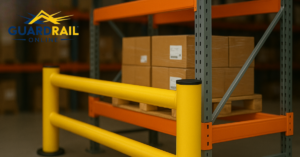
A bolt on guardrail offers a very different type of strength. These guard rails for warehouse environments are permanently anchored to posts using hardware designed to withstand repeated impact. Every component on these barriers are mechanically fixed. Hence, bolt on guardrail remains stable under high traffic and heavy equipment movement.
This makes bolt on barriers the preferred choice around high-risk zones including dock doors, palletizing areas, racking ends, and equipment rooms where the margin for error is small. Once installed, the framework becomes a long-term safety boundary that forklift operators can rely on. It creates predictable paths, prevents machinery from entering restricted areas, and absorbs impact without shifting.
Does your facility experience high collision frequency or uses large forklifts with heavy loads? A bolt-on barrier would help maintain consistent protection in such spaces. It would offer robust protection and would serve as a strong, permanent safety foundation.
Flexibility vs. Stability: Which Matters More to Your Layout?
Deciding between a lift out guard rail and a bolt-on barrier often comes down to how your warehouse functions day to day. Some facilities prioritize flexibility because of frequent product rotation or maintenance routines. Others prioritize rigid boundaries because of continuous high-impact movement.
A lift out guard rail works best where access is part of the daily workflow. Such guardrails allow cleaning crews, service teams, or operators to move efficiently without compromising safety. Most importantly, they prevent shortcuts like instances where crew climbs over barriers or forces equipment through narrow gaps. These shortcuts may “look” like they’d save time, but they actually often lead to injuries.
Bolt on guardrails, on the other hand, shine in high-risk areas where stability matters most. They act as a defense line that operators instinctively trust. These guard rails for warehouse settings create fixed lanes for forklifts, simplify traffic flow, and reduce the chances of accidental crossover into pedestrian zones.
Both systems deliver protection. The difference simply lies in how willingly they adapt to change.
Understanding Impact, Reliability, and Real-World Use
Impact performance varies quite a lot between the lift out guard rail and the bolt-on guardrail system. However, the intention behind their design remains clear. A lift out safety barrier is built to handle regular bumps and glancing impacts, but its greatest strength is accessibility. A bolt on barrier, on the other hand, is built to absorb stronger collisions from heavy forklifts, especially in tight or congested spaces.
Lift out guard rails are ideal for:
- Areas requiring frequent equipment access
- Facilities with changing layouts
- Operations that prioritize flexibility with moderate traffic
Bolt on barriers are ideal for:
- High-traffic forklift lanes
- Environments with repeated impact exposure
- Zones requiring maximum structural reinforcement
Understanding these distinctions between the two guard rails for warehouse ensure that your investment aligns with your actual operational risks.
Maintenance and Long-Term Costs
Over time, your choice of barrier system affects more than traffic flow! It influences repair costs, downtime, and efficiency.
For instance, a lift out guard rail reduces maintenance time significantly. When a part needs inspection or replacement, it can be removed without tools. This minimizes disruption and helps keep operations moving.
Bolt on warehouse barriers on the other hand last longer in high-impact conditions. However, they require tools and personnel for any adjustments and maintenance. While they offer superior durability, maintenance or reconfiguration takes more time compared to lift-out designs.
But you can save a lot when you align your barrier system with your environment. Doing so helps decrease long-term costs naturally because the barrier is performing the work it was built to do.
Conclusion
There is no universal choice between these two warehouse barrier systems. The best decision is the one that supports your layout, your equipment movement, and your safety priorities. A lift out guard rail excels in operational flexibility, while bolt-on guardrails create strong, permanent protection in demanding environments. Both play essential roles in building safer, more organized facilities. The key is understanding when each one serves your needs best so that your guard rails for warehouse protection stays reliable, practical, and aligned with your workflow.
At Guardrail Online, we offer superior-quality guard rails for warehouse environments, including both lift-out and bolt-on configurations designed for real-world conditions. Our systems are built for durability, fast installation, and long-term performance, giving your facility the protection it requires without compromising efficiency. Explore our range of barriers today!