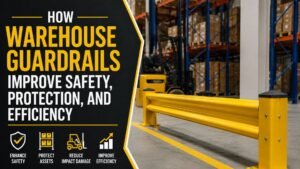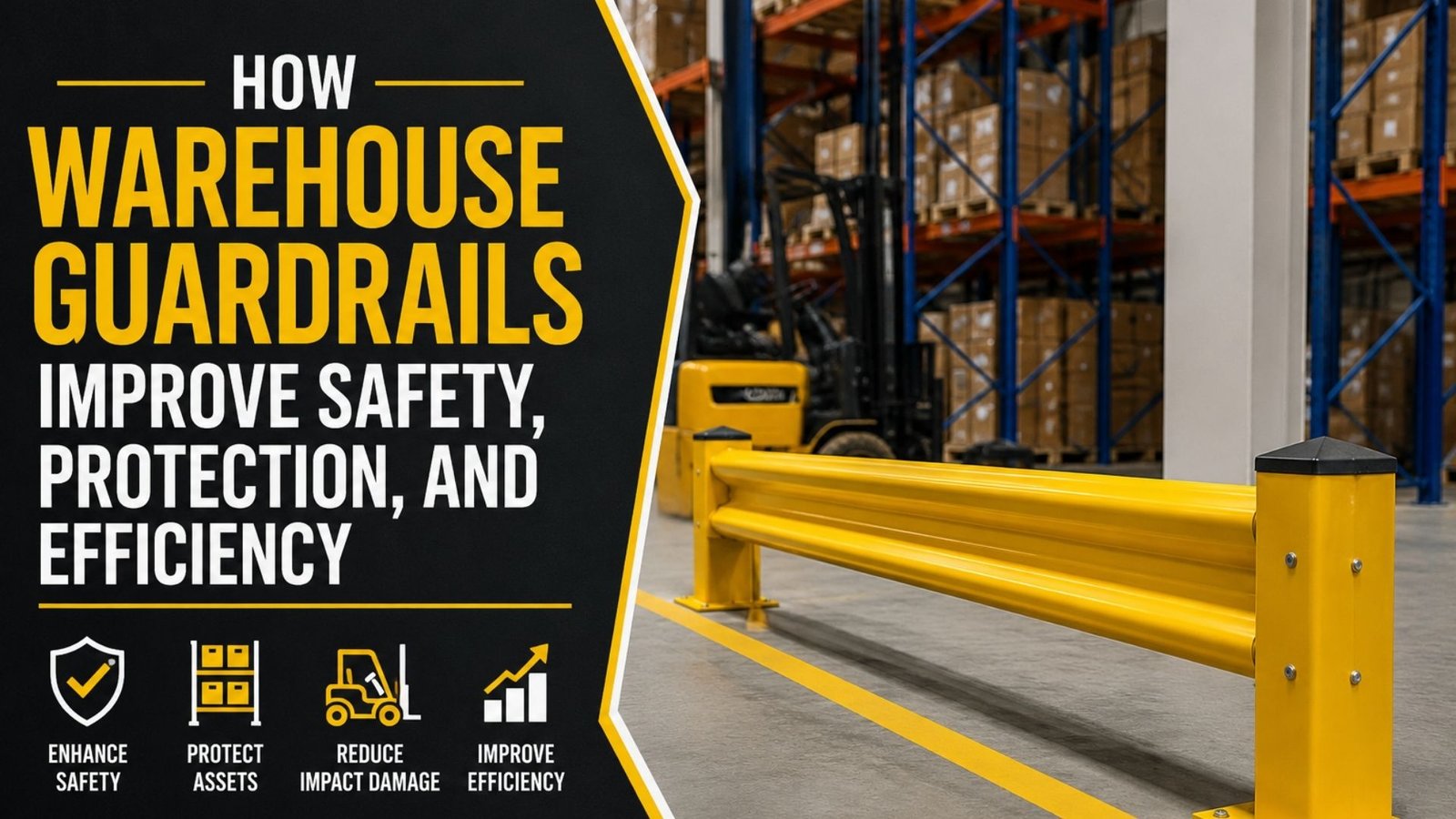
Warehouses are busy environments where forklifts, pallet jacks, carts, employees, and inventory move continuously. Without clearly defined protection zones, a single vehicle impact can damage racking, machinery, walls, inventory, or other critical infrastructure.
Warehouse guardrails provide a physical layer of protection between moving equipment, pedestrians, and vulnerable assets. When strategically installed, heavy-duty guardrail systems can help reduce the risk of impact damage while creating clearer traffic boundaries throughout the facility.
For growing warehouses, distribution centers, and manufacturing facilities, guardrails are more than a safety accessory. They can become an important part of the facility’s overall risk-management and asset-protection strategy.
Table of Contents
ToggleWhat Are Warehouse Guardrails?
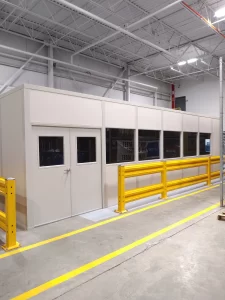
Warehouse guardrails are heavy-duty physical barriers installed around areas that need protection from vehicle and equipment impacts.
They are commonly used around:
- Warehouse racking and rack ends
- Forklift aisles and traffic lanes
- Pedestrian walkways
- Machinery and equipment
- Conveyor systems
- Building columns and walls
- Loading and receiving areas
- Storage and operational zones
Unlike floor markings or signs, a physical guardrail creates a tangible boundary between moving equipment and protected areas.
GuardRail Online supplies warehouse guard rail systems in single-height and double-height configurations, along with starter kits, add-on kits, beams, posts, and accessories for expanding protection as facility requirements change.
Why Are Warehouse Guardrails Important?
The need for warehouse protection increases as traffic, inventory, and equipment movement increase.
A forklift does not need to be traveling at high speed to cause expensive damage. Repeated contact with rack uprights, machinery, walls, or other infrastructure can gradually weaken or damage equipment.
A properly positioned guardrail provides a dedicated impact-protection zone before the moving equipment reaches the asset behind it.
1. Protect Employees and Pedestrians
One of the most important applications for warehouse guardrails is separating pedestrians from vehicle traffic.
Employees may need to walk through areas where forklifts and other material-handling equipment operate. A clearly defined pedestrian walkway supported by physical barriers can help maintain separation between foot traffic and vehicle movement.
Guardrails can be installed alongside:
- Pedestrian walkways
- Warehouse intersections
- Loading areas
- Production zones
- Forklift travel paths
This creates a more clearly defined working environment and helps reduce the chance of accidental vehicle-pedestrian interaction.
2. Protect Warehouse Racking and Inventory
Warehouse racking represents a significant investment, and forklift impacts can result in costly repairs, downtime, or damaged inventory.
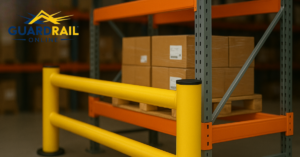
Installing heavy-duty guardrails around vulnerable rack areas provides an additional physical barrier between forklifts and rack structures.
Common applications include:
- Rack end protection
- Rack aisle boundaries
- Pallet storage areas
- High-traffic storage zones
- Loading and unloading areas
Guardrails can also help protect the inventory stored behind the barrier by reducing the likelihood of direct vehicle contact.
3. Reduce Forklift Impact Damage
Forklift traffic is one of the most important factors to consider when planning warehouse protection.
Facilities with constant forklift movement experience greater exposure to collisions around aisles, intersections, loading areas, and storage zones. That’s why protection should be concentrated around the areas where vehicle traffic creates the greatest impact risk.
Heavy-duty warehouse guardrails are designed to create a physical buffer between moving equipment and protected assets.
GuardRail Online’s systems are designed for industrial applications and, when properly installed, are rated to withstand 10,000 lbs of impact at 4 mph.
4. Create Clearer Traffic Boundaries
Warehouse safety isn’t only about stopping impacts. It’s also about controlling movement.
When pedestrian routes, forklift lanes, storage areas, and equipment zones overlap, employees and operators may have less clearly defined boundaries.
Guardrails can help establish those boundaries physically.
For example:
Forklift lane → Guardrail → Pedestrian walkway
or
Forklift aisle → Guardrail → Warehouse racking
This type of physical separation can make traffic patterns easier to understand and help organize movement throughout the facility.
5. Protect Machinery and Critical Equipment
Production equipment, conveyors, electrical equipment, control panels, and other machinery can be expensive to repair or replace.
A guardrail installed around a vulnerable piece of equipment provides a protective buffer against accidental contact.
Common applications include:
Machinery Perimeters
Protect machines positioned close to forklift or pallet-jack traffic.
Conveyor Systems
Create separation between moving equipment and conveyor infrastructure.
Electrical Equipment
Provide physical protection around sensitive electrical or control equipment where appropriate.
Building Infrastructure
Protect columns, walls, doors, and other structural elements from vehicle impacts.
Where Should You Install Warehouse Guardrails?
Not every area of a warehouse requires the same level of protection. The best locations are areas where moving equipment and vulnerable assets regularly come close to one another.
Forklift Aisles
Install guardrails along areas where forklifts travel close to equipment, walls, storage systems, or pedestrian routes.
Rack Ends
Rack ends are particularly vulnerable to turning forklifts. Physical barriers can help protect rack structures from direct impact.
Pedestrian Walkways
Use guardrails to establish a physical boundary between pedestrian routes and vehicle traffic.
Machinery Zones
Protect expensive machinery and production equipment located near material-handling routes.
Loading and Receiving Areas
Forklifts and pallet-handling equipment operate heavily around loading areas, making them important locations to evaluate for impact protection.
Building Perimeters
Columns, walls, doors, and other building infrastructure can be vulnerable to repeated forklift contact.
Choosing the Right Warehouse Guardrail System
Not every facility has the same layout or safety requirements. Before selecting a guardrail system, consider several factors.
1. Evaluate Forklift Traffic
Look at:
- Number of forklifts operating in the area
- Traffic frequency
- Turning points
- Intersections
- Loading and unloading activity
- Areas with a history of impacts
Higher traffic and greater exposure may require more robust protection.
2. Identify Vulnerable Assets
Determine what needs protection first.
Prioritize assets such as:
- Racking
- Machinery
- Pedestrian areas
- Building structures
- Conveyors
- Electrical equipment
- High-value inventory
3. Choose the Appropriate Guardrail Height
Guardrail height should be selected based on the application and the asset being protected.
GuardRail Online offers single-height and double-height guardrail systems, allowing facilities to select a configuration based on their specific protection requirements.
4. Plan for Future Expansion
Warehouse layouts change.
New racks may be installed. Production areas may expand. Forklift traffic patterns may change.
A modular guardrail system makes it easier to extend protection without replacing the entire installation. GuardRail Online offers starter kits for new installations and add-on kits for expanding existing systems.
Single-Height vs. Double-Height Warehouse Guardrails
Choosing between single-height and double-height protection depends on the area being protected and the level of coverage required.
Single-Height Guardrails
Single-height systems can be useful for protecting:
- Equipment
- Pedestrian areas
- Rack bases
- Low-level infrastructure
- Machinery perimeters
Double-Height Guardrails
Double-height systems provide additional vertical coverage for areas where greater protection is needed.
They can be considered around:
- High-risk forklift zones
- Larger equipment
- Storage areas
- Facility infrastructure
- Areas requiring additional barrier height
The right choice should be based on the facility layout, traffic patterns, and the assets being protected.
Warehouse Guardrails vs. Floor Markings
Floor markings are useful for defining traffic lanes and pedestrian routes, but they do not physically stop a forklift or pallet jack.
Guardrails provide a physical barrier.
That means the two solutions can work together:
Floor markings = visual guidance
Guardrails = physical protection
Using both can create a clearer and more structured warehouse safety layout.
Building a Scalable Warehouse Safety System
Warehouse protection shouldn’t necessarily be installed everywhere at once.
A practical approach is to identify the highest-risk areas first and expand protection as operational needs change.
For example:
Phase 1: Protect rack ends and critical machinery.
Phase 2: Separate pedestrian walkways from forklift traffic.
Phase 3: Protect building infrastructure and additional equipment.
Phase 4: Expand protection as warehouse layouts and traffic patterns change.
Modular guardrail systems make this approach easier because new sections can be added as requirements grow.
Why Choose GuardRail Online?
GuardRail Online focuses specifically on warehouse guardrails and forklift impact protection rather than offering a broad range of unrelated industrial products.
The company supplies:
- Single-height guardrails
- Double-height guardrails
- Heavy-duty guardrail beams
- Starter kits
- Add-on kits
- Guardrail posts
- Guardrail accessories
- Rack protection solutions
Its systems are designed for warehouses, distribution centers, manufacturing facilities, and other industrial environments. GuardRail Online also offers nationwide shipping from Dallas, Texas, and provides trade pricing and a 12-month warranty.
For installers, contractors, resellers, and other industrial partners, the company also provides product specifications and technical resources to support warehouse safety projects.
Final Thoughts: Make Warehouse Protection Proactive
Warehouse safety should not depend on waiting for an accident to happen.
By identifying areas where forklifts, pedestrians, equipment, and infrastructure interact, facility managers can install physical protection where it provides the greatest value.
Warehouse guardrails can help:
- Protect employees and pedestrians
- Reduce forklift impact damage
- Protect racking and inventory
- Safeguard machinery and infrastructure
- Define traffic boundaries
- Improve warehouse organization
- Support scalable safety improvements
The most effective warehouse guardrail system is one designed around the actual movement of people, equipment, and materials within the facility.
If you’re planning a new warehouse safety installation or expanding an existing system, evaluate your highest-risk areas first and build protection around those priorities.
Explore GuardRail Online’s warehouse guardrail systems to find single-height, double-height, starter-kit, and add-on solutions for your facility.
Frequently Asked Questions
What are warehouse guardrails used for?
Warehouse guardrails are physical barriers used to help protect pedestrians, racking, machinery, building structures, inventory, and other vulnerable areas from contact with forklifts and other material-handling equipment.
Where should warehouse guardrails be installed?
Common installation locations include rack ends, forklift aisles, pedestrian walkways, machinery perimeters, loading areas, conveyor zones, building columns, and other areas where vehicle traffic creates an impact risk.
Are warehouse guardrails useful for forklift protection?
Yes. Heavy-duty warehouse guardrails are designed to create a physical barrier between forklifts and protected assets. GuardRail Online systems are rated for up to 10,000 lbs of impact at 4 mph when properly installed.
What is the difference between single-height and double-height guardrails?
Single-height guardrails provide protection at a lower level and are commonly used around rack bases, machinery, pedestrian areas, and other low-level hazards. Double-height systems provide additional vertical coverage for applications requiring greater barrier height.
Can warehouse guardrails be expanded later?
Yes. Modular guardrail systems can be expanded by adding compatible beams, posts, and add-on kits as warehouse layouts or protection requirements change.
Can guardrails be used around pedestrian walkways?
Yes. Guardrails can create a physical boundary between pedestrian walkways and forklift or material-handling traffic, helping establish clearer separation within busy warehouse environments.
How do I choose the right warehouse guardrail?
Start by evaluating forklift traffic, pedestrian movement, vulnerable equipment, rack locations, available floor space, and potential future changes. The appropriate guardrail height and configuration should then be selected based on the specific application.