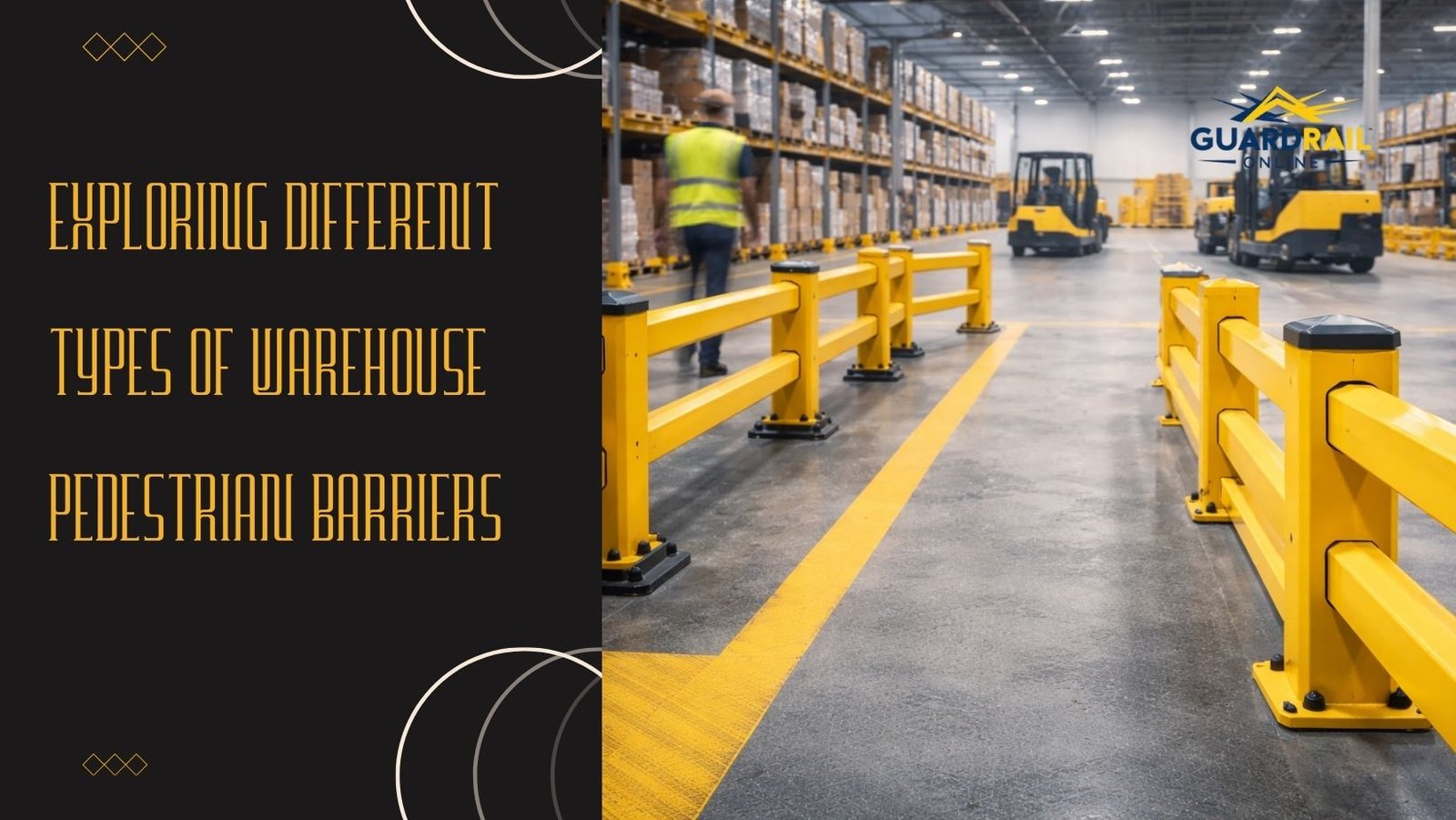
Warehouses are busy, high-pressure environments where people and equipment share the same space every day. In these conditions, safety depends less on rules and more on how movement is physically guided. This is why warehouse pedestrian barriers play a critical role.
When chosen and placed thoughtfully, they do more than separate traffic. They shape behavior, reduce hesitation, and bring clarity to how work happens. But do all types of warehouse pedestrian barriers offer the same safety and perform similarly? Absolutely not, and this article is designed to provide you with information about the same.
Quick answer: The main types of warehouse pedestrian barriers are guardrail, modular barrier systems, bollards, safety fencing, protected walkways and pedestrian gates. Use heavy-duty guardrail where walkways run beside forklift lanes, bollards to protect fixed points, fencing for long continuous separation, and gates to control the places where people cross traffic.
Table of Contents
ToggleKey takeaways
- Guardrail is the main choice where people walk beside forklift traffic.
- Bollards protect fixed points such as doorways, racking ends and equipment.
- Fencing gives continuous separation; gates control crossing points.
- Choose barriers by the speed, visibility and traffic of each area, not one product for the whole building.
In this guide
- What Are Pedestrian Safety Barriers in a Warehouse Setting?
- Why Pedestrian Barriers Matter Beyond Basic Safety
- Common Types of Pedestrian Safety Barriers and Where They Work Best
- Choosing the Right Pedestrian Barriers for Your Warehouse
- What to Look For When Buying Pedestrian Barriers
- Frequently Asked Questions
- Conclusion
What Are Pedestrian Safety Barriers in a Warehouse Setting?
Pedestrian safety barriers are physical systems used to separate foot traffic from vehicle movement inside industrial environments. Their purpose is not only to block access, but to guide behavior before conflict occurs.
In practical terms, warehouse pedestrian barriers define
- Where people should walk,
- Where equipment should not drift,
- How close people and equipment are allowed to operate near one another
When these boundaries are clear and consistent, daily movement becomes predictable. When they are unclear or incomplete, people improvise. That improvisation is where risk begins.
Why Pedestrian Barriers Matter Beyond Basic Safety
Most warehouses install barriers after an incident or during a compliance review. In those moments, the goal is usually to stop something from happening again. What often gets missed is how barriers can shape everyday movement long before an incident occurs.
The truth is that well-planned warehouse pedestrian barriers go beyond collision prevention because they remove uncertainty from daily decisions on the floor.
They reduce micro-decisions for pedestrians
Without physical boundaries, workers constantly judge whether stepping outside a marked path is acceptable in the moment. Those judgments may not always be right, especially when the workers are under time pressure. Pedestrians may hence tend to take shortcuts, blurring paths. But the need to make such judgments disappears when warehouse pedestrian barriers are used to clearly define where walking is allowed. They set the boundary, preventing pedestrians from making wrong decisions due to a time crunch.
They remove guesswork for equipment operators
Forklift operators are constantly making spatial judgments while turning, reversing, or aligning loads. Without fixed physical references, these judgments change based on load size, visibility, and how busy the floor feels at that moment. Under pressure, operators may drive wider than necessary or hesitate near pedestrian zones, disrupting flow. Warehouse pedestrian barriers eliminate this uncertainty by clearly defining safe clearance. They show operators exactly how close is too close, allowing movement to stay confident, controlled, and consistent.
They allow the environment to enforce rules consistently
Rules written on paper depend on memory and discipline. Signs rely on people noticing and reacting in time. Both can fail when activity increases. Physical barriers do not rely on reminders or supervision. Once installed, warehouse pedestrian barriers guide behavior the same way on every shift, regardless of who is working or how busy the operation becomes. This consistency keeps pedestrian routes respected even during peak demand, without the need for constant intervention.
They improve efficiency as a direct result
When pedestrians no longer negotiate space and operators no longer hesitate, movement becomes smoother across the floor. Informal crossings disappear, near misses reduce, and traffic flows follow predictable patterns. Supervisors spend less time correcting shortcuts or stopping unsafe behavior and more time managing throughput and priorities. Over time, warehouse pedestrian barriers stop feeling like safety additions and start functioning as quiet systems that support steady, efficient operations.
Common Types of Pedestrian Safety Barriers and Where They Work Best
Pedestrian barriers exist to manage pressure, not just space. Different zones create different risks based on speed, visibility, and decision-making. Each barrier type works best when matched to how people and equipment actually move in that area, not just where separation seems logical on paper.
1. Guardrail-Based Pedestrian Barriers
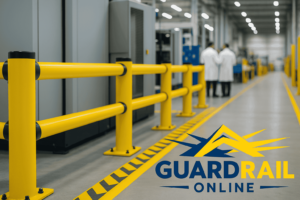
Guardrail systems are among the most reliable warehouse pedestrian barriers for high-traffic zones. Their strength lies in continuous, visible separation that discourages shortcuts and reinforces fixed walking paths. When aligned and uninterrupted, they function effectively as pedestrian aisle barriers along main forklift routes.
2. Modular Pedestrian Barrier Systems
Modular systems suit facilities where layouts change often. As warehouse walk-way barriers, they allow routes to shift without removing protection. Their effectiveness depends on rigidity as these systems can lose authority if they flex or feel temporary. Hence, strong modular designs maintain structure even as operations evolve.
3. Bollards and Post-Based Barriers
Bollards protect specific points such as corners, doors, and intersections. They are not meant to define full walkways. Their value comes from reinforcing decision zones within larger warehouse pedestrian barriers, especially where movement changes direction or clearance tightens suddenly.
4. Safety Fencing for Continuous Separation
Safety fencing provides total separation where access must be controlled. Used as warehouse walk-way barriers around automation or restricted zones, they remove ambiguity entirely. Their limitation is flexibility. Poor planning can restrict flow, so fencing works best where routes are stable and access is intentional.
5. Pedestrian Walkways with Physical Barriers
Painted lines suggest behavior. Physical barriers enforce it. When walkways combine markings with warehouse pedestrian barriers, pedestrians follow routes naturally, and operators respect boundaries instinctively. These hybrid systems are among the most effective warehouse walk-way barriers in fast-paced environments.
6. Pedestrian Gates and Controlled Crossings
Pedestrian gates manage when and where crossings occur. Integrated into pedestrian aisle barriers, they prevent informal crossings under pressure. Self-closing designs further add discipline by ensuring access points are never left open, even during busy shifts or frequent transitions.
Choosing the Right Pedestrian Barriers for Your Warehouse
Choosing pedestrian safety barriers is not a matter of picking the strongest system and installing it everywhere. Warehouses are dynamic spaces, and barriers that work well in one zone can quietly create problems in another. When selection is done without context, protection exists, but movement suffers.
The smarter approach is to start by:
- Observing how pressure builds on your floor.
- Look closely at where people hesitate or improvise paths to save time.
- Notice where forklifts correct suddenly because clearance feels uncertain.
- Pay attention to walkways that feel unclear and to areas where traffic intensity spikes during peak hours.
These patterns tell you where guidance is needed most. Continuous pedestrian aisle barriers provide clear direction and prevent informal crossings in high-flow areas. Gates and controlled crossings are better for transition points because they help regulate access. Modular warehouse walk-way barriers are ideal for facilities that change frequently. These offer protection without locking the layout in place.
Remember, the right combination does not restrict movement. It removes confusion, allowing work to move smoothly without friction.
What to Look For When Buying Pedestrian Barriers
Before you order, check each barrier against these points:
- Impact resistance: the barrier should be rated for the vehicles it will face, with posts anchored into the concrete.
- Height and design: taller, double-rail barriers keep people on the walkway; single rails suit equipment and wall protection.
- Modularity: starter and add-on kits let you extend or reroute walkways when the layout changes.
- Visibility: high-visibility finishes help both walkers and drivers see the barrier.
- Durability and maintenance: replaceable rails and posts make repairs after an impact simple.
- Crossing points: plan where people cross and fit pedestrian safety gates there.
For walkway protection beside forklift lanes, see our double height guardrail.
Frequently Asked Questions
What barriers protect pedestrians in a warehouse?
Pedestrian protection barriers include guardrails, safety fencing, bollards and controlled-access gates. They create physical separation between people and moving equipment, guide foot traffic and reduce conflict points on the warehouse floor.
How can you prevent accidents when walking in a warehouse?
Use defined walkways protected by physical barriers, keep sightlines clear and control the points where people cross forklift aisles. Barriers let people move predictably without negotiating space with equipment.
What pedestrian safety rules should warehouse workers follow?
Stay on designated walkways, avoid shortcuts, cross only at controlled crossings, make eye contact with forklift operators before crossing, stay out of blind spots and report damaged barriers or unclear routes.
How strong should warehouse pedestrian barriers be?
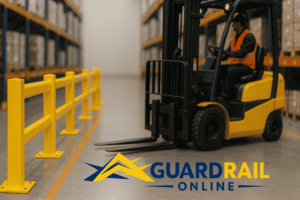
Match the barrier to the traffic it faces. Beside forklift lanes, use heavy-duty steel guardrail anchored to the concrete and compare impact ratings for the vehicles in your facility. Lighter barriers and fencing suit areas with foot traffic only.
How do I maintain warehouse pedestrian barriers?
Inspect barriers regularly for bent rails, damaged posts and loose anchors, especially after any impact. Replace damaged parts promptly, because a damaged barrier may not stop the next impact.
Conclusion
Safety improves when warehouse pedestrian barriers are selected based on how people and equipment actually move, not simply on strength or appearance. In fact, they are known to enhance protection without disrupting flow when chosen with intent. So, why choose random warehouse pedestrian barriers when you can find and install the right ones?
At Guardrail Online, we offer a wide range of pedestrian safety solutions designed for real warehouse conditions. Explore our collection of pedestrian aisle barriers and warehouse walk-way barriers today.
Written by the Guardrail Online team. Reviewed and updated in October 2026.