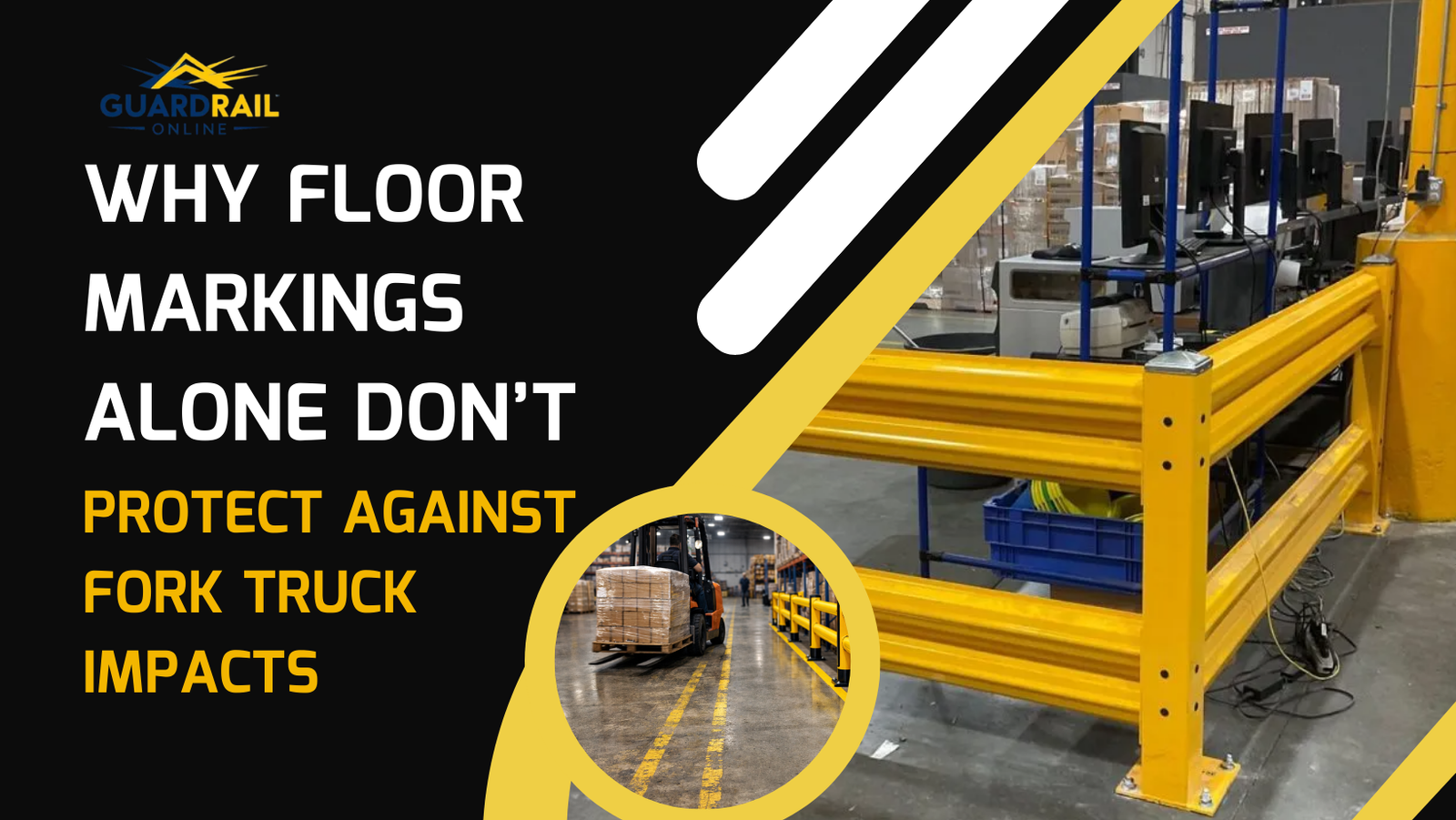
Floor markings are often the first safety measure introduced in a warehouse. They are fast to apply, easy to follow, and they make a facility look organized almost immediately. Lanes appear defined. Walkways feel clear. At a glance, the floor seems controlled.
But appearance is not protection. Floor markings rely entirely on attention, timing, and ideal behavior in environments where distraction, pressure, and movement are constant. When forklifts drift, loads overhang, or people hesitate at the wrong moment, paint offers no resistance.
This article explains why floor markings alone cannot prevent fork truck impacts, and how warehouse safety barriers fill the gap by introducing real control where visual guidance falls short.
Quick answer: Floor markings alone do not protect against fork truck impacts because they only guide behavior; they cannot stop a forklift. They fade, get covered and become part of the background in busy facilities. Keep markings to guide movement, and add physical barriers such as guardrail at walkways, crossings, doorways, blind corners and equipment where people and forklifts meet.
Table of Contents
ToggleKey takeaways
- Markings guide; barriers stop.
- Painted lines fade and get ignored in busy facilities.
- Use guardrail where a collision would put a person at risk.
- Keep floor markings alongside barriers rather than replacing them.
In this guide
- Here’s The Common Safety Misconception Around Floor Markings
- The Solution: Fork Truck Barriers That Actually Protect
- Remember to Place Fork Truck Barriers Based on Real Movement
- Where Floor Markings Still Help
- Frequently Asked Questions
- Conclusion
Here’s The Common Safety Misconception Around Floor Markings
Many warehouse managers rely heavily on painted aisles and crosswalks as a complete safety solution. The logic feels sound. Floor markings are affordable, visible, and quick to implement. Once applied, the layout appears organized and controlled. However, this confidence often rests on a misunderstanding of what paint can realistically do.
The misconception usually shows up in a few consistent assumptions:
- Paint enforces behavior: It does not. Painted lines only communicate intent. They cannot stop a forklift that drifts during a tight turn or slows late under load.
- Paint protects distracted pedestrians: It does not. A worker focused on a task can still step into traffic despite clear markings.
- Paint remains effective over time: In reality, paint fades under traffic, cleaning, and pallet abrasion. As visibility drops, compliance follows.
- Paint defines separation: It cannot change geometry. It does not prevent corner cutting, restrict swing paths, or create physical distance between people and equipment.
In short, paint guides movement. It does not control it. When a layout relies on markings alone, safety depends on perfect attention and ideal behavior. That is rarely sustainable in real warehouse operations.
The Solution: Fork Truck Barriers That Actually Protect
Warehouse safety barriers solve a problem that floor markings never can. They intervene when movement starts to drift, not after contact has already occurred. While paint depends on attention and compliance, a well-designed fork truck barrier introduces physical control into the layout itself.
Physical barriers do two things that paint cannot. They remove choice, and they stop motion. A properly designed fork truck barrier shapes behavior long before contact happens. These warehouse safety barriers define paths, limit drift, and protect assets by controlling how equipment moves through the space.
Here are key reasons fork truck barriers work:
- Non-negotiable separation. A steel rail forces equipment away from a protected zone. People cannot rely on judgment alone.
- Energy management. Heavy-duty posts and rails absorb and redirect force. They prevent impacts from transferring force into racks or walls.
- Predictable movement. Continuous fork truck barriers create a visual and physical line that operators respect. Turns become controlled. Corrections happen earlier.
- Durability. Forklift-rated warehouse safety barriers tolerate repeated low-speed contact. They do not deform and become hazards themselves.
Remember to Place Fork Truck Barriers Based on Real Movement
Simply installing fork truck barriers does not automatically make a warehouse safer. Many facilities invest in strong protection but still experience contact, near-misses, or repeated damage in the same locations. The reason is rarely the barrier itself. It is how and where that barrier is placed.
Safety improves only when barriers are positioned with real movement in mind, not ideal layouts or painted intentions. That requires stepping back and applying a few clear placement and design principles that align protection with how forklifts and people actually move. These include:
- Design for movement, not paint: Observe turning patterns. Place warehouse safety barriers where equipment actually travels, not where lines suggest it should.
- Offset from assets: Set fork truck barriers back from racking to accommodate the turning radius and load overhang.
- Create continuous separations: Avoid gaps that invite shortcutting. Use controlled crossings where interaction is necessary.
- Match barrier to floor: Check slab thickness, joints, and reinforcement. Use anchors rated for the expected impact energy.
- Plan for inspection: Regular QA prevents slow failures. Look for base plate rocking, elongated holes, and repeat dent patterns.
Where Floor Markings Still Help
Floor markings are still worth keeping. They work well for:
- Marking directions of travel and parking or staging spots.
- Showing where walkways and crossings are, so people know where the protected routes run.
- Low-traffic or storage-only zones where a collision would not put a person at risk.
Where people and forklifts share space, back them up with double height guardrail along walkways and pedestrian safety gates at crossings.
Frequently Asked Questions
Are floor markings enough to protect pedestrians from forklifts?
No. Floor markings show people and drivers where to go, but they cannot stop a forklift that misjudges a turn, reverses unexpectedly or carries a load that blocks the driver's view.
Should I remove floor markings once barriers are installed?
No. Keep them. Markings and barriers work together: markings guide movement and mark crossings, while barriers physically stop vehicles at the highest-risk points.
Where do floor markings work well on their own?
In low-traffic areas, storage zones with no foot traffic, and for marking parking spots, staging areas and directions of travel where a collision would not put a person at risk.
Where are physical barriers needed instead?
Along walkways beside forklift aisles, at doorways that open into travel lanes, at blind corners and around equipment, offices and rack ends.
Why do people ignore floor markings over time?
Painted lines fade, get covered by pallets and become part of the background. In busy facilities, people and drivers stop noticing them, which is why barriers are needed where the risk is highest.
Conclusion
Floor markings help communicate intent, but they cannot control movement or absorb impact. In active warehouse environments, relying on paint alone leaves safety dependent on perfect attention and ideal behavior.
Real protection begins when layouts introduce physical limits that guide equipment, protect people, and manage energy before contact occurs. That is why well-designed warehouse safety barriers and properly placed fork truck barriers are essential for long-term risk reduction.
So, are you looking to move beyond visual guidance and install protection that performs under real conditions? Guardrail Online offers forklift-rated safety barriers engineered to deliver consistent, reliable protection where it matters most.
Written by the Guardrail Online team. Reviewed and updated in October 2026.