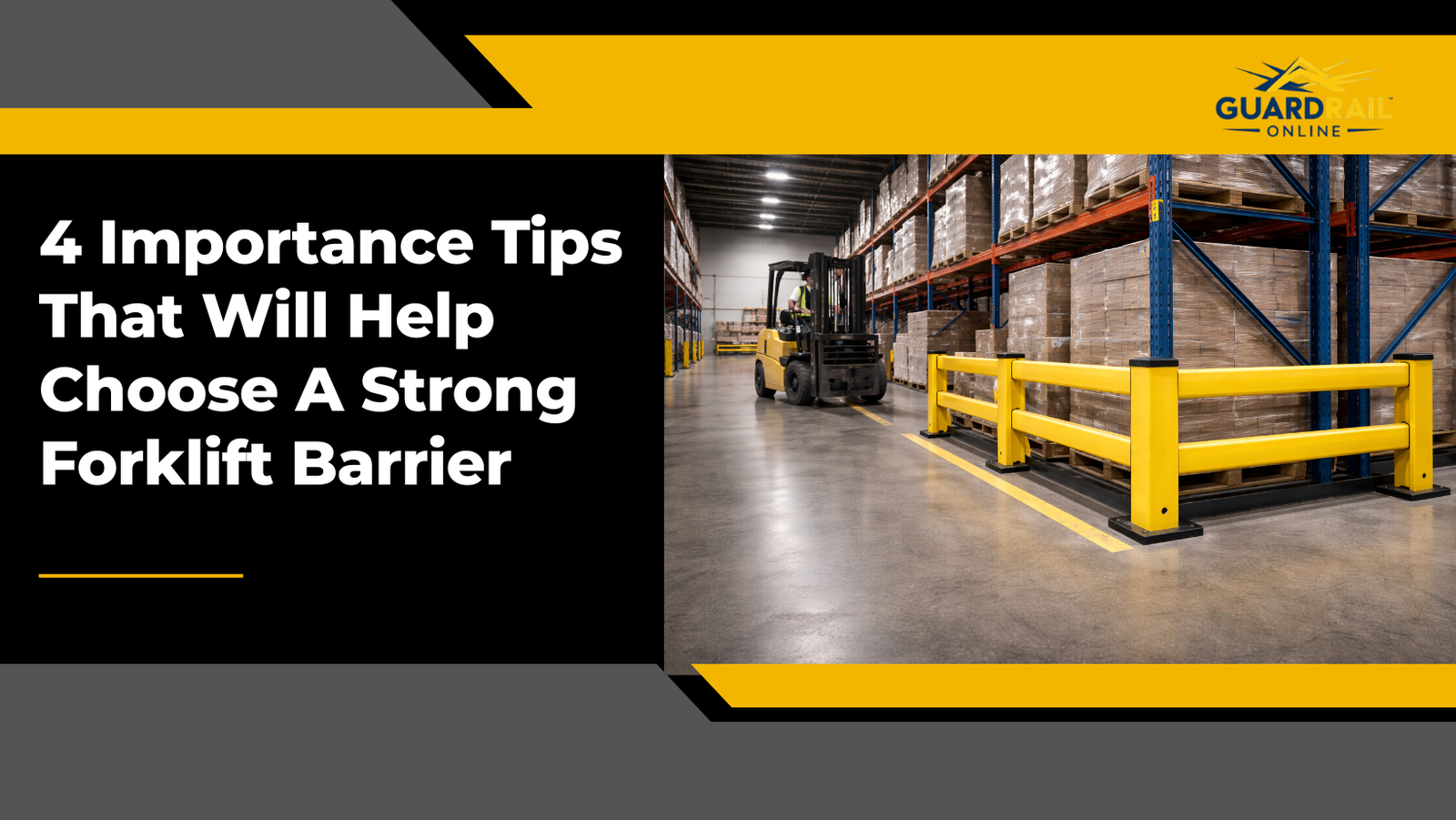
Choosing a forklift barrier is often treated as a checkbox decision. Something strong. Something visible. Something that “should work.” But in real warehouses, that assumption is where problems begin.
Forklifts do not behave predictably. Impacts are rarely dramatic. Damage builds slowly through repetition, drift, and correction under pressure. That is why selecting the right forklift safety barriers requires more than visual inspection or impact claims. It requires understanding how forklifts actually move, hit, and stress protection systems.
This guide breaks down the most important factors that truly matter when choosing a forklift barrier that lasts.
Table of Contents
ToggleTip 1: Choose Forklift Barriers Built for Repeated Impact, Not One-Time Contact
Most people assume forklift damage happens because of one big mistake. A crash. A major hit. A dramatic incident. But in real warehouses, that is rarely how damage actually begins.
In most facilities, serious damage builds quietly. A turn taken slightly wider than planned. A pallet that drifted just a few inches during staging. A correction made a second too late in a tight aisle. None of these moments feel serious on their own. But they repeat. Day after day. Shift after shift.
This is exactly why forklift barriers must be designed for repeated, low-speed contact, not just a single high-impact event.
A strong forklift barrier is not meant to “take a hit and look fine.” It is meant to:
- Absorb contact
- Redirect force
- Stay aligned over time
That means the rails should flex in a controlled way. Posts should remain upright. Energy should move through the system instead of into the floor or surrounding structure. Many guardrails can stop one impact. However, a very few can handle ongoing contact without bending, loosening, or transferring damage elsewhere. That difference is what separates a visual divider from a true forklift safety barrier.
When evaluating a forklift barrier, ask:
- How it performs after repeated contact.
- Does it maintain alignment?
- Does it continue guiding movement?
- Does it prevent damage without becoming the damage point itself?
Barriers designed for forklifts are tested, engineered, and built with repetition in mind, because repetition is where real risk lives.
Tip 2: Match Barrier Height and Coverage to Forklift Behavior, Not Just Aisle Width
One of the most common mistakes facilities make is assuming forklift impact happens at a single, predictable height. It does not. Forks travel low, but loads extend forward. Counterweights often swing outward during turns. Masts are bound to shift as forklifts accelerate, brake, or adjust load position. Each of these movements changes where contact is most likely to occur.
This is why selecting a forklift barrier based only on aisle width is rarely enough. In many warehouses, a single-height guardrail looks adequate during a walkthrough. In real operations, however, that same height often leaves upper rack beams, wall panels, and equipment housings exposed to repeated contact.
Barrier height should be selected based on how forklifts behave in that zone:
- Single-height barriers (typically 18–24 inches): Suitable for pedestrian separation and low-load areas where contact risk stays near fork level.
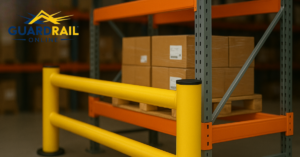
- Double-height barriers (typically 36–42 inches): Necessary where loads extend forward, pallets stack higher, or forklifts turn tightly near assets. These intercept drift before it reaches racking or equipment.
Remember, the most effective forklift safety barriers use height intentionally. They intercept contact across the full movement envelope, not just at floor level.
.
Tip 3: Verify Anchoring and Floor Compatibility Before Selecting the Barrier
A forklift barrier does not perform in isolation. It relies entirely on how well it is anchored and how capable the floor is of supporting repeated impact. When those two elements are overlooked, even the strongest barrier will begin to fail quietly.
Before selecting a forklift barrier, you should evaluate the following:
- Concrete thickness and condition: Thin slabs, surface cracking, or worn concrete reduce the floor’s ability to absorb impact energy. Barriers anchored into such compromised concrete will loosen over time, regardless of rail strength.
- Presence of expansion joints or slab edges: Base plates installed too close to joints or edges cannot distribute load evenly. This often leads to anchor pull-out, plate distortion, or localized concrete failure.
- Anchor type and embedment depth: Post-installed anchors have specific requirements for embedment depth, spacing, and edge distance. If these limits are not met, impact forces concentrate at the anchor instead of flowing through the system.
- Compatibility between barrier design and slab capacity: Forklift safety barriers are tested under controlled conditions. If your slab cannot support the intended load transfer, performance drops long before visible damage appears.
So, before choosing a forklift barrier, confirm that it is engineered not just for impact ratings, but for your actual floor conditions. Barriers stay aligned, energy transfers correctly, and protection lasts longer when anchoring and slab compatibility are treated as part of the system.
Tip 4: Choose Systems Engineered for Forklift Traffic, Not General Safety Use
Not every barrier on a warehouse floor is meant to interact with forklifts. Some are designed only to guide pedestrians. Others exist to define space visually. Using these systems in forklift zones is one of the most expensive mistakes facilities make.
Forklifts bring mass, momentum, and repetition. A barrier that looks solid may still be engineered only for light contact or visual separation. These systems deform quickly when exposed to forklift traffic. The barrier may remain standing, but protection is already compromised.
This is exactly why forklift barriers must be evaluated by specification, not appearance.
- Base plates should be sized to spread impact load into the slab, not concentrate it. In forklift zones, plates should be typically 10–12 inches wide and at least ¾-inch thick, with multiple anchor points.
- Posts must resist bending after repeated low-speed impacts. That usually means you need heavy-wall steel posts that are 4–6 inches in diameter or equivalent box section. They should be designed to tolerate 5,000–10,000+ lbs of force without permanent deformation.
- Rails should be thick enough to flex and recover, not fold. Hence, go for forklift-rated rails made of 3–5 mm steel. These are shaped to absorb energy and redirect it along the system instead of transferring it into racks, walls, or floors.
Remember, if a barrier system cannot clearly state:
- impact force rating,
- post section size,
- base plate dimensions, and
- anchor requirements,
then it is not built for forklift traffic. Instead, it is a general safety barrier being pushed beyond its design limits.
Conclusion
So, are you looking for forklift barriers that actually meet the demands of real forklift traffic, not just basic safety expectations?
At Guardrail Online, we supply forklift safety barriers engineered to meet and exceed forklift-specific requirements. Our systems are built with forklift-rated rails, heavy-duty posts, properly sized base plates, and anchoring designed for real warehouse floors. Explore our range of barriers online now.