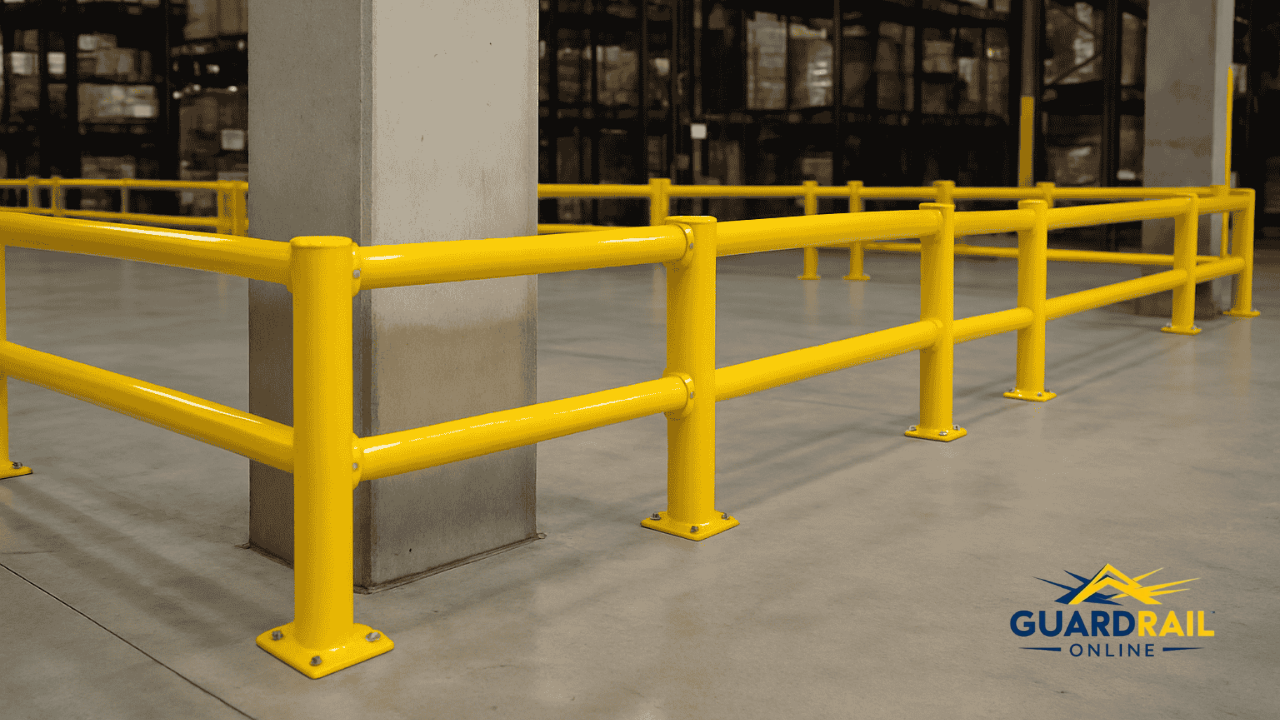
Warehouses, distribution centers, and manufacturing facilities operate around constant movement. Forklifts travel through aisles, pallet jacks move inventory, employees work around equipment, and loading areas remain active throughout the day.
With so much activity happening at the same time, accidental contact with racking, machinery, walls, conveyors, and other infrastructure can happen quickly.
Industrial safety guardrails provide a physical barrier between moving equipment and the areas that need protection. But not every guardrail system is designed the same way. Material, construction, impact resistance, anchoring, visibility, and configuration all affect how well a system performs in a busy industrial environment.
If you’re comparing warehouse guardrails for your facility, here are seven important features to consider before making a purchase.
Table of Contents
Toggle1. Heavy-Duty Steel Construction
The material used to manufacture a guardrail has a direct effect on its strength and durability.
Warehouse environments can expose guardrails to repeated contact from forklifts, pallet jacks, carts, and other material-handling equipment. A lightweight barrier may not provide the level of protection required for areas with frequent vehicle traffic.
GuardRail Online uses ASTM A1011 corrugated steel for its guardrail beams. The corrugated design adds rigidity to the rail while providing a durable structure for industrial applications.
Corrugated steel also helps the beam maintain its structural shape when exposed to impact forces.
When evaluating industrial guardrails, look beyond appearance and consider:
- Steel grade and material specification
- Steel thickness
- Beam construction
- Post construction
- Weld quality
- Overall system design
A guardrail should be selected based on the actual conditions in your facility rather than simply choosing the lowest-cost option.
2. High-Visibility Safety Yellow Finish
A guardrail can only provide visual guidance if employees and equipment operators can easily see it.
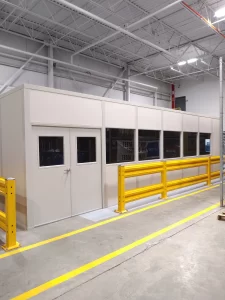
Warehouse floors can contain racks, machinery, pallets, columns, equipment, and other visual distractions. A high-visibility guardrail helps create a clear boundary around areas that require protection.
GuardRail Online guardrails feature a safety yellow powder-coated finish, making the barriers easy to identify across warehouse floors and industrial work areas.
The powder-coated finish also provides a protective surface that helps the steel resist normal wear, scratches, and environmental exposure.
Why visibility matters
A clearly visible guardrail can help operators recognize:
- Pedestrian boundaries
- Forklift travel areas
- Protected equipment
- Rack ends
- Building structures
- Restricted or protected zones
For busy warehouses, combining physical protection with strong visual identification can help create a more organized safety environment.
3. Proven Impact Resistance
One of the most important factors when selecting heavy-duty warehouse guardrails is impact resistance.
Forklifts and other material-handling equipment are capable of generating significant impact forces, particularly when carrying heavy loads or operating in confined areas.
GuardRail Online systems are rated to withstand 10,000 lbs of impact at 4 mph when properly installed.
This rating provides an important reference when evaluating the level of protection required for a facility.
However, impact performance depends on the complete installation, including the guardrail beam, posts, base plates, anchors, concrete substrate, layout, and installation method.
That’s why it’s important to evaluate the entire guardrail system rather than looking at the beam alone.
Areas where impact protection can be particularly important include:
- Forklift aisles
- Rack ends
- Loading areas
- Machinery perimeters
- Pedestrian walkways
- Conveyor areas
- Building columns
- High-traffic warehouse zones
4. Strong Posts, Base Plates, and Floor Anchoring
A guardrail system is only as reliable as its connection to the floor.
Even a strong beam may not provide effective protection if the posts, base plates, or anchors are not properly designed and installed.
GuardRail Online’s guardrail posts are manufactured from heavy-duty steel and use reinforced base plates for floor mounting. The current system specifications include 4.75-inch × 4.75-inch posts welded to 10-inch × 10-inch steel base plates.
These components work together to transfer impact forces through the guardrail structure and into the concrete floor.
Important components include:
Heavy-duty posts
Support the guardrail beam and provide the vertical structure of the system.
Reinforced base plates
Provide a larger mounting surface and help distribute forces at the floor connection.
Concrete anchors
Secure the posts to the floor and help keep the system in position.
Compatible mounting hardware
Ensures the components can be assembled and installed as intended.
When comparing industrial safety barriers, don’t focus only on the visible beam. Ask how the complete system is constructed and anchored.
5. Modular Configuration Options
Every warehouse has a different layout.
Columns, walls, loading docks, rack aisles, machinery, doors, and pedestrian routes can make it difficult to install a rigid barrier system.
That’s where modular guardrail systems can provide an advantage.
GuardRail Online offers configurations that allow guardrails to be installed in straight, offset, and corner applications, helping the system adapt to different warehouse layouts. Multiple rail lengths can also be used to create protection across different spans.
Modular systems can be useful when you need to:
- Protect a straight rack aisle
- Create a corner around machinery
- Work around columns or walls
- Separate pedestrian walkways
- Protect equipment with limited clearance
- Extend an existing guardrail run
- Modify protection as warehouse layouts change
A modular system can also make future expansion easier because additional compatible components can be added when protection requirements increase.
6. Heavy-Duty Hardware and Anchors
The connections between guardrail components are just as important as the components themselves.
A properly designed guardrail system needs hardware that can maintain secure connections during normal operation and impact events.
GuardRail Online’s kits include heavy-duty mounting hardware, including 3/4-inch × 4-1/2-inch wedge anchors and Grade 8.8 bolts, along with matching washers and locking hardware.
Including compatible hardware as part of the system can also simplify installation and reduce the need for installers to source individual components separately.
Before purchasing a warehouse guardrail system, consider whether the required hardware is included and whether it is compatible with the posts, beams, base plates, and installation surface.
7. Proper Dimensions and Steel Thickness
Dimensions matter when selecting an industrial guardrail.
A barrier needs to provide adequate physical protection without unnecessarily interfering with visibility, access, or normal warehouse operations.
GuardRail Online’s guardrail beams are designed with a 12-inch height and 13-gauge steel construction.
These dimensions form part of the overall system design and work together with the posts, base plates, and anchors.
When comparing guardrails, consider:
- Beam height
- Steel gauge or thickness
- Post dimensions
- Base plate size
- Beam length
- Clearance from protected assets
- Available floor space
The correct dimensions depend on the specific application, traffic patterns, and area being protected.
What Should You Protect With Industrial Guardrails?
Industrial guardrails can be used in many areas of a warehouse or manufacturing facility.
Warehouse Racking
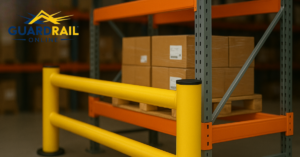
Rack ends are frequently exposed to forklift traffic, particularly when operators turn into or out of aisles.
Guardrails can create a physical buffer between forklifts and rack structures.
Pedestrian Walkways
Guardrails can help establish a physical boundary between pedestrians and material-handling equipment.
They can be positioned alongside designated walkways, work areas, and other locations where employees operate near vehicle traffic.
Machinery and Equipment
Expensive machinery can be vulnerable to accidental forklift or pallet-jack contact.
A properly positioned barrier can help protect equipment from direct impact.
Conveyors and Production Areas
Guardrails can help separate moving equipment from conveyor systems and other production infrastructure.
Building Columns and Walls
Structural columns, walls, doors, and other building elements can also be vulnerable to repeated vehicle contact.
Installing physical protection around these areas can help reduce the risk of impact damage.
Loading and Receiving Areas
Loading docks and receiving zones often experience heavy forklift activity, making them important areas to evaluate for physical protection.
How to Choose the Right Industrial Safety Guardrail
Before purchasing guardrails, start by evaluating how your facility operates.
Consider Your Forklift Traffic
Identify:
- Main forklift routes
- Turning areas
- Intersections
- Loading zones
- High-traffic aisles
- Areas with previous impact damage
Identify Vulnerable Assets
Determine which assets would be most costly or disruptive to repair.
These may include:
- Warehouse racking
- Machinery
- Conveyors
- Electrical equipment
- Building structures
- Inventory
- Pedestrian areas
Evaluate Available Space
Make sure guardrails can be installed without creating unnecessary obstructions or interfering with normal material movement.
Plan for Expansion
If your facility is growing, consider a modular system that can be expanded as new racks, equipment, or operational areas are added.
Verify Installation Requirements
Proper installation is critical to guardrail performance. The concrete substrate, anchor type, spacing, and installation method should all be appropriate for the specific application.
Why Choose GuardRail Online?
Choosing industrial safety guardrails is about more than purchasing a steel barrier.
You need a system that combines durable materials, structural strength, visibility, secure anchoring, and flexible configuration options.
GuardRail Online focuses on warehouse guardrails and industrial impact-protection solutions, offering products designed for warehouses, distribution centers, manufacturing facilities, and other high-traffic environments.
Our product range includes:
- Single-height guardrails
- Double-height guardrails
- Heavy-duty guardrail beams
- Single-height post kits
- Double-height post kits
- Starter kits
- Add-on kits
- Rack protection solutions
- Guardrail accessories
The modular product range allows facilities to build new protection systems or expand existing installations as their requirements change.
GuardRail Online also supports installers, contractors, resellers, and other industrial partners with product information and technical resources.
Build a Guardrail System Around Your Facility
There is no single guardrail configuration that works for every warehouse.
The right system depends on your facility’s traffic patterns, equipment, floor layout, protected assets, and future requirements.
Start by identifying the areas with the highest impact risk.
Then determine:
- What needs protection?
- Where does forklift traffic occur?
- Where do pedestrians and vehicles operate near each other?
- What guardrail height and configuration are appropriate?
- How will the system be anchored?
- Can the system be expanded later?
Taking this approach helps you build protection around the actual needs of your facility rather than installing barriers without a clear purpose.
Final Thoughts
Industrial safety guardrails are an important physical protection measure for warehouses and other high-traffic facilities.
When choosing a system, don’t evaluate the product based on appearance or price alone.
Look at the features that determine long-term performance:
- Heavy-duty steel construction
- High-visibility safety yellow finish
- Impact resistance
- Strong posts and base plates
- Secure floor anchoring
- Modular configuration
- Appropriate dimensions and steel thickness
A well-designed guardrail system can help protect people, equipment, racking, inventory, and facility infrastructure from accidental vehicle contact.
For facilities planning a new installation or upgrading an existing safety system, choosing the right guardrail configuration is an investment in both physical protection and operational continuity.
Frequently Asked Questions
What are industrial safety guardrails used for?
Industrial safety guardrails are physical barriers used to help protect people, equipment, racking, machinery, building structures, and other vulnerable areas from accidental contact with forklifts and other material-handling equipment.
What should I look for when buying industrial guardrails?
Important factors include steel construction, impact rating, post and base plate design, floor anchoring, visibility, dimensions, configuration options, and whether the system can be expanded in the future.
Are GuardRail Online guardrails rated for forklift impact?
GuardRail Online states that its guardrail systems are rated to withstand 10,000 lbs of impact at 4 mph when properly installed. Actual performance depends on the complete installation and site conditions.
What type of steel is used in GuardRail Online guardrails?
GuardRail Online’s guardrail beams are manufactured using ASTM A1011 corrugated steel.
What color are warehouse guardrails?
GuardRail Online guardrails feature a safety yellow powder-coated finish designed to provide high visibility in warehouse and industrial environments.
Can industrial guardrails be customized for different warehouse layouts?
Modular guardrail systems can accommodate different layouts through configurations such as straight runs, offset posts, and corners. This allows protection to follow warehouse conditions around equipment, walls, aisles, and other obstacles.
Are industrial safety guardrails required by OSHA?
OSHA requirements depend on the specific workplace hazard and application. OSHA does not establish one universal industrial forklift guardrail product that every warehouse must use. Employers are responsible for addressing recognized workplace hazards and following applicable OSHA standards. For a specific installation, the applicable OSHA requirements should be reviewed based on the hazard and use case.
How do I determine where to install warehouse guardrails?
Start by identifying areas where forklifts or other moving equipment operate close to pedestrians, racking, machinery, building structures, conveyors, or other valuable assets. Prioritize locations with frequent traffic, limited clearance, or a history of impacts.
Protect Your Warehouse With the Right Guardrail System
Ready to improve physical protection in your warehouse?
Explore GuardRail Online’s range of heavy-duty warehouse guardrails, starter kits, add-on kits, posts, beams, and rack protection solutions to build a system around your facility’s specific requirements.
Choose the right protection. Build for your facility. Plan for the future.